

What Is Coffee Extraction and How It Shapes Flavor
Most home brewers follow a recipe and wonder why the cup still tastes off. The problem usually isn’t the recipe. It’s a misunderstanding of what is coffee extraction and how it actually works. Coffee extraction is the process where hot water dissolves soluble flavor compounds from your coffee grounds, pulling acids, sugars, and bitter compounds into your cup in a specific sequence. Get the timing and variables right, and you land in a sweet spot that tastes balanced and complex. Get them wrong, and you end up with something sour, flat, or harsh. This guide covers the science, the variables, the methods, and the fixes.
Table of Contents
- Key Takeaways
- What is coffee extraction, exactly
- The four variables that control extraction
- Brewing methods and their extraction profiles
- Diagnosing problems and fixing your brew
- My take on learning extraction the right way
- Put your extraction knowledge to work with Font-mag
- FAQ
Key Takeaways
| Point | Details |
|---|---|
| Extraction is sequential | Acids extract first, then sugars, then bitters. Stopping at the right moment defines your cup’s flavor. |
| Four variables control extraction | Grind size, water temperature, brew time, and coffee-to-water ratio all interact and must be adjusted together. |
| Method changes the rules | Pour-over, French press, and cold brew each have different extraction benchmarks that require method-specific adjustments. |
| Grind consistency matters most | Uneven grind particles cause simultaneous over- and under-extraction in the same brew. |
| Taste is your best diagnostic tool | Sourness signals under-extraction; bitterness signals over-extraction. Adjust one variable at a time. |
What is coffee extraction, exactly
Coffee extraction is chemistry in a cup. When water contacts ground coffee, it begins dissolving hundreds of soluble compounds locked inside the cell structure of the beans. These compounds don’t all dissolve at the same rate or at the same moment. That’s the part most home brewers don’t fully appreciate.
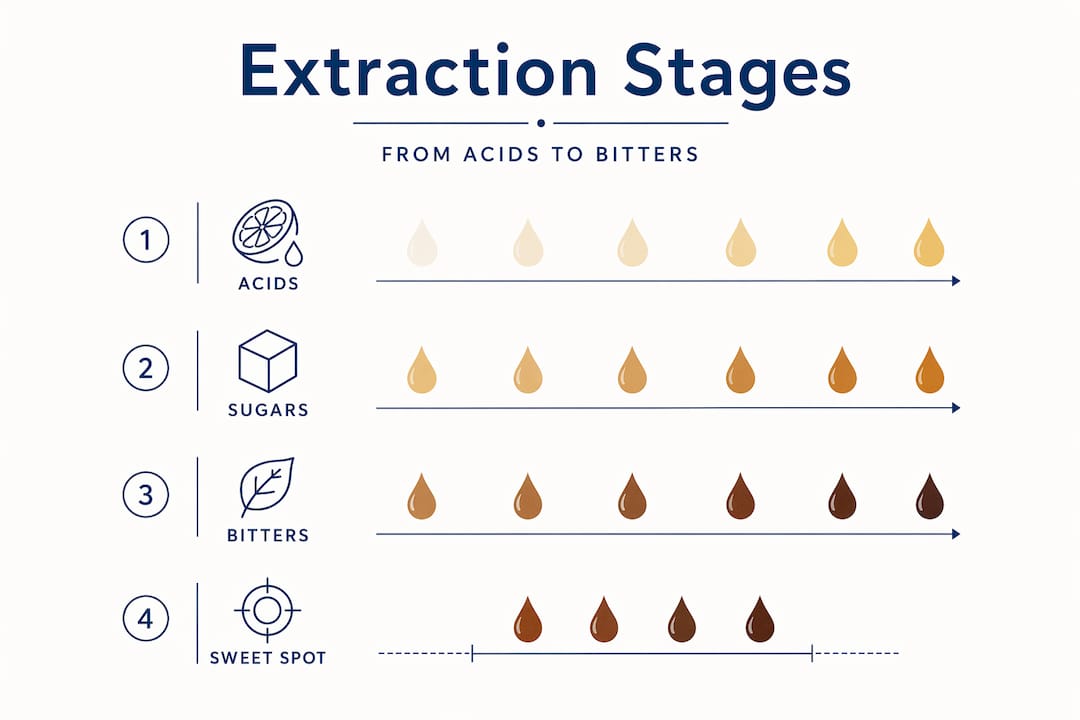
Extraction follows a timeline: acids extract first, then sugars, then bitter compounds. Think of it like peeling layers off a flavor onion. Stop too early, and you get a sour, sharp, underdeveloped cup because you’ve pulled mostly acids without enough sweetness to balance them. Push too far, and the bitter compounds dominate, drowning out everything pleasant.
The roast level of your beans plays a significant role here too. Darker roasts are more porous and soluble, meaning compounds dissolve faster. Lighter roasts are denser and require more time or finer grinding to reach the same extraction level. This is why a recipe that works perfectly for a medium roast can produce a sour, weak cup when applied to a light roast without adjustment.
“Extraction is not a fixed formula. It’s a dynamic process where timing, temperature, and contact time interact to shape every sip.”
The goal is what coffee professionals call the “sweet spot,” the extraction range where acids, sugars, and a controlled amount of bitterness coexist in balance. That range is narrower than most people expect, which is exactly why understanding the underlying science gives you so much more control than blindly following a recipe.
Pro Tip: If your cup tastes sour and thin, you haven’t extracted enough. If it tastes harsh and dry, you’ve gone too far. Use these as your compass, not the clock.
The four variables that control extraction
Understanding how coffee extraction works means understanding the four levers you can pull. Each one affects how fast and how completely flavor compounds dissolve from your grounds.
-
Grind size. This is your most powerful tool. Finer grinding increases the surface area exposed to water, which accelerates extraction. Coarser grinding slows it down. In pour-over brewing, draw-down time under 2:30 suggests your grind is too coarse. Over 3:45 means it’s too fine. These benchmarks give you a physical, observable way to diagnose your grind without relying purely on taste.
-
Water temperature. Hotter water increases the solubility of coffee compounds, pulling them out faster. The standard range for most brewing methods sits between 195°F and 205°F. Below that, you risk under-extraction even with a fine grind and long brew time. Above it, you accelerate bitter compound extraction more aggressively than you want.
-
Brew time. Contact time between water and coffee directly controls how much of each compound gets extracted. Longer contact means more extraction. Shorter contact means less. This is why French press, which steeps coffee in water, requires a coarser grind than pour-over, which moves water through grounds continuously.
-
Coffee-to-water ratio. This variable controls both extraction yield and perceived strength. A higher ratio of coffee to water produces a more concentrated brew. A lower ratio produces something thinner. These aren’t the same thing, though. A weak cup can still be over-extracted. A strong cup can still be under-extracted. Ratio and extraction are related but separate dimensions.
The critical insight here is that these four variables are interdependent. Changing one affects the others. If you grind finer to increase extraction, you may need to shorten brew time to avoid over-extraction. If you lower your water temperature, you might need a longer steep or a finer grind to compensate. Adjusting one variable at a time and tasting between changes is the only reliable way to dial in your brew.
Pro Tip: When troubleshooting, change only one variable per brew session. Changing grind size and temperature at the same time makes it impossible to know which adjustment actually fixed the problem.
Brewing methods and their extraction profiles
Different coffee extraction methods create fundamentally different extraction environments. Knowing what each method does helps you set realistic expectations and make smarter adjustments.
Percolation vs. immersion
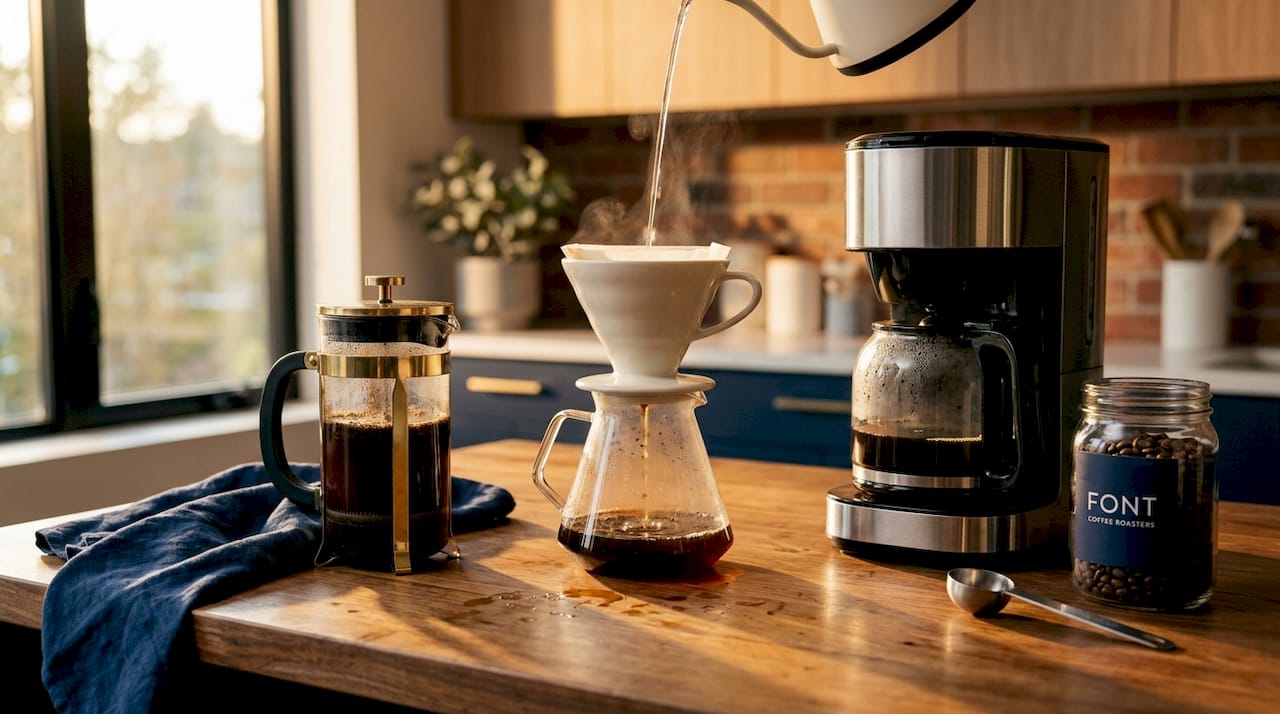
Pour-over and drip coffee are percolation methods. Water passes through the grounds continuously, extracting as it moves. This makes them sensitive to grind particle size distribution. Inconsistent grind particles cause simultaneous over-extraction in fine particles and under-extraction in coarse chunks, all in the same brew. A quality burr grinder isn’t optional for pour-over. It’s the foundation.
French press is an immersion method. Grounds sit in water for the entire brew time, which creates a more even extraction environment but also allows oils and fine particles into the cup. Paper filters in pour-over remove diterpenes that pass freely through metal filters and French press mesh, which changes both the taste profile and the chemical composition of the final cup.
Cold brew sits in its own category entirely. Without heat or pressure, extraction is dramatically slower. Cold brew compensates by steeping coffee for 12 to 24 hours. The result is a cup that’s naturally lower in perceived acidity, not because the acids aren’t there, but because the extraction environment favors a different balance of compounds.
| Method | Ratio | Brew time | Grind size | Key characteristic |
|---|---|---|---|---|
| Pour-over | 1:16 | 2:30 to 3:30 min | Medium-fine | Percolation; sensitive to grind consistency |
| French press | 1:15 | 4 min | Coarse | Immersion; oils remain in cup |
| Cold brew | 1:8 | 12 to 24 hours | Coarse | No heat; low acidity, long steep |
| Drip machine | 1:16 | 5 to 6 min | Medium | Automated percolation; variable consistency |
- Pour-over targets a 1:16 ratio with a draw-down time between 2:30 and 3:30 minutes for a balanced extraction.
- Cold brew’s long steep time is the mechanism that compensates for the absence of heat and pressure.
- French press produces a heavier, more textured cup because of the oils and fine particles that remain in suspension.
- Drip machines vary widely in quality, and water temperature inconsistency is the most common reason home drip coffee underperforms.
Diagnosing problems and fixing your brew
Once you understand what affects coffee extraction, troubleshooting becomes straightforward. You’re not guessing anymore. You’re reading the cup.
Sour or sharp taste means under-extraction. You stopped the process before enough sugars and body compounds dissolved. The fixes are: grind finer, increase water temperature, extend brew time, or use a combination of all three.
Bitter or harsh, dry finish means over-extraction. You pulled too many bitter compounds into the cup. The fixes are: grind coarser, lower water temperature, shorten brew time, or reduce the amount of coffee relative to water.
Flat or hollow taste with no brightness often signals a stale grind or beans that have lost their volatile aromatics. Fresh beans ground immediately before brewing make a bigger difference than most equipment upgrades.
Beyond the basics, a few specific techniques make a real difference in extraction consistency:
- Bloom your coffee. Before a full pour, add twice the weight of your coffee in water and wait 30 to 45 seconds. This releases trapped CO2 from fresh beans, which would otherwise create uneven extraction by repelling water from the grounds.
- Pour evenly and slowly. Channeling, where water finds a path of least resistance through the grounds, causes uneven extraction. Slow, circular pours keep the bed saturated evenly.
- Use filtered water. Mineral content in water affects extraction. Very soft water under-extracts. Very hard water can cause off flavors. Water with moderate mineral content, around 150 ppm total dissolved solids, tends to produce the most balanced results.
- Try the Ross droplet technique. Adding a small drop of water to your beans before grinding reduces static electricity that causes clumping and uneven distribution. This improves dose consistency and extraction evenness, and it’s been validated scientifically.
Pro Tip: If your pour-over draw-down finishes in under two minutes, your grind is too coarse regardless of what the taste tells you. Fix the grind first, then adjust for taste.
My take on learning extraction the right way
I’ve watched a lot of home brewers get stuck in the same loop. They buy a better grinder, then a better kettle, then a better scale, and the cup still doesn’t taste the way they want. What I’ve found is that equipment matters far less than understanding what you’re actually trying to do with it.
The biggest shift in my own brewing came when I stopped treating recipes as instructions and started treating them as starting points. A recipe tells you where to begin. Your palate and your understanding of extraction tell you where to go next. When I started making one small, intentional adjustment per session and tasting the result, I learned more in two weeks than I had in two years of following guides.
What I wish someone had told me earlier is that the bloom phase is not optional for fresh beans. Skipping it is like trying to paint over a wet surface. The CO2 escaping from recently roasted beans creates uneven water contact, and no amount of technique downstream fixes that.
I’m also genuinely excited about where extraction science is heading. Electrochemical measurement methods are showing real promise for assessing extraction quality beyond what a refractometer can tell you. That kind of precision, eventually accessible to home brewers, could make dialing in a brew as reliable as following a cooking temperature chart. We’re not there yet, but the direction is clear.
Treat brewing as a craft that rewards attention. The science gives you the framework. Your senses give you the feedback. Together, they’re more powerful than any single piece of gear.
— Rosario
Put your extraction knowledge to work with Font-mag
Understanding extraction is only half the equation. The other half is having coffee worth extracting well.
At Font-mag, every bag comes from four generations of small-batch Texas roasting, which means the flavor compounds you’re learning to extract are actually there to be found. If you want to practice extraction across roast levels, the Marécage Decaf dark roast from Brazil is a great way to study how darker roasts behave differently under the same variables. For brewers who want to experiment at volume without burning through expensive single-origin beans, the wholesale 5lb blend gives you consistent, quality coffee to dial in your technique over dozens of sessions. Free shipping on orders over $35 makes stocking up easy.
FAQ
What is coffee extraction in simple terms?
Coffee extraction is the process where water dissolves flavor compounds from coffee grounds. Acids extract first, then sugars, then bitter compounds, and the balance between them determines how your cup tastes.
What causes a bitter cup of coffee?
Bitterness is a sign of over-extraction. Water has dissolved too many bitter compounds, usually because the grind is too fine, the brew time is too long, or the water temperature is too high.
How does grind size affect extraction?
Finer grinds increase surface area and speed up extraction. Coarser grinds slow it down. In pour-over brewing, draw-down time outside the 2:30 to 3:30 minute window is a direct signal that your grind size needs adjustment.
Why does cold brew taste less acidic than hot coffee?
Cold brew steeps for 12 to 24 hours without heat or pressure, which changes the extraction environment and favors a different balance of compounds. The result is a naturally smoother, less sharp flavor profile.
What is the best coffee-to-water ratio for pour-over?
The standard pour-over ratio is 1:16, meaning 20 grams of coffee to 320 grams of water. This ratio provides a balanced extraction at medium-fine grind with a target brew time between 2:30 and 3:30 minutes.