

Why Coffee Goes Stale and How to Stop It
Your morning coffee doesn’t lose flavor because it “goes bad” the way milk does. Understanding why coffee goes stale comes down to chemistry, and the process starts the moment your beans leave the roaster. Most people blame old packaging or cheap beans, but the real culprits are oxygen, heat, moisture, and time working together against the complex compounds that make coffee taste remarkable. Once you understand what’s actually happening inside your bag of beans, the fixes become obvious and surprisingly simple.
Table of Contents
- Key takeaways
- Why coffee goes stale: the chemistry behind it
- Environmental factors that speed up staling
- Whole beans vs. ground coffee: a freshness comparison
- The best coffee storage methods for maximum freshness
- Signs of stale coffee you shouldn’t ignore
- My honest take on how most people store coffee wrong
- Taste what fresh roasting actually means
- FAQ
Key takeaways
| Point | Details |
|---|---|
| Oxidation is the main villain | Oxygen breaks down aromatic compounds in coffee, stripping flavor within days of roasting or grinding. |
| Ground coffee stales much faster | Grinding expands surface area dramatically, speeding up flavor loss roughly 500 times compared to whole beans. |
| Heat, light, and moisture accelerate staleness | Storing coffee near a stove or in sunlight degrades quality faster than most people realize. |
| Freezing can work, but only correctly | Portioned, airtight, freezer-stable packaging prevents moisture damage when freezing for long-term storage. |
| Fresh grinding is your best defense | Grinding right before brewing preserves more flavor than any storage method applied after pre-grinding. |
Why coffee goes stale: the chemistry behind it
Coffee is one of the most chemically complex foods on earth. Roasting transforms raw green beans into something with over 1,000 volatile aromatic compounds, and those compounds are responsible for every note you taste, from fruit and chocolate to nuts and smoke. The problem is that those compounds are unstable. They want to escape, react, and break down. And they do, fast.
Oxidation is the primary driver of what causes coffee to stale. When aromatic molecules in roasted coffee contact oxygen, they undergo chemical reactions that permanently alter their structure. The fruity, floral, and nutty notes you associate with a great cup get replaced by flat, cardboard-like compounds. Lipid oxidation produces off-flavors like hexanal and nonanal, both of which signal the kind of dull, greasy staleness that makes old coffee taste like wet paper.
There’s also CO2 involved. Freshly roasted coffee releases carbon dioxide gas through a process called degassing. That CO2 actually forms a protective layer that slows oxidation in the short term. Once it’s gone, usually within one to two weeks for whole beans, oxygen has direct access to all those volatile compounds and the degradation accelerates noticeably.
Grinding makes things dramatically worse. When you grind coffee, you shatter beans into thousands of tiny particles, each with exposed surface area. Volatile evaporation is the most immediate staling pathway once coffee is ground, because now the aromatic compounds are no longer trapped inside a compact bean structure. They evaporate directly into the air around them. That rich, almost intoxicating smell right after grinding? That’s your flavor leaving the coffee in real time.
The moment you grind coffee, the clock accelerates. What took days to happen in whole bean form now happens in hours.
One more reaction worth knowing: thiol-melanoidin conjugation. Compounds called thiols, which contribute bright, roasty top notes, chemically bond with melanoidins (the dark polymers created during roasting) and become locked away inside the coffee’s structure. Sealed containers slow staling by limiting oxygen, but these internal chemical changes continue regardless. You can’t stop them entirely. You can only slow them down.
Environmental factors that speed up staling
Knowing the chemistry is one thing. Understanding which everyday conditions accelerate it is where most coffee lovers make their biggest mistakes.
Oxygen is unavoidable but manageable. Every time you open your coffee bag and let air in, you’re introducing fresh oxidants. The longer your beans sit exposed, the faster they degrade. This is why the style of container you use matters far more than most people think.
Heat speeds up every chemical reaction, including the ones that destroy flavor. Coffee is sensitive to air, heat, moisture, and light, and keeping it above the stove, near the toaster, or on a sunny countertop creates exactly the kind of warm environment where staling compounds form quickly.
Moisture is a sneaky threat. Coffee is hygroscopic, meaning it readily absorbs water from its surroundings. When moisture enters your beans or grounds, it accelerates oxidation and can trigger microbial activity. This is why condensation from temperature cycling is such a serious risk when freezing improperly. Moving coffee from a cold freezer to a warm kitchen creates condensation on the beans themselves.
Light, particularly UV light, breaks down aromatic molecules in the same way it fades paint and fabric. Clear glass jars on a bright kitchen counter look appealing but actively harm your coffee.
Odors are a less obvious issue. Coffee absorbs surrounding smells with surprising efficiency. Storing beans near spices, onions, or anything aromatic means those scents end up in your cup.
- Never store coffee directly above or beside heat sources like stoves or ovens.
- Avoid clear glass containers unless they’re kept inside a dark cabinet.
- Keep coffee away from the refrigerator door where temperature fluctuation is highest.
- Don’t store beans in a cabinet shared with strong-smelling foods.
- Buy only what you’ll use within two to three weeks to limit cumulative exposure.
Pro Tip: If you choose to refrigerate or freeze coffee, humidity and condensation risks make single-use portioning critical. Divide beans into weekly amounts before freezing, and never put partially used portions back in the freezer.
Whole beans vs. ground coffee: a freshness comparison
This is where understanding coffee storage really separates casual drinkers from people who consistently brew excellent cups. The difference in freshness between whole beans and ground coffee isn’t a matter of degree. It’s a different category altogether.
| Format | Peak freshness window | Primary staling mechanism | Staling speed |
|---|---|---|---|
| Whole beans | 1 to 3 weeks post-roast | Oxidation, CO2 loss | Baseline rate |
| Pre-ground (sealed) | 1 to 3 days | Volatile evaporation, oxidation | ~500x faster |
| Pre-ground (open) | Under 1 hour | All mechanisms simultaneously | Extremely rapid |
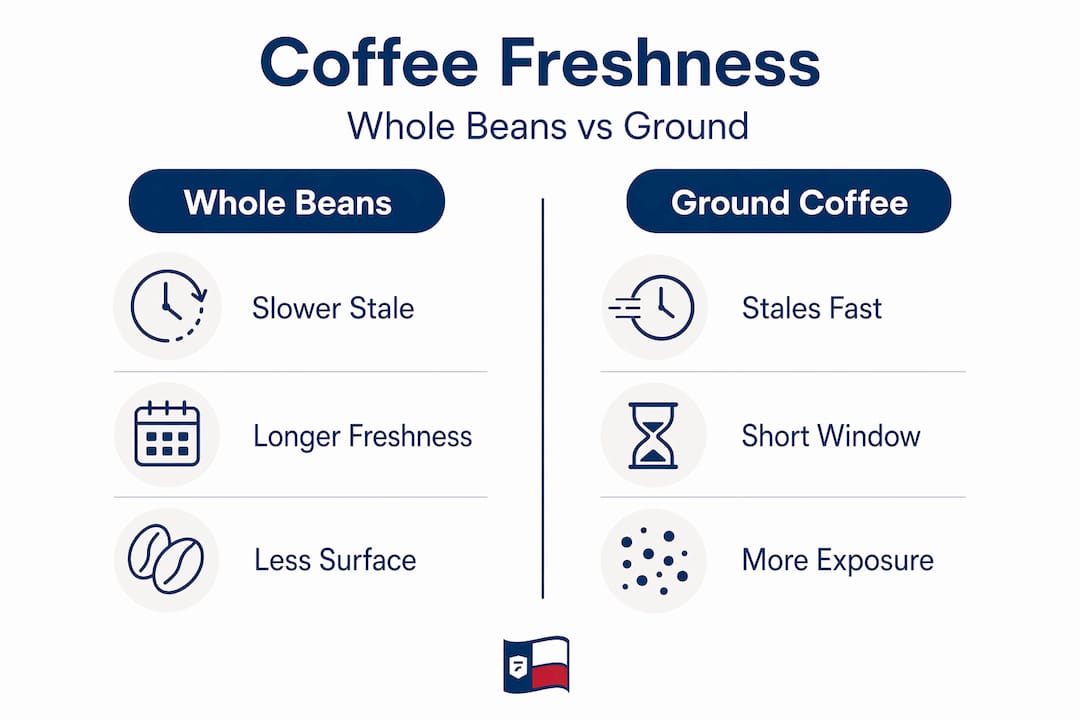
Ground coffee stales 500 times faster than whole beans due to the massive increase in surface area. Grinding takes a compact bean and creates hundreds of particles with exposed surfaces, each one immediately losing aromatic compounds to evaporation and oxidation. Even the most carefully sealed pre-ground package is a compromised product compared to freshly ground beans.
Vacuum sealing helps, but not as much as the packaging implies. Vacuum sealing combined with freezing is more effective than sealed containers alone, but internal chemical reactions still occur even without oxygen present. You’re slowing a process, not stopping one.
Pro Tip: Grinding immediately before brewing is the single most effective flavor-preservation step you can take, outperforming any storage upgrade applied after pre-grinding. A burr grinder that costs $40 to $60 will transform your cup more than a premium bag of pre-ground beans stored in a vacuum canister.
The best coffee storage methods for maximum freshness
With the science in mind, here’s how to translate that knowledge into daily habits that actually protect your coffee’s flavor.
- Use the original bag when possible. Quality coffee bags often come with one-way valve seals that release CO2 without letting oxygen in. These are genuinely effective and rolling the bag tight after each use extends freshness meaningfully.
- Invest in an opaque, airtight container. If you transfer beans from their original packaging, choose a container with a rubber gasket seal and no clear panels. Ceramic and stainless steel work well. Avoid plastic long-term due to odor absorption.
- Store in a cool, dark, dry location. A pantry shelf away from windows and heat sources is ideal. Room temperature is fine. Cold is better. Hot is the enemy.
- Freeze strategically. Freezing works when done correctly. Freezing requires portioned, airtight packaging stored in the back of the freezer where temperatures are most stable. Pull out only what you need for one to two weeks and let it reach room temperature before opening.
- Buy smaller, more frequently. Buying a 5-pound bag to save money often costs you in flavor. Fresher, smaller purchases consumed quickly almost always taste better than bulk beans that sit around for weeks.
Pro Tip: Label your containers with the roast date, not the purchase date. Roast date tells you where you actually are in the freshness window. Most specialty roasters print this on the bag, and at Font-mag you’ll find it featured prominently because freshness is the point.
Proper storage meaningfully slows flavor breakdown but cannot stop it entirely. Think of these methods as damage control. Good coffee handled well will always outperform the same coffee handled carelessly.
Signs of stale coffee you shouldn’t ignore
Recognizing signs of stale coffee before you brew saves you a disappointing cup and helps you make smarter buying decisions going forward.
- No aroma when you open the bag. Fresh coffee smells intensely complex, with layers of fruit, chocolate, or nuttiness depending on origin. If you open a bag and the smell is faint, musty, or simply flat, the volatile compounds are already gone.
- Dull or papery smell when grinding. Fresh grounds smell almost overwhelming in the best way. Stale grounds smell thin, woody, or like cardboard.
- Flat, muted flavor in the cup. This is the most obvious sign. Stale coffee develops a dull, woody taste and loses the brightness, sweetness, and complexity that made it worth buying.
- Oily or rancid surface on dark roasts. Dark roasts have more surface oil than lighter ones. When those oils oxidize, they become rancid and produce a distinctly unpleasant, almost buttery-gone-wrong taste. Dark roast beans with heavy surface oil sheen that smells off need to go.
- No bloom when brewing. When you pour hot water over fresh grounds, CO2 escapes and the bed of coffee bubbles and expands. This is called the bloom. If your grounds sit flat and don’t react, the CO2 is long gone, and so is a significant portion of the flavor.
Coffee doesn’t go unsafe to drink the way proteins do. But flavor is the entire point of specialty coffee, and a stale bean delivers none of what you paid for.
My honest take on how most people store coffee wrong
I’ve been obsessing over coffee freshness long enough to notice one consistent pattern: most people treat coffee like a pantry staple instead of what it actually is, a perishable agricultural product with a short peak window.
I made the same mistakes early on. The big glass jar on the counter looked great. The bulk buy felt smart. Storing in the freezer felt like the right move because that’s what you do with perishables. Every one of those habits was quietly ruining my coffee.
The shift that changed everything for me was simple: I started portioning. I stopped buying more than I’d use in two weeks. I kept beans in their original sealed bag inside a ceramic canister away from my stove. The improvement was immediate and obvious, not subtle. Coffee I’d been dismissing as “fine” became something I looked forward to.
What surprises most people when I share these habits is how much impact small decisions have on the final cup. The container you choose, where you put it in your kitchen, whether you grind fresh or grab pre-ground: these aren’t minor details. They’re the difference between a great cup and a mediocre one. Treat your coffee like you treat fresh produce, not like you treat dried pasta, and it will reward you accordingly.
— Rosario
Taste what fresh roasting actually means

At Font-mag, freshness isn’t a marketing claim. It’s built into how Font Coffee Roasters operates, roasting in small batches to preserve the specific flavor profile of each origin, then packaging with one-way valve seals so CO2 can escape without letting oxygen in. If you’ve been disappointed by stale, flat coffee from bulk retailers, tasting the difference starts with beans roasted to order.
The Downshift Decaf 16oz from Colombia is a great starting point, balanced, medium-roasted, and packaged for freshness from the moment it leaves the roastery. For larger households or anyone looking to stock up the right way, the wholesale 5lb blend offers volume without sacrificing roast quality. Font Coffee ships free on orders over $35, so you can restock frequently and keep your window of peak freshness working for you.
FAQ
Why does coffee go stale so fast after grinding?
Grinding shatters beans into fine particles with massive combined surface area, causing volatile aromatic compounds to evaporate rapidly into the surrounding air. Ground coffee stales roughly 500 times faster than whole beans for this reason.
What are the main signs of stale coffee?
Stale coffee typically has a flat or papery smell, no bloom when brewing, and tastes muted, woody, or cardboard-like in the cup. Dark roasts may also develop a rancid surface oil odor.
Is refrigerating coffee a good storage method?
Refrigeration is generally not recommended for everyday use because humidity and condensation risk flavor loss. A cool, dark pantry shelf in an airtight container performs better for coffee you use within two to three weeks.
Can freezing keep coffee fresh longer?
Yes, but only with the right approach. Portion beans into airtight sealed packages before freezing, store toward the back where temperature is stable, and never return partially used portions to the freezer after thawing.
How long do whole beans stay fresh after roasting?
Whole beans are typically at peak flavor between three days and three weeks after roasting, with the best window usually falling between seven and fourteen days post-roast depending on origin and roast level.