

Brew Exact Green Tea Water Temperatures Without a Thermometer
Most green tea tastes best brewed between about 70°C and 80°C (158°F to 176°F), never boiling. Delicate shaded greens like gyokuro want it cooler, closer to 122°F to 149°F (50°C to 65°C). If you have no thermometer, boil your water, then let it sit for a few minutes to cool to the correct temperature range. Steep time and water quality still shape the final cup, but temperature is the lever that decides whether you taste sweetness or bitterness.
TL;DR:
- Using a thermometer remains the most reliable way to ensure precise green tea brewing temperatures, especially for delicate teas like gyokuro.
- Most green teas should be steeped between 158°F and 176°F, with shaded greens requiring cooler water around 122°F to 149°F for optimal flavor.
- Reboiled or old water increases bitterness due to higher catechin extraction, so always start with fresh, cold water for better taste.
- Roasted green teas like hojicha can tolerate higher temperatures up to 203°F, which enhances their roasted character.
- For stovetop kettles, remove from heat immediately after boiling and wait at least two minutes before pouring to hit the right temperature range.
Table of Contents
- What Water Temperature Does Each Green Tea Need?
- How Do You Hit the Right Water Temperature?
- How Long Should You Steep Green Tea?
- Why Does Green Tea Turn Bitter?
- Why Does Water Temperature Actually Change the Flavor?
- How Font-Mag Helps You Brew More Precisely
- Does Green Tea Temperature Vary by Country?
- Adjusting Temperature for Kettles, Stovetops, and Microwaves
- A Simple Checklist for Every Brew
- Where to Find Better Leaves and the Right Tools
- Sources
- FAQ
What Water Temperature Does Each Green Tea Need?
Green tea isn’t one tea. Gyokuro, sencha, and hojicha are processed differently enough that treating them the same way with a single “green tea temperature” guarantees a mediocre cup for at least two of the three.
Leaf grade and freshness push the ideal number around a little, too. A high-grade shincha picked in spring can turn grassy and sharp at the top of its range, while a lower-grade bagged sencha barely registers a difference between 160°F and 180°F. When in doubt, start at the low end of the range below and nudge up only if the cup tastes thin.
Roasted teas like hojicha and toasted-rice genmaicha break the rule that all green tea needs low heat. Roasting drives off many of the compounds that turn harsh at high temperatures, so hotter water actually pulls out more of the roasted character these teas are known for, according to brewing charts that map temperature by tea type. Matcha isn’t steeped at all. You whisk it directly into water in that same 158°F to 176°F band, so there’s no leaf to strain and no steep timer running.
How Do You Hit the Right Water Temperature?
A cheap digital thermometer is the most reliable tool you’ll ever buy for this. Clip or dip the probe about an inch into the water, away from the kettle wall, and read it right before pouring, since temperature drops fast once you lift the kettle off heat.
No thermometer on hand? These low-tech tricks get you close enough for a good cup:
- Boil water fully, then let it sit uncovered for 2 to 3 minutes to land near 175°F, a method backed by practical brewing guidance from Jing Tea.
- Pour boiling water into a second cup or teapot before adding it to your leaves. Each transfer between vessels drops the temperature by roughly 10 to 15 degrees.
- For gyokuro’s cooler range, do two or three transfers between cups before pouring over the leaves.
Temperature-controlled electric kettles remove the guesswork entirely. Most offer presets labeled for green tea, white tea, or oolong, and they hold that temperature steady rather than letting the water cool while you’re prepping leaves. Font-mag’s tea brewing temperature guide breaks down exact ranges by kettle type if you want a printable reference near your teapot.
Pro Tip: Warm your teapot or cup with hot water first, then dump it out before brewing. A cold vessel steals heat from your water in the first thirty seconds, which quietly shifts your 170°F pour down to 155°F before the leaves even open up.
How Long Should You Steep Green Tea?
Start with 2 to 3 grams of leaf per 8 ounces of water, roughly one teaspoon. That ratio holds for most sencha and longjing; delicate gyokuro often wants slightly more leaf since it’s brewed with so little water and at such low heat.
- Gyokuro: 122–149°F water, steeped 90 seconds to 2 minutes, using a small amount of water relative to leaf.
- Sencha and biluochun: 158–176°F water, steeped 1 to 2 minutes for the first infusion.
- Longjing: 167–176°F water, steeped 2 to 3 minutes.
- Genmaicha and hojicha: 176–203°F water, steeped 2 to 3 minutes, since the roasted leaf tolerates longer contact.
- Western-style, any type: push toward 3 to 4 minutes at the higher end of the temperature range for a stronger cup, though this trade-off increases astringency compared to shorter Japanese-style infusions.
Lower temperature and shorter time aren’t independent choices. Drop the heat and you often need a touch more time to pull full flavor without crossing into bitterness. Most quality leaves handle two or three infusions; shorten each subsequent steep by 15 to 30 seconds since the leaf has already given up its most soluble compounds.
Why Does Green Tea Turn Bitter?
Bitterness almost always traces back to one of three habits: water that’s too hot, leaves left steeping too long, or water that’s been reboiled. Ester catechins, the compounds responsible for green tea’s harsh edge, extract up to three to five times faster at near-boiling temperatures than at 75°C, according to research on tea water chemistry. That’s why a cup steeped at 212°F for three minutes tastes nothing like the same leaf at 170°F for the same time.
Common mistakes and their fixes:
- Water too hot: drop the temperature 5 to 15°F and taste again before adjusting further.
- Oversteeping: shorten the steep by 30 to 60 seconds, especially on the second infusion.
- Too much leaf: cut the ratio slightly rather than shortening time, which changes the flavor profile more than the strength.
- Leaves left in the vessel: strain immediately once the timer ends, even if you’re not drinking right away.
- Reboiled water: start with fresh, cold water every time.
If the cup still tastes flat or metallic after fixing temperature and time, the leaf itself or your water may be the problem, not your technique.
Why Does Water Temperature Actually Change the Flavor?
Two families of compounds compete for extraction, and temperature decides which one wins. L-theanine, the amino acid behind green tea’s sweetness and umami depth, dissolves readily even in cooler water. Ester catechins, the bitter compounds, need much more heat and time to break loose, as tea chemistry research explains.
That gap is the whole reason 158°F to 176°F works so well: hot enough to release theanine’s sweetness, not hot enough to blast out excess catechins.
Water source matters too. Fresh, cold water holds more dissolved oxygen, which brightens aroma and mouthfeel; reboiled water loses that oxygen and tastes noticeably flatter. If your tap water runs hard or heavily chlorinated, a basic filter helps, since minerals and chlorine can mask the vegetal and umami notes that lower brewing temperatures are specifically trying to preserve.
How Font-Mag Helps You Brew More Precisely
Getting the temperature right matters less when the leaf itself is inconsistent. Font-mag’s loose-leaf selections from MAG Tea and its Japanese matcha lineup are sourced with enough consistency that the ranges above actually hold steady steep after steep, rather than shifting with every bag.
If you’re building out a proper setup, a digital thermometer or temperature-controlled kettle from Font-mag’s accessories takes the guesswork out of the wait-and-hope method. Pair that with a small loose-leaf sampler so you can test gyokuro against sencha side by side. For a deeper breakdown of ranges by kettle type, Font-mag’s tea brewing temperature guide is worth bookmarking before your next brew.
Does Green Tea Temperature Vary by Country?
Japanese and Chinese brewing traditions handle green tea differently, and that split shows up directly in temperature choices. Japanese sencha and gyokuro culture leans toward gongfu-style short infusions at precisely controlled, often quite low temperatures, especially for shaded teas grown for umami rather than brightness. A gyokuro ceremony at 122°F would look almost absurdly gentle next to a Western breakfast tea routine.
Chinese green teas like longjing and biluochun typically brew a bit hotter, in the 167°F to 176°F range, reflecting a tradition built around pan-fired rather than steamed leaf. Pan-firing changes the leaf’s structure enough that it tolerates, and often benefits from, slightly more heat than steamed Japanese leaf of similar delicacy.
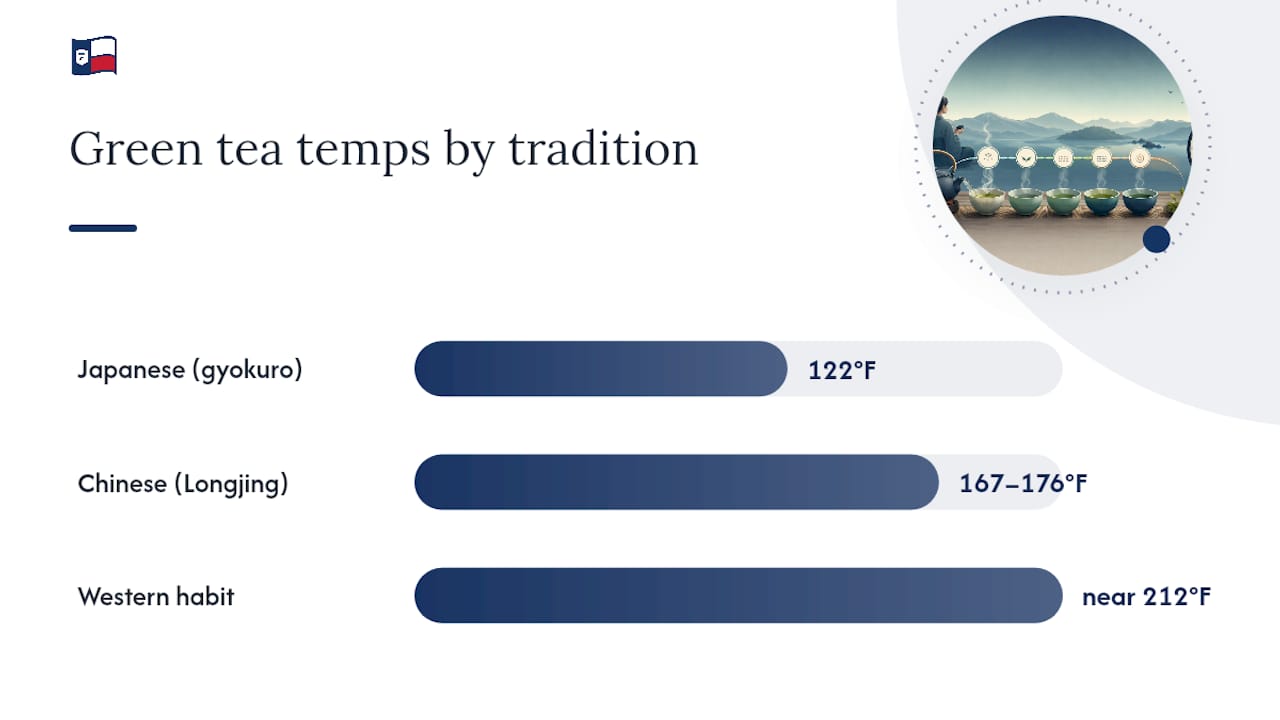
Western brewing habits, shaped for decades by black tea defaults, often push green tea toward near-boiling water and three-to-four-minute steeps out of habit rather than intention. That single habit explains a huge share of “I don’t like green tea, it’s bitter” complaints. Someone who grew up steeping black tea at 212°F simply applies the same instinct to green tea, and the leaf punishes them for it.
None of this means one tradition is objectively correct. It means the temperature ranges in this guide reflect what actually works chemically, and different cultures arrived at compatible answers through different paths, whether that’s a Japanese tea master timing gyokuro by feel or a Hangzhou tea farmer judging longjing water by sound and steam.
Adjusting Temperature for Kettles, Stovetops, and Microwaves
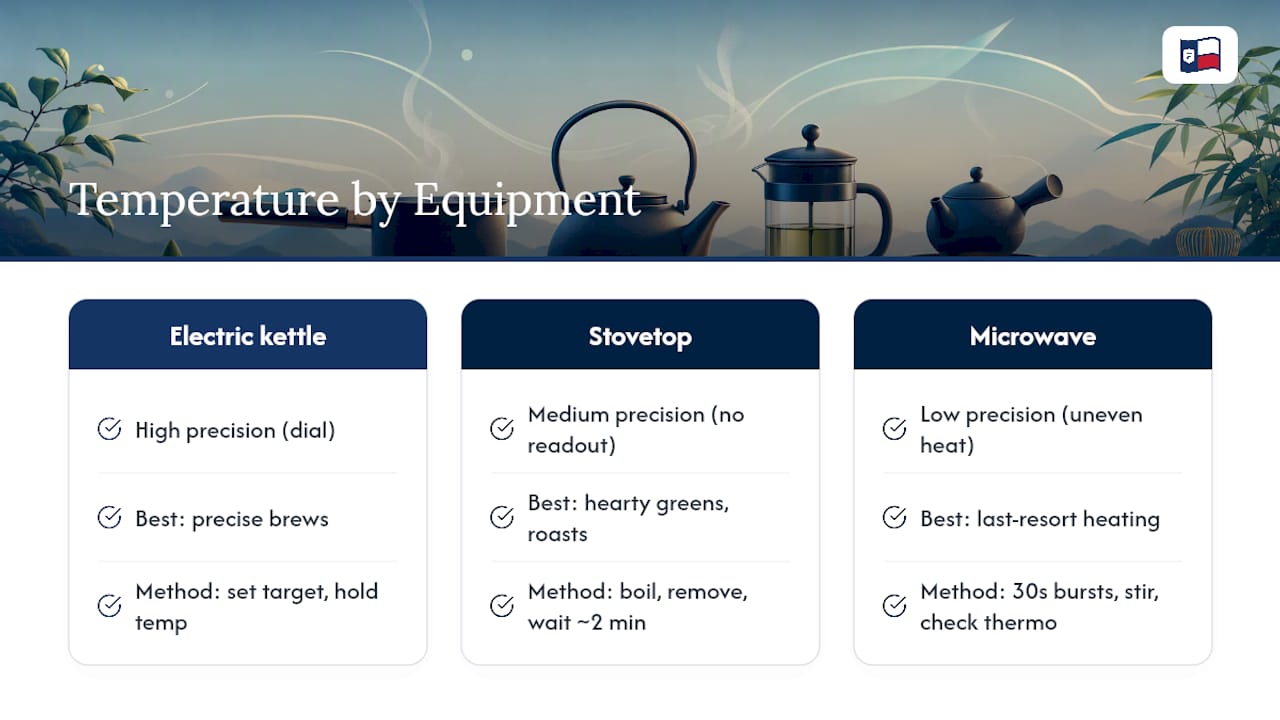
Temperature-controlled electric kettles are the easiest tool here. Set the dial to your target, and most hold that temperature within a few degrees while you measure leaves and warm your teapot. If your kettle only has a boil setting, boil it, then use the two-to-three-minute wait or the vessel-transfer trick described earlier.
Stovetop kettles demand more attention since there’s no digital readout. Bring water to a full boil, remove it from heat immediately, and either use a thermometer or count roughly two minutes of rest time before pouring over delicate greens like gyokuro. For hojicha or genmaicha, you can pour almost immediately after removing from heat since those teas tolerate the higher temperature.
Microwaves are the least precise option, since power output varies by machine and water heats unevenly without agitation. If it’s your only option, heat water in a microwave-safe container in 30-second bursts, stirring or swirling between each, and check with a thermometer before pouring. Never trust a microwave’s default “boil” setting for anything requiring precision, since uneven heating means the surface can read hot while the bottom is still lukewarm.
Whatever equipment you use, the goal stays the same: hit the target range in the cup, not just in the kettle, since even a well-heated kettle loses several degrees during the pour and the first thirty seconds of contact with a cool teapot.
A Simple Checklist for Every Brew
Five habits keep every cup consistent: hit 158°F to 176°F for most greens, cooler for gyokuro, using a thermometer or the two-to-three-minute wait trick. Use about one teaspoon of leaf per 8 ounces and steep sencha for a minute or two, longer for roasted types. Always start with fresh, cold water, never reboiled. Warm the teapot first. Finally, keep a quick note of what ratio and time you tried, since small trials teach you faster than any chart.
— Rosario
Where to Find Better Leaves and the Right Tools
Precision only gets you so far with mediocre leaves sitting stale in a bag. Font-mag’s Teas collection carries loose-leaf sencha, gyokuro, and matcha selections chosen for the kind of freshness that actually rewards careful temperature control, rather than leaf so old that no amount of precision saves it.

If your current setup is a stovetop kettle and a guess, a simple digital thermometer from Font-mag’s accessories collection solves that in one purchase. Pair it with a small loose-leaf sampler so you can test the gyokuro range against sencha in the same afternoon and actually taste the difference temperature makes. Current shipping options and offers can be found on the pricing page, so a sampler plus a thermometer is an easy way to start brewing with intention instead of guesswork. Browse the Teas collection and pick your first bag today.
Sources
For deeper technical detail beyond this guide, Far East Tea Company’s temperature breakdown covers subtype ranges, TeaTrade’s water chemistry piece explains catechin extraction, and Steep Atlas’s brewing chart compares steep times across traditions.
- Water Chemistry and Tea: Why Temperature… | TeaTrade
- Tea Brewing Water Temperature: Complete Chart by Tea Type
FAQ
How hot should the water be for green tea?
Most green tea brews best between 158°F and 176°F (70°C to 80°C), with delicate shaded types like gyokuro preferring a cooler 122°F to 149°F range. Roasted teas like hojicha tolerate hotter water, up to about 203°F.
What are common green tea mistakes?
The three biggest are using boiling water, oversteeping past two to three minutes, and reboiling old water instead of starting fresh. Each mistake accelerates the extraction of bitter ester catechins, which is what turns a smooth cup harsh.
Can you drink green tea with room-temperature water?
Room-temperature or cold water extracts flavor far too slowly for a normal steep, so a quick cup isn’t practical without heat. Cold brewing works instead, using an extended steep of several hours in the refrigerator, which is a different method than the hot-water ranges covered here.
Is 200°F too hot for green tea?
Yes, for most green teas, water above the recommended 158°F to 176°F range will pull out excess bitterness, especially with a full steep time. It’s fine for roasted types like hojicha or genmaicha, which are more forgiving of higher heat.