

70–100°C Tea Brewing Temperatures: Charted Ranges and No Kettle Methods
Green tea is best brewed with water roughly between 70 and 80°C, with gyokuro requiring even cooler temperatures. White tea prefers slightly warmer water around 75 to 85°C. Oolong teas are brewed at moderately high temperatures within a range below boiling, depending on roast level. Black tea and herbal blends are typically brewed with water near boiling. Pu-erh tea varies, with cooked types needing full boil and raw types preferring somewhat cooler water. Get the temperature right and steep time still does half the work.
TL;DR:
- Water temperature should be adjusted based on tea type, with green and white teas requiring cooler water to prevent bitterness, and black or herbal teas brewed near boiling.
- The ideal brewing temperature for green teas, like sencha or gyokuro, is around 175 to 185°F, while aged white teas can handle up to 185°F, enhancing flavor extraction.
- Use a thermometer and the boil-and-wait method to achieve consistent temperatures, especially at higher altitudes where boiling points are lower.
- Overheating delicate leaves accelerates tannin and catechin release, resulting in bitterness, so controlling temperature and steep time is essential for flavor balance.
- Mineral content of water significantly affects tea taste; moderately soft, filtered water yields the best flavor, while overly hard or soft water can dull or cloud the brew.
Table of Contents
- Tea Brewing Temperatures by Type: The Full Breakdown
- Why Temperature Controls Flavor: The Chemistry Behind the Cup
- How to Hit the Right Tea Water Temperature Without a Fancy Kettle
- Quick Reference: Tea Water Temperature Chart
- Troubleshooting Bitter, Weak, or Cloudy Tea
- Meet the Author and the Brand Behind This Guide
- Does Water Quality Actually Change Your Ideal Brewing Temperature?
- Why Altitude Changes Your Tea Brewing Temperature
- What Actually Matters Most When You’re Just Starting Out
- Bring the Right Tools to Your Next Cup
- Sources
Tea Brewing Temperatures by Type: The Full Breakdown
The ranges above are starting points, not laws. Every tea class has exceptions that reward attention, and most of those exceptions trace back to how the leaf was processed.
Take green tea. Japanese steamed greens like sencha and gyokuro are more delicate than most people realize, because steaming halts oxidation fast and leaves more chlorophyll and amino acids intact. That’s why sencha gets brewed around 176°F for about 60 seconds in traditional Japanese preparation, while Western steeping conventions often stretch that to two or three minutes at a similar temperature. Gyokuro, grown in the shade and prized for its umami, tolerates even less heat. Chinese pan-fired greens like longjing are a different animal. The pan-firing process toughens the leaf slightly, so longjing can handle the higher end of the green tea range, closer to 176°F, without turning bitter.
White tea follows a similar logic but in the other direction as it ages. Fresh white tea (think silver needle) is fragile and prefers the low end of its range, around 167°F. Aged white tea, which has spent a year or more mellowing, can handle water closer to 185°F and actually benefits from the extra heat pulling out deeper, more complex notes.
Oolong is the widest range in the entire lineup because “oolong” covers everything from barely-oxidized, lightly-rolled teas to dark, heavily-roasted ones. A green-leaning tieguanyin wants water closer to 185°F to preserve its floral character. Da hong pao, a heavily roasted rock oolong, can take water at 203°F and still taste balanced rather than scorched. Oolong sits below a full boil across the board, but where in that band depends entirely on roast level.
Black tea is more forgiving, though not infinitely so. Darjeeling, especially first-flush, is often treated more like an oolong. Many brewers pull it back to 195–200°F to protect its muscatel notes instead of blasting it with a full boil.
Why Temperature Controls Flavor: The Chemistry Behind the Cup
Water temperature is really a dial for controlling which compounds leave the leaf and enter your cup. Lower temperatures favor extraction of L-theanine and other amino acids, the compounds responsible for sweetness and umami. That’s why a lower-temp gyokuro tastes almost broth-like and savory rather than sharp.
Push the temperature higher and you accelerate the release of catechins and tannins, the compounds behind bitterness and astringency. Higher heat speeds up catechin and tannin extraction far faster than it speeds up amino acid release, which is exactly why over-hot water makes green tea taste harsh instead of sweet.
Caffeine extracts faster at higher temperatures too, and steep time multiplies whatever the temperature is already doing. A tea steeped too hot for too long compounds both problems at once. That’s the whole logic behind treating delicate, unoxidized leaves gently and letting compressed or heavily roasted teas take the heat. A shou pu-erh brick has been through fermentation and pressing; a full boil barely fazes it.
How to Hit the Right Tea Water Temperature Without a Fancy Kettle
You don’t need a $150 variable-temperature kettle to brew accurately. You need a plan and, ideally, a $10 thermometer.
Boil-and-wait method. Bring water to a full rolling boil, then let it sit off the heat. As a rough guide at sea level:
- Wait about 1 minute to drop to roughly 195°F (90°C)
- Wait about 3 to 4 minutes to reach about 185°F (85°C)
- Wait about 5 to 6 minutes to reach about 175°F (80°C)
- Wait 7 minutes or more to reach 165–170°F (74–77°C)
These are estimates for a standard kettle in a normal kitchen; a wide-mouth vessel cools faster than a narrow thermos-style kettle, and a cold ceramic teapot will pull heat out of the water the moment you pour.
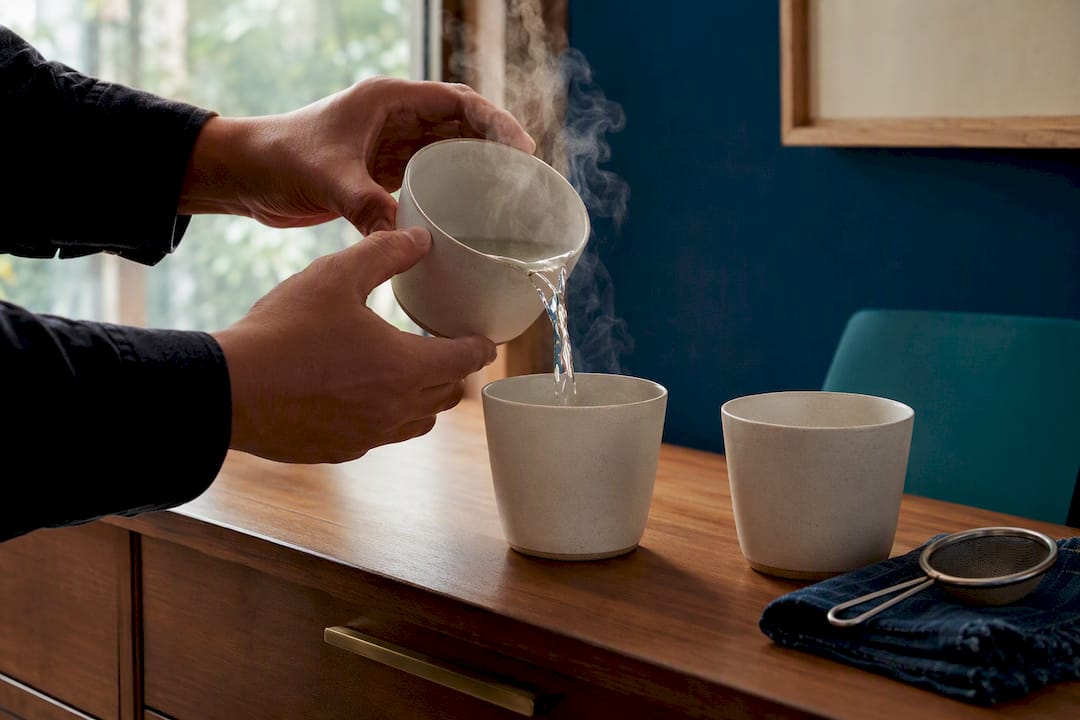
Pour-cool method. Pour boiling water between two cups a few times. Each transfer drops the temperature a few degrees, and the room’s ambient temperature and the material of your cups both affect how fast that happens.
Visual bubble cues, useful if you’re brewing gongfu-style over an open flame: fine “shrimp-eye” bubbles suggest roughly 160–170°F, “fish-eye” bubbles land closer to 180–190°F, and a rolling boil with steady streams means you’ve hit 212°F.
If you brew tea daily, a variable-temperature kettle earns its keep fast, and one with a hold function is genuinely useful for multi-infusion gongfu sessions where the temperature has to stay steady across five or six short steeps in a row.
Pro Tip: Within any given tea’s temperature window, push toward the lower end for a sweeter, more delicate cup and toward the upper end when you want more body. A 10 degree Celsius swing inside that window can be the difference between a floral oolong and a flat one.
Quick Reference: Tea Water Temperature Chart
Genmaicha, a green tea blended with roasted rice, tolerates slightly higher heat than plain sencha because the toasted rice balances out any added bitterness.
Troubleshooting Bitter, Weak, or Cloudy Tea
- Bitter or astringent tea usually means the water was too hot for the leaf, the steep ran too long, or both. Drop the temperature by 10°F, shave 30 seconds off the steep, or do both at once.
- Thin, weak-tasting tea is often a leaf ratio problem disguised as a temperature problem. Add more leaf before you crank the heat.
- Cloudy iced tea happens when hot-brewed tea cools too fast, causing tannins and caffeine to bind and cloud the liquid. Cold-brewing directly in the refrigerator for 6 to 12 hours avoids this entirely and produces a naturally clear, smoother cup.
- Flat-tasting tea despite correct temperature often traces back to water itself. Hot tap water can carry off-flavors from a water heater tank and stale, oxygen-depleted water flattens every tea style, so start with fresh, cold, filtered water every time.
Meet the Author and the Brand Behind This Guide
This guide comes from Rosario, [author bio placeholder], writing for Font-mag.
Font-mag is built on four generations of Texas craftsmanship, and that same attention shows up in how the brand curates its tea and matcha lineup. The team sources loose-leaf teas and ceremonial-grade matcha specifically because those products reward the kind of temperature precision this guide covers. [Awards and credentials placeholder]. [Customer testimonials placeholder].
If you’re brewing matcha rather than steeped tea, the temperature rules shift again: matcha whisked with water above 175°F tends to turn bitter and grassy fast, which is why barista-grade matcha and a proper bamboo whisk matter more than most people expect.
Does Water Quality Actually Change Your Ideal Brewing Temperature?
Yes, and it’s one of the most overlooked variables in the entire process. Mineral content, measured as water hardness, changes how efficiently hot water pulls flavor compounds out of tea leaves, even when the temperature reading is identical.
Water that’s too soft, like distilled or reverse-osmosis water with almost no mineral content, tends to produce a flat, muted cup no matter how carefully you hit the target temperature. It lacks the minerals that help carry aroma compounds. Water that’s too hard, heavy in calcium and magnesium, can mute delicate green and white teas and leave a filmy texture on the surface of the cup, sometimes at the exact temperature that would taste perfect with softer water.
The sweet spot is moderately soft, filtered water with some mineral presence, roughly in the range most bottled spring waters or a basic carbon filter will get you. If your tap water tastes noticeably metallic, chlorinated, or flat straight from the faucet, that flavor carries directly into your tea regardless of how precisely you hit 185°F. This matters more for delicate green and white teas, where there’s less going on to mask a water problem, and less for heavily roasted oolongs or pu-erh, where bold flavors do more of the covering.
If you’ve dialed in your temperature and steep time and something still tastes off, the water itself is worth testing before you blame the leaf.
Why Altitude Changes Your Tea Brewing Temperature
Water boils at a lower temperature the higher you go, and that single fact throws off every “boil the water” instruction you’ve ever read if you live somewhere above sea level.
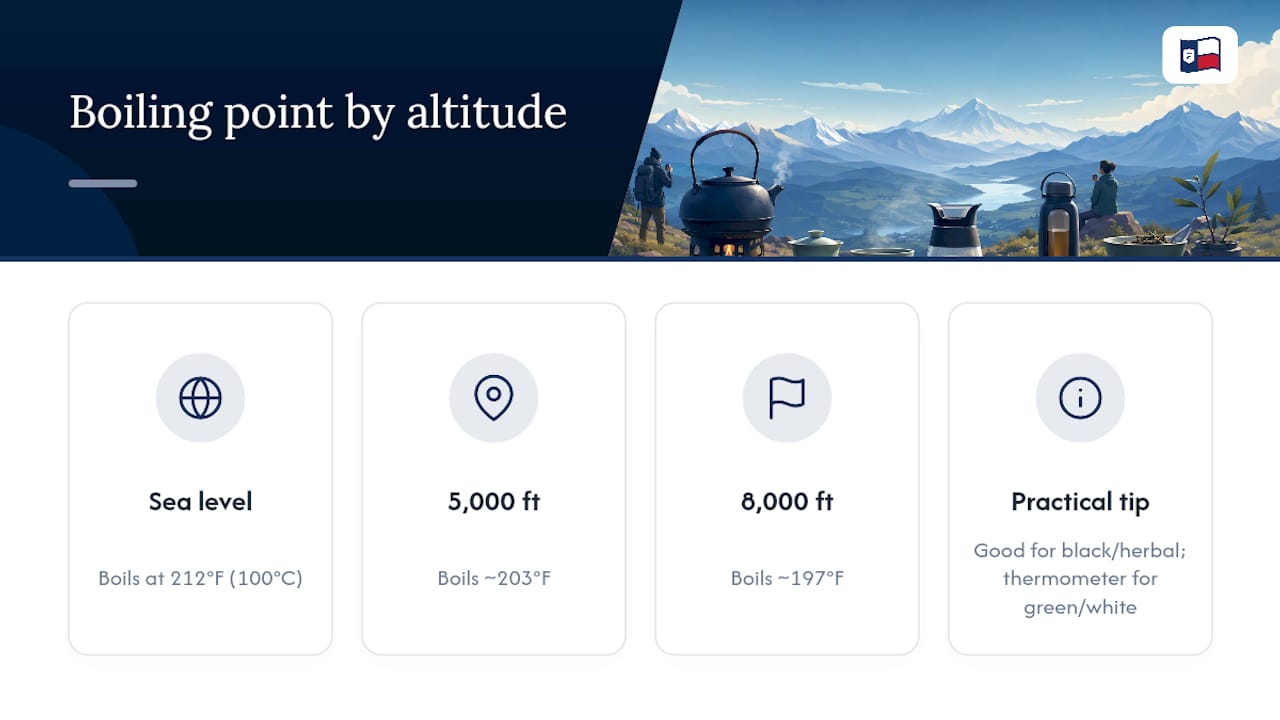
At sea level, water boils at 212°F (100°C). At 5,000 feet, roughly Denver’s elevation, water boils around 203°F. At 8,000 feet it’s closer to 197°F. That means a “full boil” at altitude is already at or below the ideal temperature for black tea and herbal blends, so simply boiling the water and pouring it straight on gives you a reasonably accurate cup for those categories without any adjustment.
The problem shows up for teas that need water well below boiling. If you’re at altitude and you’re brewing green or white tea, your boil-and-wait math needs adjusting because you’re starting from a lower ceiling. Waiting the same number of minutes off a lower-temperature boil will overshoot on the cooling side and land you with tepid, under-extracted tea. The fix is simple: use a thermometer at altitude rather than relying on timing charts built for sea-level boiling points, at least until you’ve calibrated your own kettle and cooling times to your elevation.
What Actually Matters Most When You’re Just Starting Out
Chasing exact degrees matters less than picking one lever and getting consistent with it. If you drink one cup a day, learn your kettle’s boil-and-wait timing for your two or three go-to teas and stop there. If you’re brewing gongfu-style with multiple infusions, invest in a variable-temperature kettle with a hold function, since consistency across five steeps matters more than any single perfect degree. If you’re making iced tea, skip the temperature debate entirely and cold-brew overnight. Precision helps everywhere, but it helps the person who already has a routine far more than the person still deciding what to brew tonight.
— Rosario
Bring the Right Tools to Your Next Cup
Font-mag gives you a shortcut most brewing guides can’t: ready sourced, temperature-appropriate teas and matcha instead of a bag of loose leaf and a guessing game. That matters most with matcha, where a few degrees separate a smooth, sweet bowl from a bitter one.

If this guide sent you looking for a barista-grade matcha that can handle the precision, Rishi Tea Bulk Barista Matcha is built for exactly that kind of consistent, lower-temperature whisking. Pair it with a matcha bamboo whisk to get the texture right without scorching the powder. For steeped tea drinkers ready to apply everything in this chart, Font-mag’s loose-leaf tea collection spans the green, white, oolong, and black categories covered above, and if flavored blends are more your speed, the full matcha lineup includes options like Monsoon Matcha for a different flavor angle. Orders over $35 ship free, so it’s worth stocking up on more than one temperature range at once. Pick a tea from the chart, order it, and put the boil-and-wait method to work tonight.
Sources
- Water Temperature for Tea: The Right Heat for Every Type · The Tea Hearth
- Tea Brewing Water Temperature: Complete Chart by Tea Type · SteepAtlas
- Green Tea Steeping Time & Temperature (Without the Bitterness)