

Tea Blending Flavor Profiles: A Home Brewer's Starter Guide
A successful tea blend is not a random pile of dried petals. Think of it as flavor architecture: you are balancing taste (sweet, sour, bitter, and sometimes umami), aroma, mouthfeel, a carrier that actually holds flavor, and visual cues that signal what the drinker should expect. This isn’t guesswork. It draws on flavor-pairing theory, the way volatile aroma compounds interact, and the basic chemistry of Camellia sinensis, the plant behind every true tea.
- Sweet/fruity blend: 88% base tea, 8% freeze-dried fruit, 4% natural flavoring
- Spiced/dessert blend: 85% base tea, 10% spice and root botanicals, 5% flavoring
- Floral/herbal blend: 90% base or herbal carrier, 7% aromatics, 3% petals for visual effect
Get these ratios roughly right and the rest of the process, tasting, adjusting, and scaling, becomes far more predictable.
Key Takeaways
A balanced tea blend requires managing taste, aroma, mouthfeel, and carrier function together, not adjusting flavor in isolation.
| Point | Details |
|---|---|
| Start with realistic ratios | Aim for roughly 85 to 88% base tea, 5 to 10% flavoring, and 1 to 3% aromatics or visual botanicals. |
| Fix mouthfeel first | Add hibiscus, chicory, or licorice root before finalizing flavor, since thin infusions taste less flavorful regardless of aroma. |
| Cap high-intensity ingredients | Keep spices under roughly 15% of total volume so they enhance rather than dominate the base. |
| Test one variable at a time | Brew small batches with fixed temperature and steep time, and change only one ingredient per iteration. |
| Store to protect aroma | Keep finished blends in airtight, opaque containers, since volatile aroma compounds fade quickly in light and air. |
| Build from a reliable base | Font-mag’s MAG Tea loose-leaf selections and ready-to-brew iced tea bases give home blenders a tested carrier to build recipes on. |
Table of Contents
- What Tea Blending Flavor Profiles Are Built On
- The Six Jobs Every Ingredient Has to Do
- Starter Recipes and the Strawberry Sunshine Breakdown
- How to Test, Adjust, and Finalize a Blend
- Quick-Reference Flavor Families for Blending
- Why Structured Blending Beats Guessing Every Time
- Stock Your Blending Bench with Font-mag
- Sources
What Tea Blending Flavor Profiles Are Built On
Tea blending flavor profiles rest on three sensory ideas: pairing, contrast, and synergy. Pairing means choosing ingredients that share aroma compounds, so a black tea with malty, roasted notes pairs naturally with cocoa or toasted grain. Contrast means putting two different sensations side by side so each becomes more noticeable, like tart hibiscus against a sweet vanilla base. Synergy is when two ingredients combine to create a perceived flavor that neither delivers alone, which is part of why flavor-pairing theory is now studied with data analysis and even machine learning to map which combinations actually work at a sensory level.
Underneath pairing sits taste balance. Every blend leans on some ratio of sweet, sour, bitter, and occasionally umami or salty notes. A fruity iced blend usually wants more sour brightness balanced by natural sweetness. A dessert-style black tea blend wants sweetness up front with just enough bitterness from the tea leaf to keep it from tasting flat. Professional blenders manage this by adjusting ratios of tart fruit, sweet botanicals, and the tannins naturally present in the base leaf.
Mouthfeel is the part most home blenders skip, and it’s a mistake. A thin, watery infusion tastes less flavorful even when the aroma is strong, because body affects how flavor lingers on the tongue. Botanicals like hibiscus, chicory root, and licorice root thicken the liquor and give it weight.
Pro Tip: Brew a small test cup with no added flavoring at all, just your base tea and body-building botanicals. If it tastes thin and watery on its own, no amount of fruit or spice will fix it later.
The Six Jobs Every Ingredient Has to Do
Every ingredient in a blend is doing at least one of six jobs. Knowing which job is which keeps you from wasting good ingredients on the wrong task.
- Carrier: the base that holds and delivers flavor, usually Camellia sinensis or rooibos, chosen for how well it absorbs added flavoring.
- Flavoring agent: freeze-dried fruit pieces, natural flavoring oils, or extracts that supply the dominant taste.
- Aromatic enhancer: lemongrass, lavender, or mint, added in small amounts to boost perceived flavor without changing the underlying taste structure.
- Body builder: hibiscus, chicory, or licorice root, added to thicken mouthfeel and correct thin infusions.
- Color and visual signal: petals, butterfly pea flower, or fruit pieces that tell the eye what the tongue should expect.
- Stabilizer/preserver: dried, low-moisture ingredients that keep the blend shelf-stable and prevent flavor degradation over time.
Some ingredients moonlight across categories. Hibiscus is a good example: it adds tartness, thickens body, and turns liquor a deep ruby red, all at once. That efficiency is useful, but it’s also where beginners get tripped up. A blend heavy on butterfly pea flower can turn liquor an unexpected blue-green, and an overloaded aromatic like peppermint can flatten every other note in the cup. Small doses, tested first, prevent both problems.
Starter Recipes and the Strawberry Sunshine Breakdown
Four templates cover most beginner projects. A morning black blend runs roughly 70% black tea, 15% citrus peel, 10% ginger, and 5% clove, echoing the balanced flavor-family approach recommended by experienced blenders.
To see how proportions actually deliver flavor, look at a worked example modeled on a fruit-forward blend, “Strawberry Sunshine”:
| Ingredient | Percentage | Function |
|---|---|---|
| Base tea (green or white) | 88% | Carrier, absorbs flavoring |
| Freeze-dried strawberry pieces | 5% | Flavoring, minor visual cue |
| Natural strawberry flavoring | 2% | Primary flavor driver |
| Dried petals (rose or marigold) | 1% | Visual signal only |
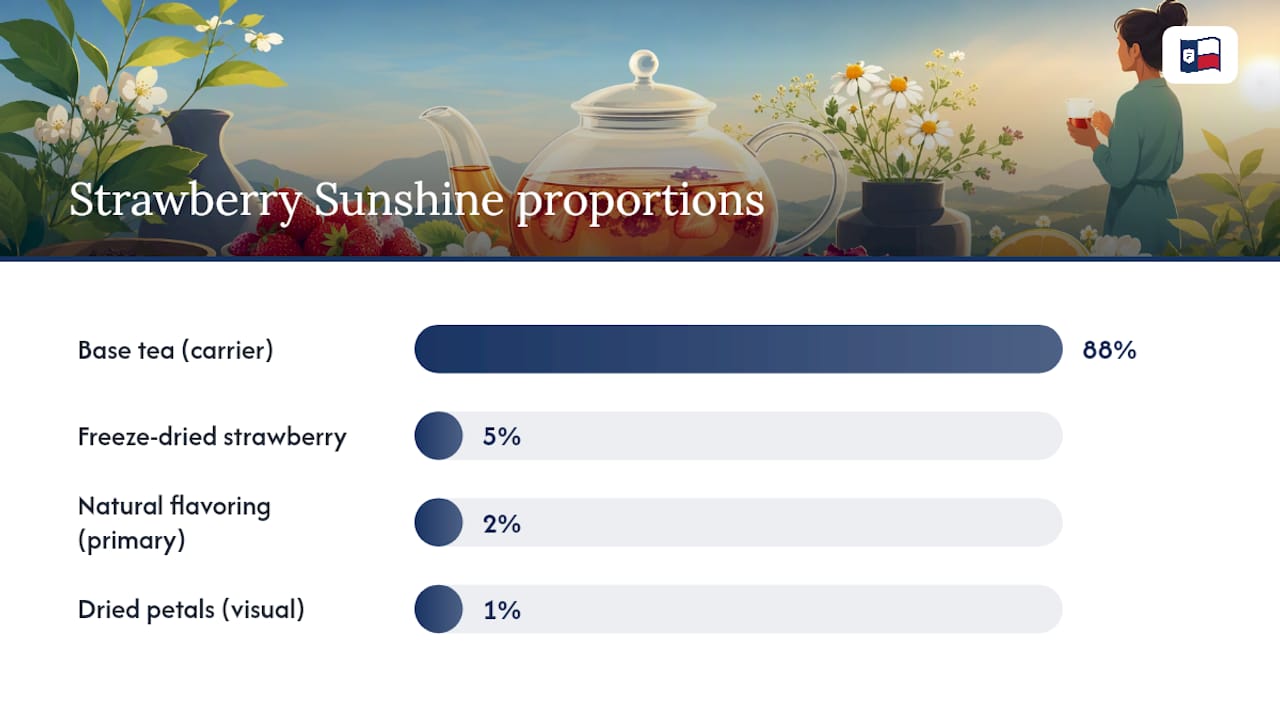
Here’s the part beginners get wrong: the fruit pieces contribute far less flavor than people assume; the base tea and the natural flavoring do almost all the work, while the petals exist purely to signal “strawberry” to the eye before the first sip. Camellia sinensis and rooibos both have strong absorption properties, which is why they’re chosen as carriers over more inert bases.
Scaling from a 50-gram test batch to 500 grams is mostly simple multiplication, but check two things as you go up: aromatic oils don’t always scale linearly, so retest at the larger volume, and mixing needs to be more thorough since clumping becomes more likely at scale.
How to Test, Adjust, and Finalize a Blend
Testing isn’t optional. Dry aroma often lies. A blend that smells amazing in the bag can taste flat once hot water hits it, because extraction changes which aromas actually come through. Run every candidate blend through this protocol before calling it finished.
- Mix a small test batch, 20 to 30 grams, so a bad ratio doesn’t waste ingredients.
- Brew with fixed, controlled parameters, same water temperature, same steep time, same leaf-to-water ratio, every time.
- Taste blind if possible, or at least without looking at your own notes first, to avoid bias.
- Change one variable per iteration, never two at once, so you know exactly what moved the needle.
- Record results immediately, before the next cup muddies your memory.
Keep a simple log for each test: brew temperature, steep time, leaf weight, and a quick rating of sweetness, tartness, body, and aroma strength. Most blends need three to five iterations before they’re dialed in. Once finalized, store the blend in an airtight, opaque container away from heat and light. Volatile aroma compounds fade fast when exposed to air, and a blend that tasted great on day one can go flat within a few weeks if storage is sloppy.
Quick-Reference Flavor Families for Blending
Grouping ingredients by flavor family makes it much faster to build a balanced recipe instead of guessing.
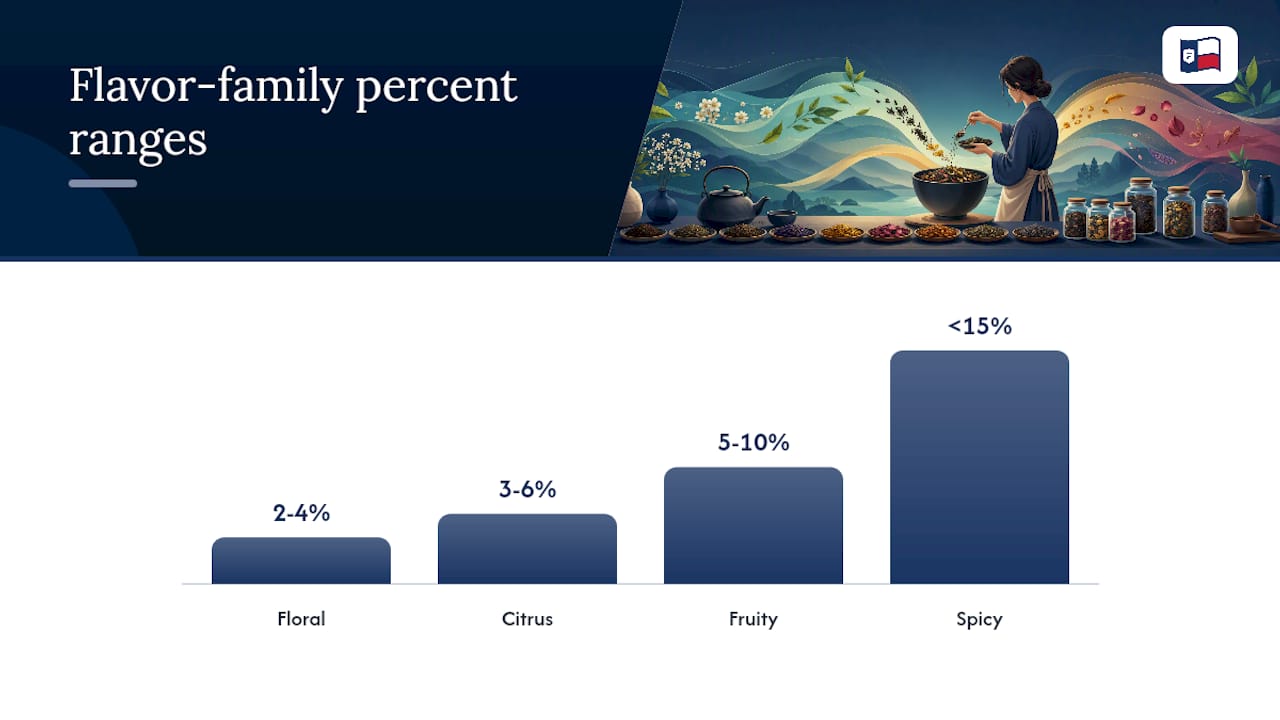
- Floral: lavender, rose, chamomile, jasmine — potent even in small amounts; start at 2 to 4%.
- Fruity: hibiscus, freeze-dried berries, dried apple pieces — moderate intensity; 5 to 10% works for most blends.
- Citrus: orange peel, lemongrass, lemon myrtle — bright and sharp; 3 to 6% is usually plenty.
- Spicy: cinnamon, clove, ginger, cardamom — the most concentrated category; keep spices under roughly 15% of total volume or they will dominate everything else.
- Earthy: rooibos, chicory root, licorice root — used mainly for body, not top-line flavor.
- Sweet: licorice root, stevia leaf, dried dates — natural sweetness without added sugar.
Color deserves its own note. Butterfly pea flower turns liquor a striking blue that shifts purple with acidity, while beetroot pieces add a deep red tint. Neither adds much flavor, so treat them as visual tools, not taste ingredients.
Pro Tip: When in doubt, build a blend from no more than three to five flavor families. More than that and the cup starts tasting muddy instead of complex.
Why Structured Blending Beats Guessing Every Time
I’d rather test one variable at a time and know exactly why a blend works than stumble into something good and be unable to repeat it. That’s the real value of flavor architecture over instinct blending: it turns a happy accident into a recipe you can rebuild on demand. Font’s work across coffee and tea flavor pairing reinforces the same lesson: structure speeds up iteration and makes results reproducible, whether you’re working with fifty grams or scaling toward a small commercial batch.
Stock Your Blending Bench with Font-mag
Every recipe in this guide depends on having the right building blocks on hand, a reliable carrier, real flavoring instead of weak substitutes, and tools precise enough to repeat a ratio exactly. Font-mag’s loose-leaf selections from MAG Tea work well as absorbent carriers for the fruit and floral blends above, and the flavored coffee line shows the same flavoring philosophy applied across a wider beverage range if you want to experiment beyond tea.
If you’re building toward iced blends specifically, start with a proven base rather than testing from scratch. The MAG Tropical Black Iced Tea gives you a stable, already-balanced carrier to layer fruit and aromatics onto, and once a recipe earns its place in regular rotation, the MAG Iced Tea concentrate in 3-gallon format lets you scale from kitchen-counter batches toward small-scale production without starting the ratio math over. For a starter kit, buy one reliable base tea, two or three aromatics from different flavor families, and a kitchen scale accurate to a tenth of a gram. Browse Font-mag’s iced tea collection to pick your first base and start testing this week.
Sources
- Application and Practice of Flavor Pairing Theory in Tea Beverage Innovation
- The Anatomy of a Tea Blend | World Tea News
- Tea Blending 101: Create Your Perfect Tea Blends at Home - Tea Perfectionist
- Herb Flavor Profiles for DIY Tea Blending
- A primer on tea pairings | Foodpairing
Recommended
- Coffee and Tea Pairing Guide: Flavors That Actually Work – Font Coffee Roasters
- Craft Cocktail and Tea Syrups: Your Home Bar Guide – Font Coffee Roasters
- How Roast Level Shapes Coffee Flavor: A Guide for Enthusiasts – Font Coffee Roasters
- Specialty Coffee Flavorings: Top 10 for Enthusiasts – Font Coffee Roasters