

How Roast Level Shapes Coffee Flavor: A Guide for Enthusiasts
Roast level determines which chemical reactions dominate the bean, and that single decision shapes everything in your cup: acidity, sweetness, bitterness, body, and aroma. Light roasts preserve the origin’s natural fruit acids and floral volatiles. Medium roasts trade some of that brightness for caramel sweetness and a fuller body. Dark roasts push past caramelization into pyrolysis territory, where smoky, roasty compounds take over and origin character largely disappears. Understanding the role of roast level in flavor means you can stop guessing at the grocery shelf and start buying with intention.
Quick roast map:
- Light roast: Bright acidity, fruit and floral notes, tea-like body. Best for pour-over, Chemex, and Aeropress when you want origin-forward cups. Ideal for single-origin washed Ethiopians or Kenyan coffees.
- Medium roast: Balanced sweetness, toasty/nutty notes, medium body. The go-to for drip brewers, flat whites, and anyone who wants complexity without sharpness. Works well as espresso when you want sweetness over roast.
- Dark roast: Bold, smoky, low acidity, heavy body. Suited to espresso with milk, French press, and moka pot. Best when you want roast-driven flavor rather than origin character.
Table of Contents
- How roast level shapes flavor: the chemistry behind the cup
- What light, medium, and dark roasts actually taste like
- How roast level changes acidity, sweetness, bitterness, body, and aroma
- Does roast level change caffeine or “strength”? The real answer
- How roast level affects your brewing choices
- How to choose a roast that actually matches your taste
- Why development time tells you more than roast color alone
- How to taste-test roast levels at home
- Key Takeaways
- Roast level is more personal than most guides admit
- Font-mag has the roasts to put this into practice
- Useful sources and further reading
How roast level shapes flavor: the chemistry behind the cup
Five chemical processes run simultaneously inside a roasting drum, and their relative contributions shift with every degree of heat applied.
The key reactions:
- Maillard reaction: Amino acids and reducing sugars combine under heat to produce hundreds of flavor compounds, including the sweet, nutty, and toasted notes that define a well-developed roast. This reaction begins around 150°C and accelerates through medium roast ranges.
- Strecker degradation: A subset of the Maillard pathway that generates aldehydes and pyrazines, contributing malty, chocolate, and earthy aromas.
- Caramelization: Sugars break down independently of amino acids, producing caramel, butterscotch, and brown-sugar tones. It peaks in the medium roast window.
- Pyrolysis: At higher temperatures, organic compounds fragment and combust. Pyrazines and sulfur compounds increase sharply, producing smoky, roasty, and sometimes burnt notes that characterize dark roasts.
- Chlorogenic acid degradation: These polyphenols break down during roasting, reducing perceived sourness and generating additional bitter compounds, particularly at higher temperatures.
Development time is the window between first crack and the end of the roast. It is as important as the final roast color. A roaster can hit the same bean color with a short, fast development time or a long, slow one, and the cups will taste completely different. Short development preserves acids and volatile compounds that read as fruity and bright. Extend it, and Maillard-derived pyrazines accumulate, pushing the profile toward nutty, roasted, and bitter.
Compound classes and their sensory roles:
- Furans and pyrazines: toasted, nutty, roasty
- Aldehydes: fruity, green, caramel (peak early, then decline at high heat)
- Organic acids (chlorogenic, citric, malic): brightness and perceived acidity
- Sulfur compounds: onion, rubbery, burnt at extreme roast levels
- Terpenes and terpenoids: floral, citrus, woody
What light, medium, and dark roasts actually taste like
Roast levels exist on a continuum, not in three clean boxes. The labels “light,” “medium,” and “dark” are shorthand for ranges of internal bean temperature and color, and there is meaningful overlap between them. That said, each range produces a recognizable sensory signature.

| Roast Level | Bean Appearance | Typical Flavor Notes | Acidity | Body | Best Brew Methods |
|---|---|---|---|---|---|
| Light | Light brown, no surface oil | Citrus, berry, floral, jasmine, stone fruit | High | Light to medium | Pour-over, Chemex, Aeropress, cold brew |
| Medium | Medium brown, no oil | Caramel, hazelnut, chocolate, toasted grain | Medium | Medium | Drip, Aeropress, espresso, flat white |
| Dark | Dark brown to near-black, oily surface | Smoky, dark chocolate, charred, bittersweet | Low | Full, heavy | Espresso, French press, moka pot |
Light roast beans reach an internal temperature of roughly 180–205°C, stopping at or just after first crack. The surface stays dry because oils have not migrated outward yet. Acidity is the dominant sensory feature: you get lemon, grapefruit, red berry, or jasmine depending on origin. Body is lighter, closer to tea than to a classic “coffee” texture. These are the roasts that reward single-origin purchases because origin character is still intact.
Medium roast (around 210–220°C, near second crack) is what most Americans grew up drinking. Research on Arabica roasting identifies the medium “American roast” as the most balanced in terms of volatile compound diversity, with the highest aroma emission intensity. Caramel and hazelnut notes come from Maillard products peaking in this range. Acidity softens but does not disappear. A medium roast maximizes pleasant aroma compounds like toasted hazelnut and caramel, making it the most crowd-pleasing option.
Dark roast pushes past 220°C into pyrolysis. Oils surface on the bean, acidity drops sharply, and roast-driven notes (smoke, dark chocolate, char) replace origin character. One practical note: extremely dark roasts are sometimes used commercially to mask defects in lower-quality beans by creating a uniform smoky profile. If a dark roast has no origin information on the bag, that is worth noticing.
How roast level changes acidity, sweetness, bitterness, body, and aroma
Every sensory dimension shifts predictably as roast progresses, though the rate and direction differ by component.
- Acidity: Starts high in light roasts (citric, malic, and chlorogenic acids intact), drops steadily through medium, and falls sharply in dark roasts as chlorogenic acids degrade. Perceived brightness in a light roast is not a flaw; it is the origin’s natural acid profile.
- Sweetness: Peaks in the medium roast window, where caramelization and Maillard reactions generate the most sugar-derived compounds. Light roasts can taste sweet but in a delicate, fruit-sugar way. Dark roasts lose sweetness as sugars fully combust.
- Bitterness: Increases with roast degree. In medium roasts, bitterness is mild and balanced by sweetness. In dark roasts, degraded chlorogenic acids convert to quinic and caffeic acids, and pyrazines add a roasty bitterness. Bitterness is often a product of over-roasting rather than higher caffeine.
- Body: Heavier as roast progresses. Light roasts feel thin and tea-like. Dark roasts feel thick and coating, partly because surface oils emulsify into the brew.
- Aroma: Researchers have identified 25 aroma-active compounds that drive most of the perceived differences between roast levels. Aroma intensity peaks around medium roast, then shifts character (not necessarily intensity) toward smoky and sulfurous notes at dark roast. Very dark roasts can generate burnt, putrid, and sulfurous scents, while very light roasts may not fully develop desirable aroma at all.
Example sensory profiles:
- High acidity + light body + floral = light roast, washed Ethiopian
- Balanced sweetness + medium body + caramel = medium roast, Colombian or Brazilian
- Low acidity + heavy body + smoky = dark roast, espresso blend
Pro Tip: If your cup tastes bitter, ask whether the bitterness is roasty (a dark, ashy, lingering quality) or sharp and astringent (a quick, mouth-drying bite). Roasty bitterness points to roast level. Sharp astringency usually means over-extraction. Adjust grind coarser or shorten brew time before blaming the roast.
Does roast level change caffeine or “strength”? The real answer
The short answer: roast level has only a modest, context-dependent effect on caffeine. Brewing variables and extraction yield matter more.
Research on caffeine in filter brews shows that caffeine concentration varies with both roast degree and extraction yield, and that the two interact. Darker roasts are more porous, which can increase extraction rate, but they also lose mass during roasting, which concentrates compounds by weight. Caffeine can partially sublimate at high roast temperatures, meaning very dark roasts may actually deliver slightly less caffeine per gram than lighter ones. Peak caffeine concentration in brewed coffee often appears near the light-to-medium roast range under typical extraction conditions.
Studies disagree on exact figures because they use different extraction yields, grind sizes, and dose methods. The practical takeaway: the differences are small enough that your dose and brew ratio matter far more than roast color.
Myth-busting list:
- “Dark roast has more caffeine”: False. Caffeine is relatively stable through most of the roast, and sublimation at very high temperatures can reduce it slightly. The difference between light and dark is small.
- “Darker roast = stronger cup”: Depends on how you define strength. Dark roasts taste bolder and more intense, but that is roast-driven flavor, not caffeine. A light roast brewed at a higher dose can be “stronger” by any measurable standard.
- “A scoop of dark roast gives more caffeine than a scoop of light”: Possibly true by volume, because dark roast beans are less dense and you may fit more beans in a scoop. But by weight, the difference is negligible. Use a scale, not a scoop, to compare fairly.
- “Bitterness means high caffeine”: No. Bitterness in dark roasts comes from degraded chlorogenic acids and pyrazines, not from caffeine content.
How roast level affects your brewing choices
Roast level changes how easily a bean extracts, and that means your grind, water temperature, and brew method need to match the roast.
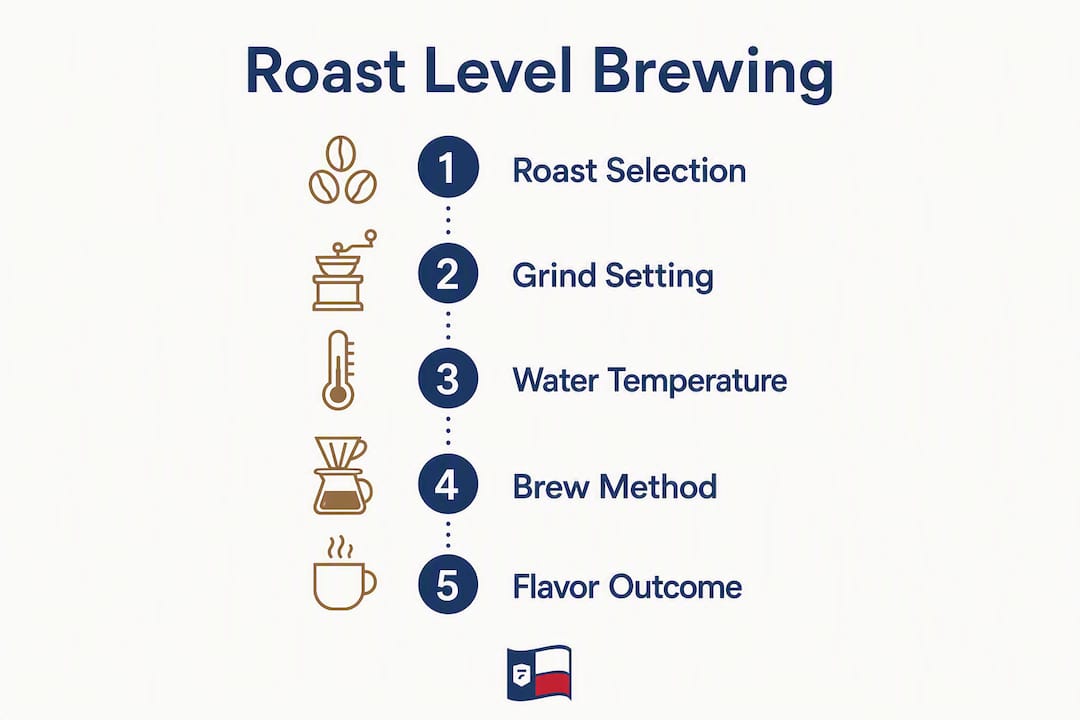
| Roast Level | Grind Setting | Water Temp | Brew Methods | Notes |
|---|---|---|---|---|
| Light | Fine to medium-fine | 200–205°F | Pour-over, Chemex, Aeropress | Higher temp and finer grind help extract fruit acids fully |
| Medium | Medium | 195–200°F | Drip, Aeropress, espresso | Versatile; adjust to taste |
| Dark | Medium-coarse to coarse | 190–195°F | French press, espresso, moka pot | Lower temp reduces harsh bitterness |
Light roasts are denser and less porous, so they resist extraction. A finer grind and higher water temperature compensate, pulling out the fruit sweetness and acidity that define the roast. Under-extract a light roast and you get a sour, thin, underdeveloped cup. Understanding coffee extraction helps you dial in the right yield for any roast.
Dark roasts are more porous and extract quickly. Brew them too hot or too fine and bitter compounds flood the cup. Drop water temperature to 190–195°F and grind coarser to slow extraction and keep the smoky-sweet balance intact.
Extraction yield interacts with roast degree to determine what ends up in your cup, which is why weight-based dosing beats volume-based dosing every time. Use a kitchen scale: 1:15 to 1:17 coffee-to-water ratio by weight for filter methods, 1:2 to 1:2.5 for espresso.
How to choose a roast that actually matches your taste
Start with the flavor attributes you value most, then match roast and brew method to reach them. This checklist works at a roastery counter, on a product page, or when talking to a roaster.
Buying checklist:
- Roast level: Light, medium, or dark? Use the flavor map above as your starting point.
- Roast date: Look for beans roasted within the past 2–4 weeks. Freshness affects flavor more than most people expect. Fresh-roasted coffee has measurably different aroma and CO₂ off-gassing than stale beans.
- Single-origin vs. blend: Single-origin coffees show origin character most clearly in light and medium roasts. Blends are often designed for consistency and work well as espresso.
- Tasting notes on the bag: Fruit and floral descriptors signal lighter roasts. Chocolate, caramel, and nut point to medium. Smoke, char, and dark chocolate indicate dark.
- Suggested brew method: A good roaster lists this. Match it.
- Recommended grind: If buying pre-ground, confirm the grind matches your brew method.
- Development time or roast profile notes: Specialty roasters increasingly list this. It tells you more about flavor intent than color alone.
Questions to ask a roaster:
- What is the development time on this roast?
- Is this a washed, natural, or honey process? (Processing affects acidity and fruit intensity independently of roast.)
- What brew method do you recommend?
Red flags: A bag labeled only “dark roast” with no origin, no roast date, and no tasting notes. That is the commercial equivalent of a mystery box.
Preference-based starting points:
- You like citrus and brightness: try a light-roast washed Ethiopian or Kenyan.
- You want chocolate and balance: try a medium-roast Colombian or Brazilian.
- You drink espresso with milk: a medium or medium-dark roast holds up well against dairy.
- You want bold and simple: a dark-roast blend for French press.
Why development time tells you more than roast color alone
Roast color is a useful shorthand, but it is an imperfect proxy for flavor. Two beans roasted to the same color can taste completely different depending on how they got there.
Research using NMR and GC-MS analysis found statistically significant sensory differences when development time was modulated while keeping roast degree constant. Fast roasts scored higher for acidity, fruit and berry notes, and sweetness. Slow or “baked” roasts scored higher for bitterness and roasted notes, even at the same color. The study identified 12 compounds with notable concentration differences across roast profiles, with faster roasts showing higher concentrations of acids linked to brightness.
“Shortening development time between first crack and roast end preserves acids and volatile compounds that produce fruitiness and sweetness; lengthening development time increases Maillard-derived pyrazines and other compounds linked to roasted, nutty, and bitter notes.” — MDPI Beverages, roast development time study
Specialty coffee has been shifting away from simple roast-color labels toward communicating development time and roast-profile details, because these metrics predict flavor outcomes more reliably than surface color. An Agtron number (a light-reflectance score used by specialty roasters) or a roast level designation like SCA RL55 gives you more information than “medium” alone.
What to look for on roast notes:
- Development time (in seconds or as a percentage of total roast time)
- First crack timing
- Roast degree by Agtron or RL score
- Roast curve shape (fast/slow profile)
What to ask your roaster: “What was the development time on this batch, and did you roast it fast or slow?” A roaster who can answer that question is worth buying from. Understanding roast profile details helps you interpret those answers and make better purchasing decisions.
How to taste-test roast levels at home
The most direct way to understand how roast affects flavor is to taste the same origin roasted to different levels side by side. Control everything except the roast.
What you need: Three coffees from the same origin (or as close as possible), roasted to light, medium, and dark. Same grind setting, same dose by weight, same water temperature, same brew method.
Step-by-step cupping:
- Grind each coffee to a medium-coarse setting (consistent across all three).
- Dose 10g of each into separate cups or glasses.
- Heat water to 200°F (just off boil).
- Pour 150ml of water over each dose simultaneously.
- Let steep for 4 minutes without stirring.
- Break the crust on each cup by pushing the grounds aside with a spoon. Smell each one immediately — this is where aroma differences are most vivid.
- Skim the grounds and let the cups cool to around 160°F before tasting.
- Slurp a spoonful of each, aerating the coffee across your palate.
- Taste in order: light → medium → dark. Rinse your palate with water between each.
- Taste again once the cups have cooled to room temperature. Flavor compounds read differently cold.
Simple score sheet:
Pro Tip: Keep grind size and dose identical across all three cups. Any variation in those variables will confuse the results. Tasting cold is not optional: light roasts often reveal their best fruit notes as they cool, while dark roasts can turn harsh.
Key Takeaways
Roast level is the single biggest variable a roaster controls, and understanding it lets you buy better coffee and brew it more confidently.
| Point | Details |
|---|---|
| Roast level drives flavor chemistry | Maillard, caramelization, and pyrolysis reactions shift with roast degree, changing acidity, sweetness, bitterness, and aroma. |
| Medium roasts maximize aroma complexity | Research identifies medium roast (around SCA RL55) as the peak for pleasant aroma compounds like toasted hazelnut and caramel. |
| Development time matters as much as color | Two beans at the same roast color can taste completely different depending on how fast the roaster moved through development. |
| Caffeine differences are small | Brewing variables and dose matter more than roast color for caffeine and perceived strength; use weight-based dosing to compare fairly. |
| Font-mag curated roasts | Font-mag’s retail coffee collection includes light and medium roasts with roast-date transparency so you can apply these principles immediately. |
Roast level is more personal than most guides admit
The conventional wisdom on roast level tends to flatten into a simple hierarchy: light roasts are for connoisseurs, dark roasts are for people who haven’t evolved yet. That framing is wrong, and it is worth pushing back on.
Dark roasts exist for real reasons beyond masking defects. A well-executed dark roast on a high-quality bean, pulled short of pyrolysis, can produce a genuinely complex cup with dark chocolate, dried fruit, and a syrupy body that a light roast simply cannot replicate. The problem is not dark roasting. The problem is dark roasting done carelessly, or used to hide low-quality green coffee.
What actually matters is the combination of roast level, development time, and brewing parameters working together. A light roast brewed at too low a temperature with too coarse a grind will taste sour and hollow. A dark roast brewed with precision at lower water temperature can be clean and satisfying. The research on development time makes this concrete: flavor is not just about how dark you go, but how you got there.
The practical takeaway for enthusiasts: stop buying roast levels and start buying roast profiles. Ask for the development time. Look for the Agtron score. Read the tasting notes as a hypothesis, not a guarantee, and then test it against your own palate with a simple home cupping. Your preferences are the only ones that matter in your cup.
Font-mag has the roasts to put this into practice
If you have read this far, you know what to look for on a bag. Font-mag makes it easy to act on that knowledge. The retail coffee collection includes single-origin light and medium roasts with roast-date transparency, so you can see exactly how fresh your beans are before you brew. For enthusiasts who want to compare roast levels directly, starting with a light and a medium from the same origin is the fastest way to hear the difference in your own cup.
Prefer your coffee without the caffeine? The Downshift Decaf is a medium-roast Colombian that preserves the caramel and hazelnut notes this article describes, without the stimulant. It is the clearest proof that roast-level flavor is about chemistry, not caffeine. Font-mag also carries the full decaf collection for anyone who wants roast-driven complexity on their own terms.
And if coffee is not your only drink, Font-mag’s catalog goes well beyond the roaster. The MAG Tea loose-leaf selections and Sweetbird syrup range give café owners and home enthusiasts a complete beverage program in one place. Browse the retail coffee collection to find your next roast, with free shipping on orders over $35.
Useful sources and further reading
- Effect of Roasting Level on the Development of Key Aroma-Active Compounds in Coffee (MDPI Molecules, 2024) — Identifies 25 aroma-active compounds across roast levels and shows how medium roasts maximize pleasant aroma; primary source for Maillard and pyrazine chemistry in this article.
- The Effect of Roast Development Time Modulations on Sensory Profile and Chemical Composition (MDPI Beverages, 2020) — Experimental evidence that development time shifts flavor outcomes independently of roast color; the key study behind the development-time section.
- Caffeine Content in Filter Coffee Brews as a Function of Degree of Roast and Extraction Yield (Scientific Reports, 2024) — Shows how extraction yield interacts with roast degree to determine caffeine; basis for the myth-busting section.
- Effect of the Roasting Level on Bioactive and Aromatic Compounds in Arabica Coffee Beans (International Agrophysics) — Compares Cinnamon, American, and Italian roasts on volatile compound profiles and aroma emission intensity.
- Effect of Roasting Level on Key Aroma-Active Compounds in Coffee (PMC) — Documents sensory outcomes at extreme roast endpoints (RL25 and RL75/RL85), including burnt and sulfurous notes at very dark roasts.
- The Impact of Roasting on Coffee Flavors and Taste (Clive Coffee) — Trade-oriented resource explaining how specialty roasters use development-time notation to communicate flavor intent.
Recommended
- Coffee Roast Levels Explained: A Flavor Guide for Enthusiasts – Font Coffee Roasters
- What Does Roast Profile Mean? A Home Roaster’s Guide – Font Coffee Roasters
- Texas Roast Coffee Brewing Guide for Enthusiasts – Font Coffee Roasters
- Why Coffee Origins Taste Different: A Flavor Science Guide – Font Coffee Roasters