

The Role of Bean Density in Roasting: a Home Roaster's Guide
If you’ve ever pulled two bags of green coffee off the shelf and wondered why the same roast profile produced wildly different results, the role of bean density in roasting is almost certainly the answer. Density is the kind of variable that looks simple on the surface but controls nearly everything about how a coffee behaves in your drum or roaster. And despite what a lot of sourcing notes imply, a denser bean isn’t automatically better quality. It’s a different physical challenge, one that demands a smarter approach.
Table of Contents
- Key Takeaways
- What the role of bean density in roasting actually means
- How density controls heat transfer during roasting
- Density’s influence on flavor and roast profile design
- Practical roasting adjustments by density
- Common misconceptions about density and other roasting variables
- What experience taught me about density as a framework
- Source thoughtfully selected beans for every density profile
- FAQ
Key Takeaways
| Point | Details |
|---|---|
| Density shapes heat behavior | Denser beans absorb heat more slowly, requiring stronger, steadier drying phases to develop evenly. |
| It’s a roasting variable, not a quality score | High density predicts roasting behavior, not superior flavor or cup quality on its own. |
| Adjust charge temperature by density | High-density beans need higher charge temps; low-density beans need gentler starts to avoid scorching. |
| Other factors interact with density | Moisture, bean size, and processing all modify how density-based adjustments should be applied. |
| Sensory feedback still matters | Density informs your roast plan, but real-time monitoring and tasting refine your results. |
What the role of bean density in roasting actually means
Before you can apply density knowledge, you need a clear definition. Bean density is simply the mass of a coffee bean relative to its volume, typically measured in grams per cubic centimeter. That’s the physics of it. But what it means in practice is that every bean in your batch has a specific capacity for absorbing, holding, and transferring heat, and that capacity varies significantly from one origin to another.
Several factors influence how dense a green coffee bean ends up being:
- Altitude: Higher-grown coffees mature more slowly in cooler temperatures, building denser cellular structures.
- Varietal: Bourbon, Typica, and Geisha tend toward higher density; some hybrid varietals land lower.
- Maturation speed: Faster-maturing beans often have lower cellular density because the structure develops with less time.
- Processing method: Natural-processed coffees sometimes show slightly different density profiles compared to washed counterparts from the same farm.
You can measure density through simple flotation tests, by sifting and separating beans by size and mass, or through direct weighing and volume calculation. Professional roasters often use a pycnometer for accurate readings, but for home roasters, knowing the general category (high, medium, or low density) is usually enough to make meaningful profile adjustments.
Pro Tip: Don’t assume altitude alone tells you density. Two coffees from the same 2,000-meter farm can have meaningfully different densities based on varietal and processing. Measure rather than guess, and your profiles will be far more consistent.
How density controls heat transfer during roasting
This is where the science becomes genuinely useful. Denser beans absorb heat more slowly at the start of the roast, particularly during the drying phase. Their tighter cellular structure acts like a thermal buffer. Heat needs more time and sustained energy to penetrate through to the core.
Low-density beans behave in almost the opposite way. Their looser, more porous structure absorbs surface heat quickly but unevenly. The outside of the bean heats fast while the inside lags. That’s a recipe for scorching on the exterior before the center finishes drying. If you’ve ever tasted a cup with bright, harsh bitterness and a thin body from what should have been a well-developed roast, uneven heat transfer in low-density beans is a likely culprit.
Here is what the roasting timeline looks like when density differences play out:
- Charge temperature: High-density beans benefit from a higher charge temperature to initiate heat transfer efficiently. Low-density beans need a gentler start to prevent the surface from getting too far ahead of the core.
- Drying phase: Dense beans need a longer, more sustained drying phase to push moisture evenly out from the center. Rushing this risks internal underdevelopment that won’t fix itself later.
- Maillard reaction: For dense beans, a deliberately extended Maillard stage pays off in sweetness and complexity. The structural tightness means sugars and amino acids react more gradually.
- First crack timing: Low-density beans dry quickly and unevenly, often hitting first crack earlier than expected. Dense beans may delay first crack but then release energy sharply once it begins.
Pro Tip: The biggest density-related risks happen during the drying phase specifically. Watch the drying phase closely for dense beans to prevent internal moisture lag, and reduce your early heat application for porous beans to avoid surface defects before the interior catches up.
Density’s influence on flavor and roast profile design
Here is a distinction that matters enormously and that most home roasting guides skim past. Density does not dictate what flavor a coffee will have. It frames the conditions under which flavor compounds develop. That’s a different thing entirely.
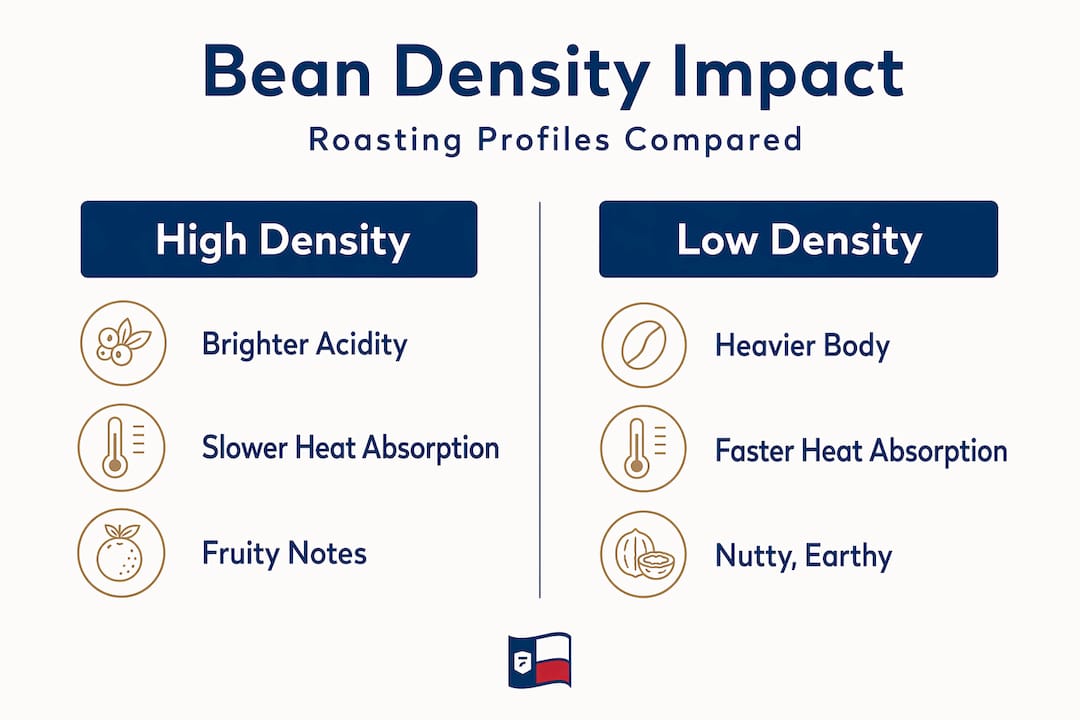
High-density beans, when roasted with a profile that respects their heat absorption rate, tend to express brighter acidity, clean sweetness, and layered floral or fruity aromatics. The extended Maillard time available in a well-managed dense roast allows more nuanced development. Ethiopian Yirgacheffe is a good real-world example. Its high-grown density supports a slow, structured build toward first crack that rewards patience with jasmine and blueberry notes.
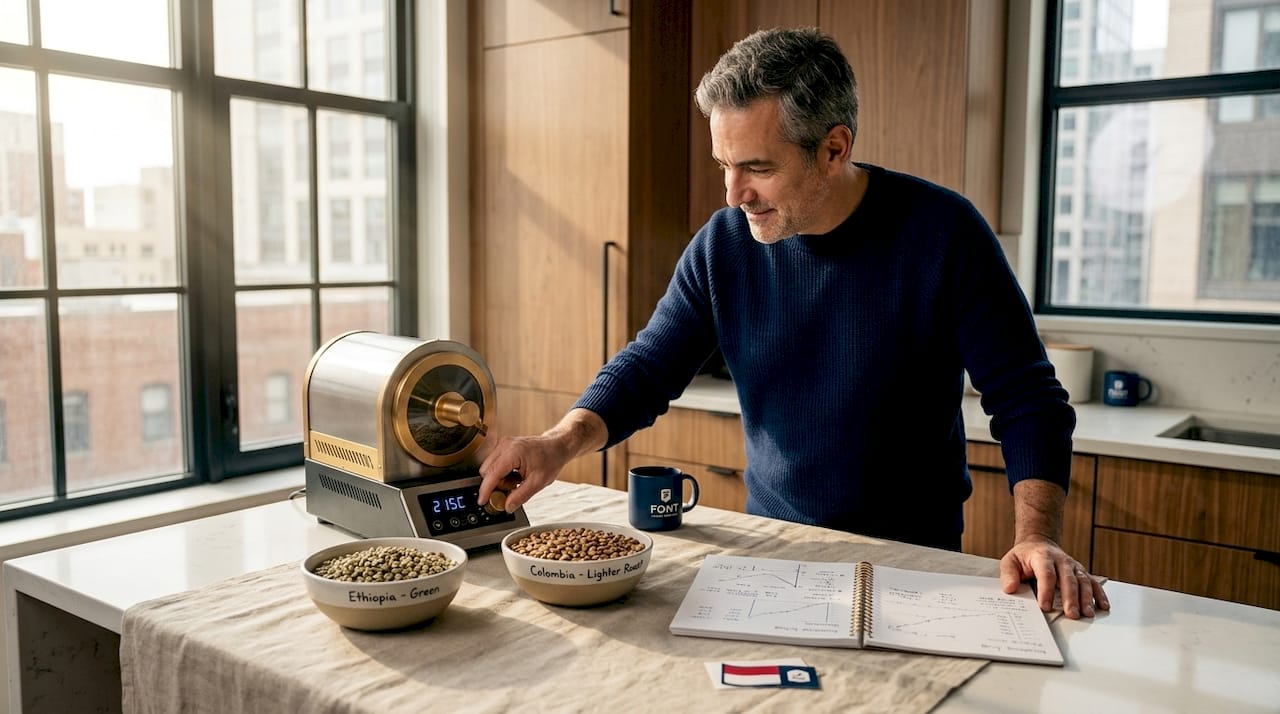
Low-density beans often develop heavier body, earthier character, and deeper chocolate or nutty tones. Brazilian naturals from lower altitudes frequently fall into this category. They’re not inferior. They’re different, and they need a different strategy.
| Characteristic | High-density beans | Low-density beans |
|---|---|---|
| Heat absorption | Slow and steady | Fast and uneven |
| Typical flavor notes | Bright acidity, floral, fruity | Heavier body, earthy, nutty |
| Risk during roasting | Underdevelopment, flat sweetness | Scorching, harsh bitterness |
| Ideal drying phase | Longer, sustained energy | Shorter, lower initial heat |
| First crack behavior | Delayed, sharp onset | Earlier, more gradual |
Density should sharpen your roast planning, not lock you into a rigid formula. A high-density bean roasted with too much early aggression will deliver scorched, underdeveloped results just as quickly as a low-density bean treated with too little care. Understanding how density affects roasting is about working with the bean’s physical nature, not fighting it.
Practical roasting adjustments by density
Knowing the theory only helps if you can translate it into settings. Here are the adjustments that actually move the needle at home:
- Charge temperature for high-density beans: Start 10 to 20°F higher than your baseline for medium-density coffees. The extra thermal energy gives the roast momentum needed to carry through the extended drying phase without stalling.
- Charge temperature for low-density beans: Drop your charge temperature by 10 to 15°F. Let the bean surface and core warm together rather than shock the exterior.
- Airflow during drying: Increase airflow slightly for low-density beans early in the roast to help carry surface moisture away without letting heat pile up. For dense beans, moderate airflow during drying supports even moisture migration without cooling the drum too fast.
- Drum speed: Manipulating drum speed during drying helps manage density-related risks more effectively than charge temperature changes alone. Higher drum speed increases contact for dense beans; moderate speed reduces friction heat for light, porous ones.
- Monitoring momentum around first crack: Watch your Rate of Rise carefully. Dense beans often show a sharp RoR spike at first crack that needs managing to avoid a runaway roast. Low-density beans may show a slow, drawn-out first crack that tempts you to push heat when you should hold.
Pro Tip: Measure density rather than assuming it from origin or altitude notes. Build a simple log that pairs each green coffee with a density category, your charge temp, drying phase length, and first crack time. Within three to four roasts of the same bean, you’ll have a repeatable foundation.
Common misconceptions about density and other roasting variables
The most persistent misunderstanding in home roasting circles is treating density as a quality guarantee. It’s not. Density is a predictor of roasting behavior, full stop. A dense bean roasted poorly will taste worse than a low-density bean roasted with skill and attention.
Several factors complicate the picture further:
- Moisture content: Two beans with the same measured density can behave very differently if their moisture percentages differ. Moisture, bean size, and processing method all interact with density to change roast behavior in ways that require separate adjustments.
- Bean size: Larger beans of equivalent density have more total mass to heat through. Smaller beans with the same density may develop faster simply because there is less material.
- Processing style: Natural-processed coffees carry residual sugars and sometimes additional cellular changes that affect how they respond to heat, independent of their density reading.
- Environmental conditions: Ambient temperature and humidity in your roasting space affect heat transfer dynamics. A density-informed roast profile that works perfectly in a climate-controlled kitchen may need small tweaks on a humid summer afternoon.
The practical takeaway is this: use density as your starting framework, then layer in moisture, size, and processing information to refine your approach. Using density alone can mislead your roast profiling in ways that take several batches to diagnose. Work with the full picture.
What experience taught me about density as a framework
Understanding density changed the way I approach every new green coffee I put in the drum. Before I started tracking it seriously, I was adjusting heat reactively, chasing whatever symptom showed up mid-roast. The results were inconsistent in ways I couldn’t explain, even when the origin and farm notes were identical batch to batch.
What I’ve learned is that roasters who ignore density adjust heat reactively, and reactive roasting means inconsistent flavor. Once I started treating density as the first variable I looked at before writing a profile, my roast-to-roast consistency improved faster than any other single adjustment I’d ever made.
My honest take: most home roasters oversimplify density into a charge temperature rule and stop there. That misses most of the benefit. The real value comes from using density to anticipate the entire arc of the roast. Where will the drying phase stall? When will first crack arrive and how sharp will it be? What Maillard duration makes sense for this particular bean’s structure? Density answers all of those questions in advance. Sensory feedback during and after the roast then fine-tunes the execution.
Patience with this process matters more than most people want to admit. Understanding how density relates to coffee extraction and cup flavor takes time, but when those pieces click together, the difference in your cup is immediately obvious.
— Rosario
Source thoughtfully selected beans for every density profile

At Font-mag, we think the quality of your roast starts long before your drum heats up. It starts with the green coffee in your hands. Our specialty offerings span a range of origins, densities, and processing styles, giving home roasters and enthusiasts the material to put the density principles above into real practice. From bright, high-grown Ethiopian lots to smooth, lower-density Brazilian naturals, every bean in our selection is chosen with roastability in mind.
We also carry our full retail coffee collection alongside Japanese matcha from premium sources, loose-leaf teas from MAG Tea, and the complete Sweetbird syrup line for your café setup. Free shipping on orders over $35, with fulfillment that gets your favorites to your door fast.
FAQ
What is bean density in coffee roasting?
Bean density refers to the mass of a green coffee bean relative to its volume, measured in grams per cubic centimeter. It determines how a bean absorbs and transfers heat during roasting, making it one of the core physical variables that shapes your roast profile.
Does higher bean density mean better coffee?
No. Bean density is a predictor of roasting behavior, not a quality score. High-density beans can produce exceptional cups when roasted correctly, but density alone does not guarantee flavor superiority over lower-density origins.
How does bean density affect first crack?
Dense beans typically delay first crack and then release energy sharply when it arrives. Low-density beans tend to reach first crack earlier and more gradually, which requires careful momentum management to avoid overdevelopment or stalling.
Can I use the same roast profile for different densities?
No. Two beans with identical density may even require different profiles based on moisture and processing. Applying a single profile across different densities is one of the most common causes of inconsistent results in home roasting.
How do I adjust my roast for low-density beans?
Start with a lower charge temperature (10 to 15°F below your standard baseline), moderate drum speed, and gentle early airflow to prevent surface scorching before the interior has dried evenly. Watch your RoR closely through the Maillard phase since low-density beans can stall quickly after an early burst.