

Ethically Sourced Coffee: Your 2026 Conscious Guide
Ethically sourced coffee is coffee grown, traded, and processed under conditions that protect farmers, workers, and the environment while ensuring fair economic terms throughout the supply chain. At its core, it means three things: fair income and safe labor for the people who grow it, sustainable farming practices that protect ecosystems, and enough transparency that you can actually verify the claims on the bag. Certifications from bodies like Fairtrade International, Rainforest Alliance, and USDA Organic serve as useful indicators, but no single label covers every dimension of ethical production. The honest reality is that few companies meet all criteria perfectly, which is why understanding what each certification does and does not cover matters as much as spotting the logo.
- Fair wages and income: Farmers receive prices at or above living income levels, not just commodity market rates.
- Safe, legal labor: No child labor, no forced labor, and documented working conditions.
- Sustainable farming: Practices that protect soil, water, and biodiversity rather than depleting them.
- Traceability: The ability to follow coffee from your cup back to a specific farm or cooperative.
What is ethically sourced coffee and why does it matter?
The stakes behind your morning cup are real. Coffee is grown predominantly by smallholder farmers in some of the world’s most economically vulnerable regions, and the gap between commodity prices and a living income has historically been wide. When you pay a premium for ethically sourced coffee, that money can directly support a farmer’s ability to send children to school, invest in their land, and weather a bad harvest.
The environmental case is equally strong. Shade-grown coffee supports around 19 times more biodiversity than sun-grown monocultures and stores double the carbon, while also improving soil water retention and reducing erosion. That is not a marginal difference. Conventional sun-grown coffee farming has contributed to deforestation across Central America, Ethiopia, and Vietnam, making the choice of farming method a genuinely consequential one.
Social justice sits at the center of ethical sourcing too. Ethical coffee sourcing requires fair income, the absence of child and forced labor, environmental stewardship, and transparent supply chains. When brands commit to these standards, they push the entire industry toward better norms, not just their own supply chain.
How to tell if your coffee is ethically sourced
Spotting genuinely ethical coffee takes a bit more than scanning for a logo. Here is what to look for:
- Certification labels: Fairtrade, Rainforest Alliance, USDA Organic, and Smithsonian Bird Friendly are the most recognized. Each covers different ground, detailed in the next section.
- Farm or cooperative traceability: Packaging that names a specific farm, region, or cooperative is a stronger signal than vague “single origin” claims. Traceable supply chains with documented compliance are the backbone of genuine ethical sourcing.
- Direct trade disclosures: Some roasters buy directly from farmers at negotiated prices above market rates and publish those relationships openly. This is often more rigorous than certification alone.
- Pricing transparency: Brands that publish what they pay producers, or explicitly state they pay above Fairtrade minimums, are showing their work.
- Deforestation commitments: Look for explicit statements that the coffee was not grown on recently cleared forest land.
Pro Tip: When a brand’s website cannot tell you the name of a single farm or cooperative they work with, that silence is itself informative. Ethical sourcing requires traceability, and traceability means names.
| Signal | What it tells you | Limitation |
|---|---|---|
| Fairtrade certification | Fair minimum prices, community premiums, labor standards | Does not mandate shade-grown or organic practices |
| Rainforest Alliance seal | Biodiversity, farm management, deforestation checks | Shade management is not required |
| USDA Organic | No synthetic pesticides or fertilizers | Does not address labor conditions |
| Smithsonian Bird Friendly | Organic + strict shade management | Less widely available |
| Named farm or cooperative | Farm-level traceability | Requires brand follow-through to verify |
| Direct trade disclosure | Higher prices, long-term relationships | No third-party verification standard |

Independent roasters who share detailed origin and producer information on their packaging tend to be more accountable than large commodity brands, simply because their reputation depends on it.
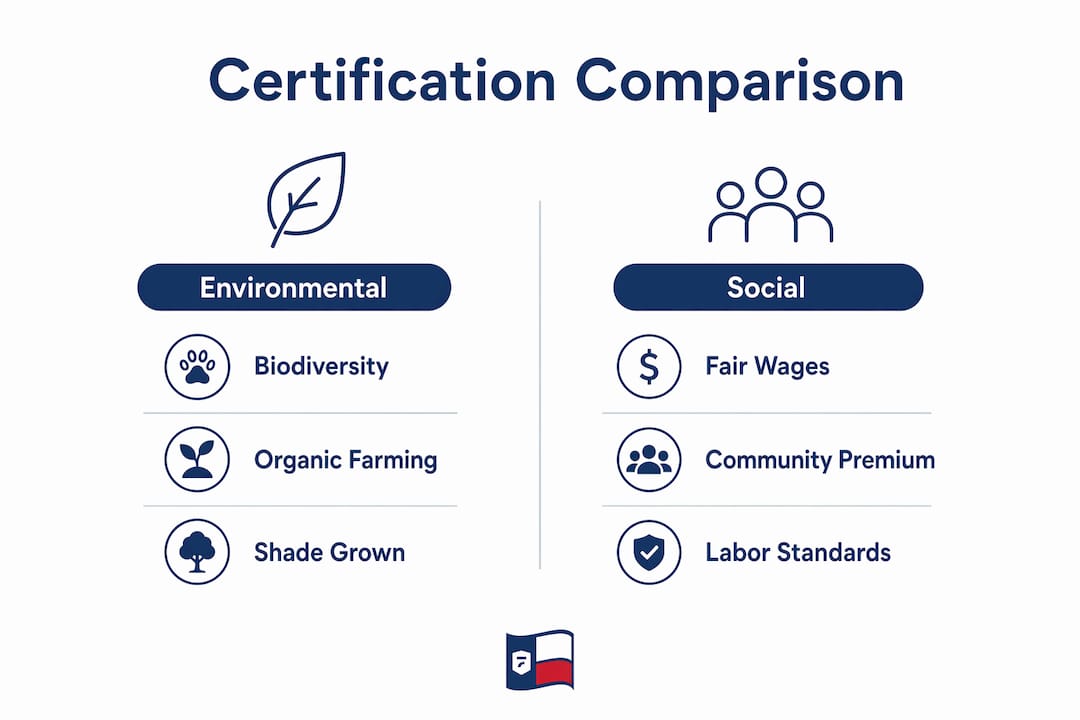
What the major certifications actually cover
Understanding each certification’s scope prevents you from over-relying on any single label.
Fairtrade International sets minimum price floors and pays a community development premium on top, which farming cooperatives direct toward local priorities like schools, healthcare, and infrastructure. Fair Trade Certified standards prohibit forced and child labor, require safe working conditions, and encourage environmentally sustainable practices including limits on deforestation and pesticide use. The weakness: Fairtrade minimums can still fall short of a true living income in high-cost-of-living growing regions.
Rainforest Alliance focuses on biodiversity conservation, farm management, and supply chain traceability. Its standards align closely with the EU Deforestation Regulation requirements, making it increasingly relevant for global supply chains. One important caveat: shade management is not mandatory under Rainforest Alliance certification, and less than 20% of Rainforest Alliance coffee is also USDA Organic. The seal signals meaningful environmental effort, but it is not the ceiling.
USDA Organic certifies that coffee was produced without specific synthetic pesticides and fertilizers, protecting soil health and farmworker exposure to chemicals. That is genuinely valuable. But USDA Organic does not require fair wages, safe labor conditions, or any particular farming structure. A certified organic farm can still pay poverty wages.
Smithsonian Bird Friendly is the most rigorous environmental certification available. It mandates both organic production and strict shade management, creating the kind of canopy habitat that supports migratory bird populations and maximizes biodiversity. If environmental impact is your primary concern, this is the gold standard, though it appears on far fewer products than the others.
The Coffee Sustainability Reference Code, developed by the Global Coffee Platform, provides a common framework for sustainable sourcing that aligns economic, social, and environmental principles. It is designed to complement rather than replace existing certification schemes, giving companies a shared baseline language for responsible sourcing commitments.
| Certification | Labor standards | Environmental focus | Organic required | Shade required |
|---|---|---|---|---|
| Fairtrade International | Yes | Partial | No | No |
| Rainforest Alliance | Partial | Strong | No | No |
| USDA Organic | No | Chemical-free only | Yes | No |
| Smithsonian Bird Friendly | No | Strongest | Yes | Yes |
Why certifications alone are not enough
The most common mistake conscious consumers make is treating a certification label as a complete answer. Relying solely on labels without demanding brand transparency can actually mislead you about a coffee’s ethical standing. This is sometimes called the “certification trap.”
Certification costs and audit fees can burden smallholder farmers, and the premiums those certifications generate depend heavily on consumers being willing to pay more. A small cooperative in Guatemala may produce genuinely ethical coffee but lack the resources to pursue formal certification, while a large industrial farm can afford the paperwork without meaningfully improving conditions.
The takeaway from accountability research is clear: certification schemes are foundational but not definitive. Traceability and accountability matter more for real ethical impact.
Best practices for going beyond the label:
- Seek brands that publish farm names, producer relationships, and pricing details.
- Prioritize roasters with direct trade relationships, which typically offer better traceability and higher prices for farmers.
- Look for premiums paid above Fairtrade minimums, including additional premiums earmarked for women producers.
- Combine certification signals: Smithsonian Bird Friendly plus a living income commitment, or Rainforest Alliance plus Fairtrade, covers more ground than either alone.
- Check whether the brand explicitly addresses deforestation in its sourcing policy.
Sustainable coffee packaging practices also reflect a brand’s broader commitment to ethical production. How a roaster presents its sourcing story on the bag tells you a lot about how seriously it takes accountability.
How your purchasing choices shape the coffee supply chain
Every bag you buy sends a signal. When consumers consistently choose coffee with verified ethical sourcing, they create financial incentives for farmers, cooperatives, and roasters to maintain and improve those standards. Demand for transparency has already pushed many mid-sized roasters to publish sourcing details they would have kept internal a decade ago.
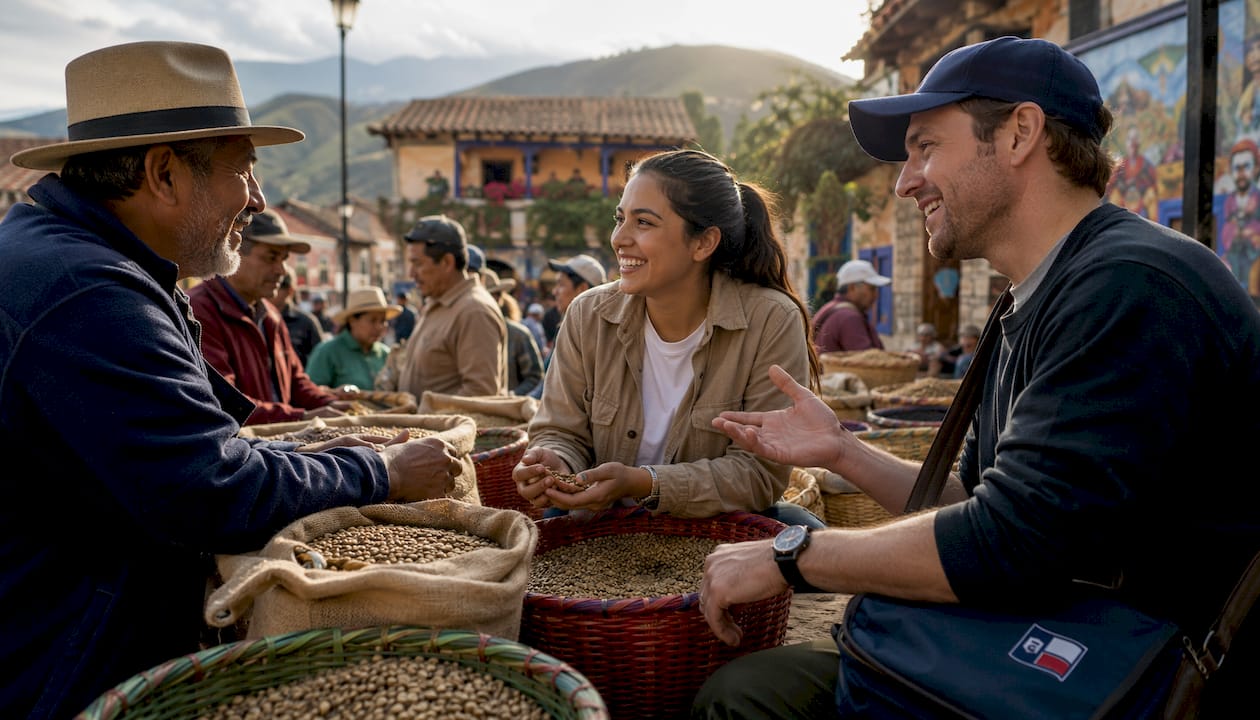
Paying a premium for ethically sourced coffee directly supports living wages. The price difference between commodity coffee and certified or direct trade coffee often represents the margin that allows a farmer to invest in better farming practices, hire safely, and plan beyond a single harvest. Supporting local and independent roasters who prioritize ethical sourcing amplifies this effect, since smaller operations tend to have closer relationships with their producers.
Consumer advocacy extends beyond purchasing. Contacting brands to ask about their sourcing, sharing information about certifications, and choosing employers or cafés that prioritize ethical coffee all contribute to shifting industry norms. The farm-to-cup transparency movement has gained real traction precisely because consumers started asking harder questions.
Font-mag brings ethical sourcing to your cup and beyond
Conscious consumers who care about where their coffee comes from deserve a source that takes sourcing as seriously as they do. Font-mag, built on four generations of Texas craftsmanship, curates small-batch coffees with the kind of quality and transparency that makes ethical purchasing straightforward rather than a research project.
The retail coffee collection includes carefully selected offerings for home connoisseurs and café owners alike, with free shipping on all orders over $35. Beyond coffee, Font-mag carries premium Japanese matcha, MAG Tea loose-leaf selections, and the Sweetbird syrup collection, so your entire beverage lineup can reflect the same values. Whether you are stocking a café or upgrading your home setup, Font-mag ships fast and keeps quality front and center. Browse the full collection at font-mag.com and find your next favorite cup.
Key Takeaways
Ethically sourced coffee requires fair income for farmers, safe labor conditions, sustainable farming practices, and supply chain transparency that goes beyond any single certification label.
| Point | Details |
|---|---|
| No single label covers everything | Fairtrade, Rainforest Alliance, and USDA Organic each address different concerns; combining them gives broader coverage. |
| Shade-grown coffee matters | Shade-grown farming supports around 19 times more biodiversity than conventional methods and doubles carbon storage. |
| Certifications have real costs | Audit fees can burden smallholder farmers; consumer willingness to pay premiums directly sustains ethical sourcing. |
| Traceability beats labels alone | Farm-level transparency and direct trade relationships are stronger indicators of ethical sourcing than certification alone. |
| Font-mag for conscious consumers | Font-mag’s curated retail coffee and specialty beverage range gives conscious consumers a quality-focused, transparent sourcing option. |
Recommended
- Why Independent Roasters Beat Corporations: 2026 Guide – Font Coffee Roasters
- Supporting Local Roasters Checklist for Coffee Lovers – Font Coffee Roasters
- What Is Carbon Neutral Coffee Roasting? A Clear Guide – Font Coffee Roasters
- Farm to Cup Texas Coffee Guide for True Enthusiasts – Font Coffee Roasters