
Why Independent Roasters Beat Corporations: 2026 Guide
Independent roasters beat corporations because they deliver fresher beans, deeper community ties, and traceable sourcing that mass production structurally cannot match. The specialty coffee market in 2026 has made this gap impossible to ignore. While corporate chains compete on convenience and price, independent roasters compete on identity, craft, and relationships. That is a fight corporations consistently lose. Understanding why independent roasters outperform corporate coffee brands means looking at four interconnected advantages: flavor quality, community loyalty, sustainability, and operational speed.
Why independent roasters beat corporations on flavor
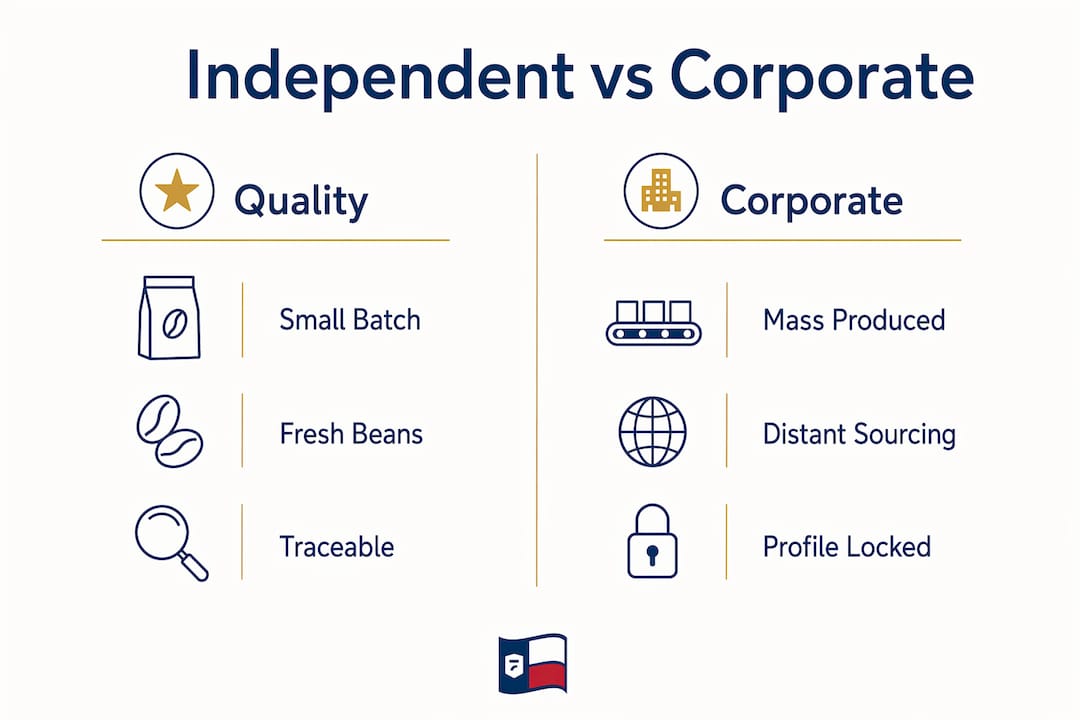
Small batch roasting is the foundation of every quality advantage independent roasters hold. Smaller roast batches produce superior flavor and aroma retention compared to industrial mass production. That is not a marketing claim. It is a direct result of physics: less coffee in the drum means more even heat distribution, more precise control over development time, and faster feedback between roaster and result.
Corporate roasters lock in profiles months in advance to maintain consistency across thousands of locations. Independent roasters can adjust a profile between batches. That agility produces cups that reflect the actual character of the bean rather than a standardized target designed for the lowest common denominator.

Freshness compounds this advantage. Beans begin oxidizing the moment they leave the roaster. A local roaster ships within days of roasting. A corporate supply chain may take weeks. Locally roasted coffee reaches your grinder at peak flavor, not past it.
Pro Tip: Check the roast date on any bag before buying. If there is no roast date printed, that is a red flag. Independent roasters almost always print it. Corporate brands rarely do.
The benefits of small batch roasting extend beyond freshness:
- Precision profiling: Roasters can experiment with temperature curves and airflow on small batches without wasting large quantities of expensive green coffee.
- Origin transparency: Smaller volumes allow roasters to source single-origin lots that tell a specific story, from a specific farm, in a specific harvest season.
- Rapid iteration: Customer feedback on a new Ethiopian natural can translate into a profile adjustment within the next roast cycle, not the next quarterly review.
- Sensory consistency: With fewer variables in play, a skilled independent roaster achieves cup-to-cup consistency that rivals industrial output on quality metrics that actually matter to enthusiasts.
Does community loyalty actually favor independent roasters?
The answer is yes, and the mechanism is more specific than most people realize. A 2026 analysis found that loyalty to independents is “almost always identity-based rather than product-based.” That distinction matters enormously. Product loyalty is fragile. Identity loyalty is durable. When a customer buys from a local roaster, they are expressing something about who they are, not just what they want to drink.
Corporate chains can build habit. They cannot build identity. A Starbucks loyalty card tracks purchases. A relationship with your neighborhood roaster tracks conversations, preferences, and shared values. Those are not equivalent.
Authentic storytelling and specific brand identity build deeper customer trust than product quality alone. This is why independent roasters who share the story of a specific farmer, a specific harvest, or a specific roasting decision consistently outperform brands that lead with generic quality claims.
Here is how independent roasters build that loyalty in practice:
- Visible presence: The roaster is often in the shop, at the farmers market, or behind the counter. Customers interact with the person making the product.
- Educational engagement: Local shops offer sampling, tasting events, and brewing classes that turn casual buyers into committed regulars.
- Values alignment: Independents can take public positions on sourcing ethics, environmental practices, and community causes. Corporate brands face shareholder pressure that limits this authenticity.
- Personalized service: Staff at independent shops learn customer names and preferences. That level of personalization is structurally impossible at scale.
“Small roasters’ true competitive edge is their ability to be specific and personal, which large brands cannot replicate despite similar quality claims.” — Ink Roast, 2026
Engaging local customers through events and education is not a nice-to-have for independent roasters. It is the primary mechanism by which they convert first-time buyers into advocates.
How independent roasters drive real sustainability
Sustainability in coffee is not a branding exercise for independents. It is a structural outcome of how they source. Sustainability challenges in coffee require coordinated approaches across the value chain, and independents’ direct engagement consistently improves outcomes for farmers and ecosystems alike.
Corporate roasters purchase at volume through intermediaries. That distance creates opacity. An independent roaster buying 10 bags of green coffee from a specific cooperative in Oaxaca knows exactly what that farmer was paid. A corporation buying container loads through a commodity broker often does not.
| Factor | Independent Roasters | Corporate Roasters |
|---|---|---|
| Sourcing model | Direct trade or relationship-based importers | Commodity brokers and large intermediaries |
| Price transparency | High: farmer payments often disclosed | Low: pricing obscured by supply chain layers |
| Traceability technology | Blockchain and lot-level tracking increasingly common | Inconsistent; varies by brand and region |
| Environmental accountability | Roaster-level decisions, visible and personal | Delegated to sustainability departments |
| Response to farmer issues | Direct communication, rapid adjustment | Formal procurement processes, slow response |
Blockchain and traceability technology can reduce information asymmetry in coffee supply chains, but adoption depends on organizational conditions. Independent roasters, with fewer layers between decision-maker and supplier, adopt these tools faster and use them more meaningfully.
Pro Tip: When evaluating a roaster’s sustainability claims, ask for the importer’s name and the farm or cooperative name. A roaster who can answer that question immediately is genuinely traceable. One who cannot is not.
The supporting local roasters movement is not nostalgia. It is a rational response to a supply chain problem that corporate scale makes worse, not better.
How fast can independent roasters respond to market shifts?
Local shops respond to market feedback in hours or days, while corporations take months or years due to complex management tiers. That speed gap is one of the most underappreciated advantages of independent roasters. When a neighborhood develops a taste for light-roasted Kenyan single origins, an independent roaster can have a new offering on the shelf within a week. A corporate chain must route that insight through regional managers, product development teams, and procurement committees before anything changes.
This agility shows up in several concrete ways:
- Menu flexibility: An independent can rotate seasonal offerings, limited releases, and experimental blends without approval chains.
- Local partnerships: Collaborations with nearby bakeries, restaurants, or breweries happen on a handshake. Corporate partnerships require legal review and brand alignment sign-off.
- Event programming: A cupping event, a latte art competition, or a farm-to-cup tasting can be organized in days. Corporate event programs operate on quarterly calendars.
- Sourcing pivots: If a crop fails or a relationship sours, an independent roaster can find an alternative lot quickly. Corporate procurement contracts lock in supply years in advance.
This operational speed also protects quality. When a batch does not meet standard, an independent roaster pulls it and adjusts. A corporate roaster with distribution commitments across thousands of locations faces enormous pressure to ship anyway.
Independent vs. corporate coffee: how value chain governance differs
The specialty coffee value chain is buyer-driven, with importers coordinating quality and information. Relational contracts and trust enable informal quality governance downstream, and independents near buyers influence value and relationships more effectively than corporations.
This is a technical point worth unpacking. In specialty coffee, quality is not just a physical attribute. It is a social agreement between roaster, importer, and farmer about what a specific lot should taste like and what it is worth. That agreement works best when the parties know each other and communicate directly.
Concentration of quality knowledge in importers intensifies information asymmetry, which independents mitigate through direct relationships. Corporate roasters, by contrast, rely on standardized grading systems and formal contracts that strip out the relational context that makes specialty coffee special.
The specialty coffee price breakdown reflects this reality. When you pay more for an independent roaster’s coffee, you are paying for the relationship infrastructure that produced it, not just the bean.
Key takeaways
Independent roasters beat corporations because their structural advantages in quality, loyalty, sustainability, and speed compound into a customer experience that corporate scale actively prevents.
| Point | Details |
|---|---|
| Small batch quality | Smaller roast batches produce better flavor retention and allow rapid profile adjustments. |
| Identity-based loyalty | Customers buy from independents to express values, not just preference, making that loyalty durable. |
| Traceable sustainability | Direct trade relationships give independents real transparency that corporate supply chains cannot match. |
| Operational speed | Independents respond to local feedback in days; corporations take months due to management layers. |
| Relational governance | Trust-based contracts between roasters and importers produce better quality outcomes than formal systems. |
Why this matters more than most people admit
I have spent years tasting coffee from every tier of the market, and the gap between independent and corporate is not closing. If anything, it is widening. The corporations have gotten better at marketing the language of craft. They use words like “small batch” and “single origin” on bags that contain neither. That is not cynicism. It is a documented pattern.
What strikes me most is how the sustainability argument has shifted. Five years ago, independent roasters talked about sustainability as a value. Now it is a verifiable operational reality. When a roaster can tell you the name of the importer, the cooperative, and the farmer, that is not a story. That is a supply chain. Corporate brands cannot say the same without a sustainability report written by a PR team.
The identity-based loyalty finding from 2026 research resonates with everything I have observed. People do not just want good coffee. They want coffee that means something. They want to know the person who roasted it, or at least know that a real person made a real decision about it. That is not a niche preference. It is a growing majority of the specialty market.
If you are a café owner deciding between suppliers, or a home enthusiast deciding where to spend your coffee budget, the case for choosing local is not sentimental. It is structural, traceable, and backed by research.
— Rosario
Explore font-mag’s specialty coffee collection
Font-mag is built on four generations of Texas craftsmanship, and every product in the lineup reflects the same principles that make independent roasters worth choosing. The Broken Arrow Reserve is the signature expression of that commitment, but the collection runs deep.
Whether you are stocking a café or building a home setup, Font-mag carries freshly roasted retail coffee sourced and roasted with the transparency that corporate brands cannot offer. For café operators, the wholesale coffee collection delivers small-batch quality at volume. Looking for something beyond coffee? Font-mag also carries premium loose-leaf teas from MAG Tea and the full Sweetbird range of syrups and café essentials. Free shipping applies to all orders over $35.
FAQ
What makes small batch roasting better than industrial roasting?
Small batch roasting allows more precise heat control and faster profile adjustments, producing better flavor and aroma retention than mass production methods.
Why do customers stay loyal to independent coffee roasters?
A 2026 analysis found that loyalty to independent roasters is identity-based rather than product-based, making it significantly more durable than habit-driven loyalty to corporate chains.
How do independent roasters improve coffee sustainability?
Independent roasters use direct trade relationships and traceability tools like blockchain to verify farmer payments and environmental practices, creating transparency that corporate supply chains structurally lack.
Can independent roasters compete with corporate chains on price?
Independent roasters do not compete on commodity pricing. They compete on quality, freshness, and relationship value. The higher price reflects traceable sourcing and superior craft, not markup.
How quickly can a local roaster respond to customer preferences?
Local roasters can vet and launch new offerings within days of receiving customer feedback, compared to months or years for corporate chains navigating complex management tiers.