

Why Espresso Is Concentrated Coffee: A Home Barista Guide
Espresso is concentrated coffee because pressurized extraction yields a much higher percentage of dissolved solids, emulsified oils, and suspended fines per ounce than gravity-brewed coffee. Pull a shot from grounds under pressure, producing a liquid with a TDS significantly higher than drip coffee. That gap is not a matter of degree. It is a different category of beverage.
Three mechanical drivers create that concentration:
- Pressure: Forces water through the puck fast enough to emulsify oils and dissolve CO2, producing crema and a syrupy body no gravity method can replicate.
- Dose-to-yield ratio: A typical 1:2 ratio (18g in → 36g out) concentrates dissolved solids into a tiny serving volume.
- Fine grind and short contact time: A near-powdery grind creates resistance that slows water just long enough to extract sweetness and body without over-extracting bitterness.
Table of Contents
- How espresso and drip coffee differ mechanically
- Pressure, emulsification, and why espresso feels different in your mouth
- Measuring concentration: TDS, extraction yield, and the benchmarks that matter
- How to dial in concentrated espresso at home
- Why concentration makes espresso the right base for milk drinks
- Key Takeaways
- The part most guides skip
- Fresh beans and supplies for better concentrated espresso
- Selected sources for further reading
How espresso and drip coffee differ mechanically
The difference between espresso and drip is not roast level or bean origin. It is physics.
Espresso machines push water through a tightly packed puck at high pressure, significantly greater than atmospheric pressure. Drip and pour-over methods rely on gravity, which exerts roughly 1 bar. That pressure gap changes everything downstream: which compounds dissolve, whether oils emulsify, and how much CO2 stays suspended in the liquid.
The filter type matters too. A metal portafilter basket lets oils and fine particles pass into the cup. Paper filters used in drip coffee strip most of those oils out, producing a cleaner but noticeably thinner cup. That is why drip coffee can taste bright and delicate while espresso tastes dense and coating.
| Variable | Espresso | Drip / Pour-Over |
|---|---|---|
| Pressure | High pressure typical of espresso machines | Atmospheric pressure typical of drip coffee |
| Grind size | Very fine (near powdery) | Medium to coarse |
| Dose → yield | A small dose resulting in a concentrated yield | A larger dose resulting in a much greater volume |
| Extraction time | Short duration typical of espresso | Longer duration typical of drip coffee |
| Serving size | Small volume typical of espresso | Larger volume typical of drip coffee |
| TDS | Higher total dissolved solids typical of espresso | Lower total dissolved solids typical of drip coffee |
| Filter type | Metal basket (oils pass through) | Paper (oils removed) |
| Body / mouthfeel | Syrupy, viscous | Clean, lighter |
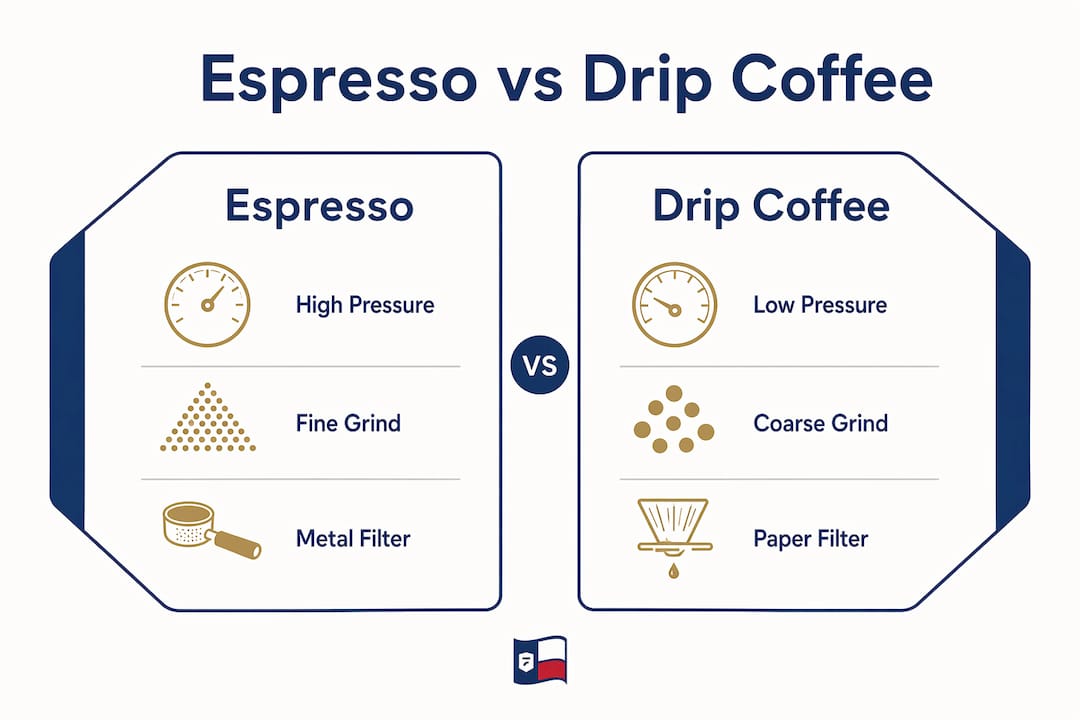
Grind size and dose-to-yield ratio compound the pressure effect. A fine grind creates enough resistance that water slows to a controlled trickle, extracting a high proportion of solubles in a fraction of the time drip requires. The resulting liquid is packed into 1–2 oz instead of 8–16 oz, which concentrates every dissolved compound further. That is espresso concentration explained in its simplest mechanical form.
Pressure, emulsification, and why espresso feels different in your mouth
Concentration is not just a number on a refractometer. You can feel it.
Under 9 bars, water forces oils out of the coffee cell walls and into a stable emulsion — tiny oil droplets suspended throughout the liquid rather than floating on top or being filtered out. Simultaneously, CO2 that was trapped in the grounds during roasting dissolves under pressure and then releases as the shot exits the basket, forming crema: a layer of oil-coated CO2 bubbles and suspended fines sitting on top of the shot. A well-pulled shot shows a 2–4 mm crema layer with a reddish-brown color and a texture often compared to warm honey.
Those emulsified oils raise the liquid’s viscosity. Espresso coats the tongue in a way drip coffee does not. Baristas call it “syrupy legs” — the way a shot clings briefly to the side of a glass after swirling. That physical weight is a direct consequence of oil content and suspended fines, not roast darkness or bean variety.
Concentration (TDS) and perceived intensity are related but not identical. A shot with high TDS tastes dense and coating. A shot with lower TDS but poor extraction balance can taste harsh or thin. The goal is high TDS and balanced extraction — sweetness and body without bitterness dominating.
Here is a quick sensory check: at 5–10 seconds after pulling the shot, tilt the cup. Proper emulsification shows as a thick, slow-moving liquid with visible reddish-brown crema intact. If the crema dissipates immediately or the liquid runs thin and fast, the shot likely under-extracted or the grind was too coarse.
Pro Tip: Stir the crema into the shot before tasting. The crema itself tastes bitter in isolation; mixed in, it contributes aroma and body. A shot that tastes harsh before stirring often tastes balanced after.
One common misconception: espresso’s intensity does not mean more caffeine per serving. A double espresso contains caffeine that can be less than or comparable to a larger cup of drip coffee, which varies depending on brew strength. Espresso is higher in caffeine per ounce, but the serving is so small that total caffeine per cup often comes out lower. Concentration (TDS) and stimulant load are separate metrics — worth keeping distinct when you are dialing for flavor versus caffeine goals.
Measuring concentration: TDS, extraction yield, and the benchmarks that matter
Numbers give you something to test against. Here are the ones that matter for home baristas.
TDS (Total Dissolved Solids) measures what percentage of the liquid in your cup is dissolved coffee. Espresso targets roughly 7–12% TDS; drip coffee sits at 1–2%. A refractometer (the VST or Atago models are widely used) measures TDS directly, but a scale and timer get you most of the way there without one.
Extraction yield measures what percentage of the dry coffee grounds ended up dissolved in the cup. The target range for a balanced espresso shot is approximately 18–22%. Below 18% and you are under-extracting: sour, sharp, thin. Above 22% and bitterness and astringency dominate.
The dose-to-yield ratio controls both. A standard recipe of 18g in → 36g out in 25–32 seconds is the most common starting point for a balanced double shot. Adjust the yield and you shift both TDS and extraction yield simultaneously.
| Shot style | Dose | Yield | Ratio | Time | Expected character |
|---|---|---|---|---|---|
| Ristretto | 18g | 36g | 1:1.5 | 18–22s | Dense, sweet, low bitterness |
| Standard double | 18g | 36g | 1:2 | 25–32s | Balanced, full body |
| Lungo | 18g | — | 1:3 | 25–32 seconds | Lighter, more bitter |
Pressure is the binary threshold. Without approximately 9 bars, you do not make true espresso. A moka pot reaches 1.5–2 bars — enough to brew strong coffee, not enough to emulsify oils or form crema. The extraction kinetics change at that pressure threshold: oils that would otherwise stay locked in the grounds get forced into the liquid, and CO2 dissolves rather than escaping as steam.
Understanding coffee extraction more broadly helps here. Acids and fruity esters extract first, then sweetness and body, then bitter compounds. Espresso’s 25–32 second window is tuned to capture the middle phase — sweetness and body — while limiting the bitter tail. A shot that runs long pulls too far into that bitter phase; one that runs short stops before sweetness develops.
Pro Tip: Weigh your yield, not your volume. Crema adds volume without adding dissolved solids, so a volumetric measurement overstates your actual yield. A scale under the cup is the most reliable way to hit your target ratio consistently.
How to dial in concentrated espresso at home
Getting a consistently concentrated shot requires controlling four variables in sequence: dose, grind, tamp, and yield. Change one at a time.
Step-by-step checklist:
- Flush the grouphead for 2–3 seconds to stabilize temperature before pulling.
- Weigh your dose — start at 18g for a standard double. Use a scale, not a scoop.
- Distribute evenly — use a distribution tool or the Stockfleth’s move (finger sweep) to level the puck before tamping.
- Tamp with consistent pressure — roughly 30 lbs of downward force, level. An uneven tamp creates channels where water bypasses the puck.
- Lock in and start the timer simultaneously.
- Weigh the yield as it drips — stop at 36g for a 1:2 ratio.
- Check your time — target 25–32 seconds for a standard double.
Dialing guidance:
- Shot runs fast and sour (under 20s): grind finer, or increase dose slightly.
- Shot runs slow and bitter (over 35s): grind coarser, or reduce dose.
- Shot tastes thin and sharp despite correct time: check distribution and tamp evenness.
Troubleshooting common problems:
- Channeling: Water finds a path of least resistance through the puck, producing simultaneous over- and under-extraction in the same shot. Symptoms: uneven flow from the spout, blond streaks in the crema, sour-bitter imbalance. Fix: improve distribution before tamping.
- Inconsistent crema: Often a freshness issue (stale beans off-gas less CO2) or a temperature issue (grouphead too cool). Check bean age and run a longer pre-flush.
- Grinder burr wear: Grind uniformity is more important than machine quality for shot consistency. Dull burrs produce uneven particle sizes, which cause channeling regardless of technique.
Pro Tip: Clean your grouphead and portafilter basket after every session. Coffee oils go rancid fast and add a bitter, stale note to subsequent shots. A blind basket and backflush with espresso machine cleaner once a week keeps extraction flavors clean.
For a deeper look at how home barista ingredients and equipment choices affect your cup, that guide covers grinder selection and dosing in practical terms.
Why concentration makes espresso the right base for milk drinks
A single or double espresso disappears into 8–10 oz of steamed milk. That is the point.
Espresso’s high TDS means its flavor compounds are concentrated enough to remain perceptible even when diluted by a large volume of milk. A standard latte uses a double shot (roughly 36g of liquid espresso) mixed with 8–10 oz of steamed milk. The espresso’s dissolved solids are intense enough that coffee flavor still registers through the fat and sweetness of the milk. A drip coffee poured into the same volume of milk would taste like warm milk with a memory of coffee.
This is why espresso’s concentrated profile became the industry standard for café drinks, as seen in Belfast’s specialty coffee brew innovations that highlight contemporary espresso use. Cappuccinos, flat whites, cortados, macchiatos — all of them depend on a shot concentrated enough to hold its identity in the final drink.
Beyond milk drinks, concentration matters wherever small volume is required. Affogato (a shot poured over ice cream) works because the espresso is intense enough to flavor the dessert without making it watery. Espresso cocktails like the espresso martini rely on the same principle: a small, dense shot that punches through spirits and sweeteners without getting lost. Even some baking recipes call for a shot specifically because the concentration delivers coffee flavor without adding excess liquid.
Key Takeaways
Espresso is concentrated coffee because 9 bars of pressure extracts a far higher proportion of dissolved solids, emulsified oils, and suspended fines per ounce than any gravity method can achieve, producing a TDS of 7–12% versus drip coffee’s 1–2%.
| Point | Details |
|---|---|
| Pressure is the threshold | Without ≈9 bars, oils do not emulsify and crema does not form — moka pots and drip cannot replicate true espresso. |
| TDS defines concentration | Espresso runs 7–12% TDS vs. drip’s 1–2%; that gap is what makes the same beans taste so different in each method. |
| Dose-to-yield ratio controls it | An 18g → 36g yield in 25–32 seconds targets 18–22% extraction yield for a balanced, concentrated shot. |
| Concentration ≠ total caffeine | A double espresso carries roughly 125 mg caffeine; a 12-oz drip cup can carry 120–240 mg — serving size matters. |
| Font-mag specialty beans | Font-mag’s specialty offerings include small-batch espresso blends sourced for the extraction variables covered here. |
The part most guides skip
There is a version of the espresso conversation that stays entirely in the numbers — TDS, bars, extraction yield — and never connects those numbers to the decision that actually matters: what you put in the portafilter.
Pressure and grind are the mechanics. Bean selection is where the flavor lives. A well-dialed shot from a flat, commodity blend will hit every benchmark and still taste like nothing in particular. The reason specialty roasters obsess over processing method, origin, and roast development is that espresso’s concentration amplifies everything in the bean, good and bad. A washed Ethiopian that tastes pleasantly floral as a pour-over can taste almost perfume-like as an espresso. A natural-processed Brazilian that tastes mild as drip can taste like chocolate and dried fruit as a ristretto.
This is the part home baristas often underestimate: dialing in is not just about hitting 25–32 seconds. It is about understanding what the bean wants to give you at that extraction level, and adjusting yield and ratio to find the sweet spot for that specific coffee. A lighter roast often needs a slightly longer yield or finer grind to develop sweetness; a darker roast can turn bitter fast if you push past 30 seconds.
Font-mag’s catalog, built on four generations of Texas craftsmanship, includes blends like the Broken Arrow Reserve that are developed with this extraction range in mind. But the same logic applies to any specialty bean you choose: know the roast level, know the processing method, and let those facts guide your first dial-in decision before you touch the grind setting.
Fresh beans and supplies for better concentrated espresso
Pulling a properly concentrated shot starts with fresh, quality beans — and that is where Font-mag makes the most practical difference for home baristas.
Font-mag’s specialty offerings include small-batch espresso blends roasted for the extraction variables covered in this guide, with fast shipping and free delivery on orders over $35. Beyond coffee, the catalog covers the full specialty beverage range: premium syrups and sauces for flavoring espresso drinks at home, Japanese matcha and loose-leaf teas from MAG Tea for days when you want something other than espresso, and café essentials including cleaning supplies to keep your equipment pulling clean shots. Browse the specialty lineup and pick a fresh espresso blend to start dialing in with the benchmarks from this guide.
Selected sources for further reading
These are the primary sources cited throughout this article, organized by what each one covers best:
-
Espresso — Wikipedia: Covers crema formation, viscosity benchmarks (2–4 mm crema layer), and the physical properties of emulsification under pressure. Good starting point for the physical chemistry.
-
What Is Espresso? Definition, How It’s Made, and How It Compares to Coffee — Home Espresso Lab: Explains the 9-bar pressure threshold and why moka pots and drip methods cannot replicate true espresso’s extraction kinetics. Useful for understanding the binary pressure requirement.
-
What Is Espresso? Expert Barista Guide — The Coffee Locator: Covers TDS benchmarks (7–12% for espresso vs. 1–2% for drip) and addresses the common misconception that espresso is defined by roast level rather than brewing method.
-
Espresso Extraction Explained — The Coffee Locator: The most detailed source on extraction yield targets (18–22%), dose-to-yield ratios, and the sequential extraction order (acids → sugars → bitters). Essential for dialing in at home.
-
What’s the Difference Between Coffee and Espresso? — America’s Test Kitchen: Explains how metal baskets vs. paper filters affect oil content and mouthfeel, and why espresso’s concentrated profile makes it the standard base for milk drinks.
-
How Much Caffeine in an Espresso Shot? — MasteringCoffee: Covers caffeine per serving for espresso vs. drip, grind uniformity as a key variable for consistent extraction, and the channeling problem caused by uneven particle distribution.
-
Espresso vs. Coffee: Caffeine and Strength, Settled — Barista Life: Practical breakdown of the “espresso has more/less caffeine” paradox, with per-ounce and per-serving comparisons grounded in USDA data. Good reference for explaining the concentration vs. total caffeine distinction.
-
What Is Coffee Extraction and How It Shapes Flavor — Font-mag: Font-mag’s own guide to extraction mechanics, TDS, and how brewing variables shape flavor — a practical companion to the benchmarks in this article.