

What Is Cupping in Coffee? A Complete Guide
What is coffee cupping and why does it matter?
Coffee cupping is a standardized sensory evaluation method used to objectively assess the quality, character, and consistency of coffee. The Specialty Coffee Association (SCA) defines it as a controlled process that measures specific attributes, including fragrance, flavor, acidity, body, and aftertaste, each scored on a numeric scale that aggregates to a 0–100 total. A coffee scoring above a certain threshold qualifies as specialty grade; higher scores indicate exceptional quality.
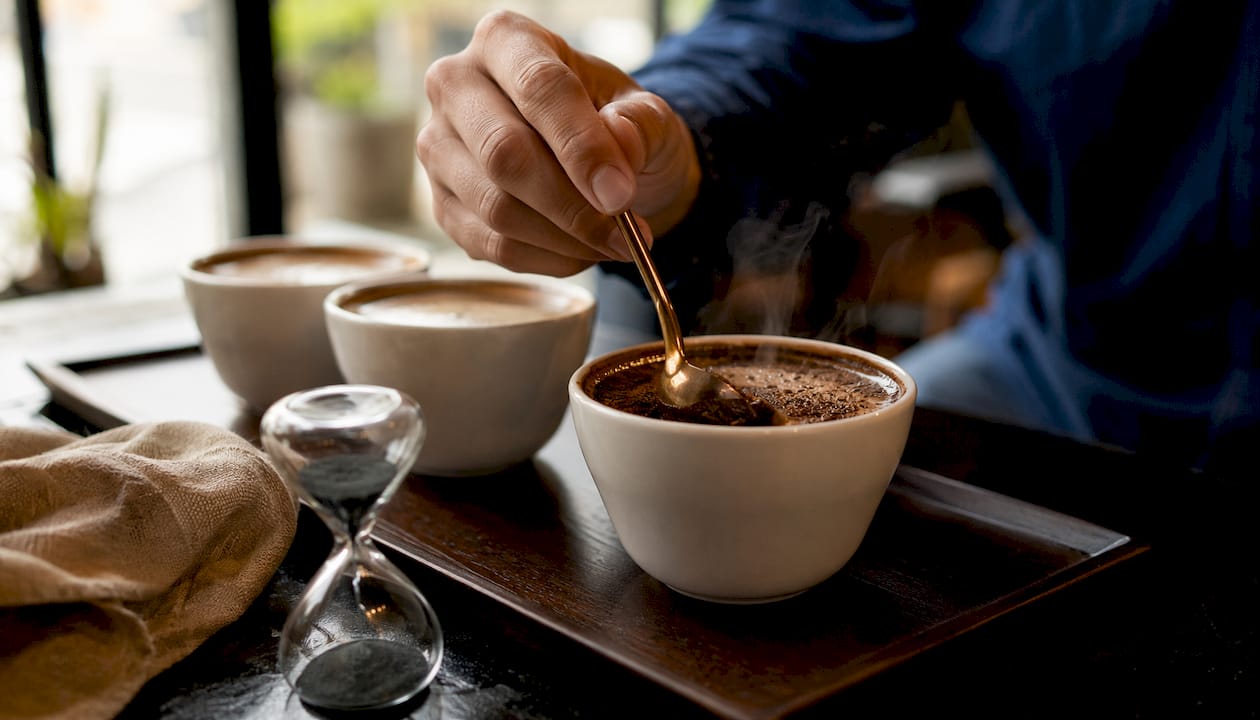
What separates cupping from casual tasting is its purpose. This is not about whether you personally enjoy a cup. It is a descriptive, repeatable assessment designed to minimize individual bias and produce results that professionals across the supply chain can compare and act on.
Here is what cupping accomplishes in practice:
- Quality control: Roasters verify batch uniformity and confirm that a roast profile is hitting its intended flavor targets.
- Procurement decisions: Green coffee buyers evaluate lots before committing to purchase.
- Roasting calibration: Roasters use cupping feedback to fine-tune development time and temperature curves.
- Palate development: Baristas, Q Graders, and students train their sensory vocabulary through repeated, structured sessions.
- Producer evaluation: Farmers and mill operators assess their own crop quality before it reaches export.
The SCA scoring form evaluates ten categories: fragrance/aroma, flavor, aftertaste, acidity, body, balance, uniformity, cleanliness, sweetness, and overall impression. Every number on that form carries weight.
Table of Contents
- How to cup coffee the right way
- Who actually cups coffee, and why?
- Common mistakes that ruin a cupping session
- What your senses are actually evaluating
- The equipment you need for a proper cupping session
- How coffee cupping became a global standard
- Advanced insights: the crust break and objective assessment
- Professional cupping vs. casual tasting: what actually differs
- Font-mag brings specialty-grade coffee to your door
- Key Takeaways
How to cup coffee the right way
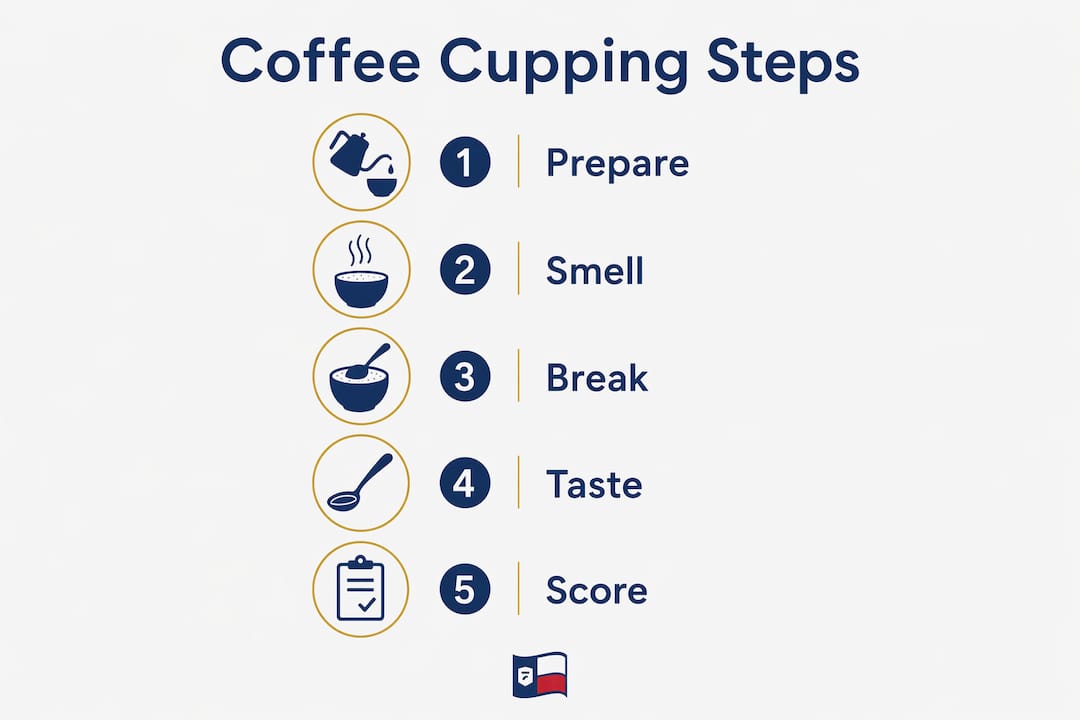
The cupping coffee technique follows a precise sequence. Shortcuts at any stage compromise the results.
Sample preparation
- Roast samples within a window before cupping to ensure consistent degassing.
- Weigh each sample carefully. The SCA standard ratio is 8.25g of coffee per 150mL of water; while some professionals may slightly adjust for grinder precision, maintaining the same ratio across cups is crucial for consistent results.
- Grind immediately before brewing. Use a medium-coarse grind appropriate for cupping.
- Purge the grinder with 2–3 grams of the next sample before grinding the main batch. Skipping this step bleeds residual flavors from the previous coffee into your sample.
Brewing and steeping
- Pour water just off boiling temperature directly onto the grounds in a single, even pour.
- Let the coffee steep for exactly 4 minutes. Do not stir, swirl, or disturb the crust.
Breaking the crust
- At the 4-minute mark, use your cupping spoon to break the crust with three gentle strokes, pushing the grounds to the back of the cup.
- Lean in and inhale deeply the moment the crust breaks. This is the peak aromatic release, and it tells you more about the coffee’s freshness and character than almost any other moment in the session.
Tasting
- After skimming the foam and grounds from the surface, wait for the coffee to cool to around 160°F before tasting.
- Load the spoon and slurp forcefully. The goal is to spray the coffee across your entire palate and force aromatic compounds up through the retronasal pathway to your nose. A quiet, polite sip misses most of what makes cupping work.
- Taste the coffee again as it cools to room temperature. Flavor profiles shift significantly, and some defects only appear at lower temperatures.
Recording scores
- Use SCA cupping forms to score each attribute immediately after evaluating it. Do not rely on memory.
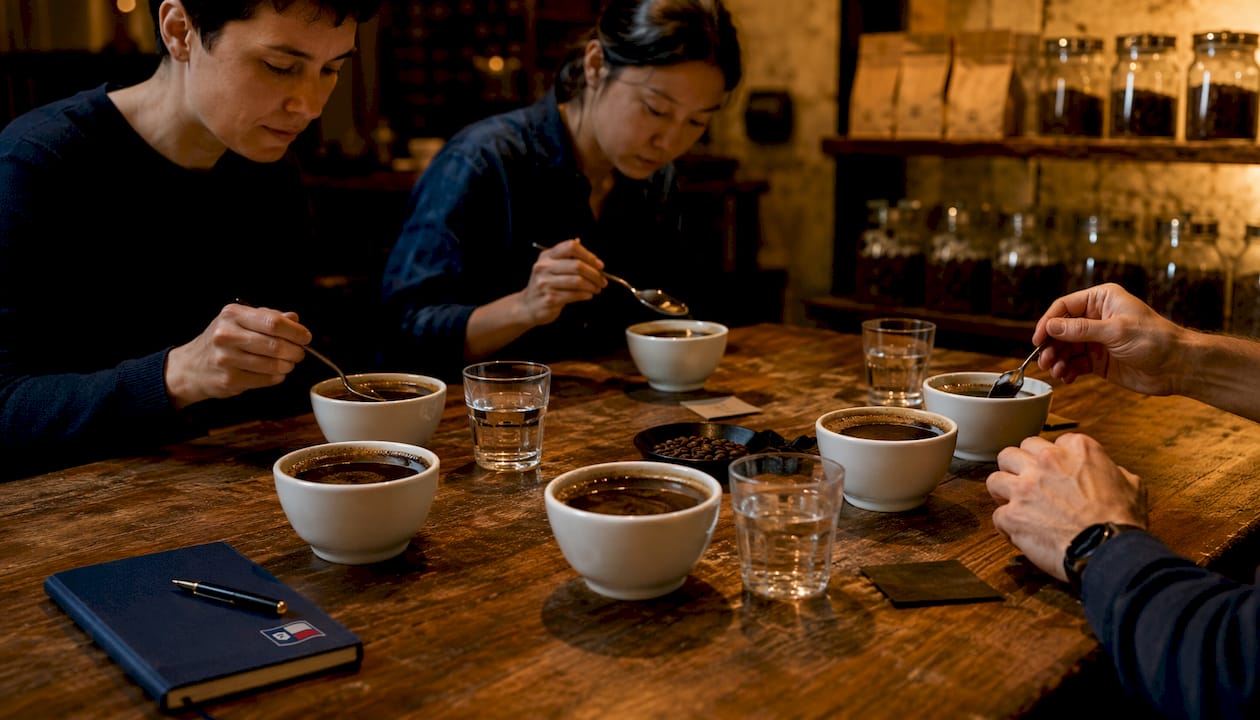
Pro Tip: Set up your cups in a U-shape and move around the table in the same direction every pass. This keeps your tasting order consistent and prevents you from accidentally favoring or penalizing a sample based on where it sits.
Who actually cups coffee, and why?
Cupping draws professionals from every point in the supply chain, each with a distinct reason to be at the table.
- Roasters cup to verify that each batch matches the intended roast profile and to catch defects before coffee reaches customers.
- Green coffee buyers use cupping to evaluate lots from origin before purchasing, often cupping dozens of samples in a single session to narrow a selection.
- Q Graders are licensed professionals trained and certified by the Coffee Quality Institute to score coffee using SCA methodology. They cup to calibrate their palates and produce scores that carry recognized trade authority.
- Baristas and café managers cup to understand the coffees they serve, identify which origins or roast levels suit their menu, and sharpen their ability to describe flavor to customers.
- Producers and mill operators cup their own harvests to assess crop quality, identify processing defects, and benchmark against market expectations.
- Enthusiasts cup to build sensory vocabulary, compare origins side by side, and develop a more precise understanding of what they taste in the cup every morning.
Understanding coffee processing methods deepens what you notice at the cupping table. A washed Ethiopian and a natural Ethiopian from the same farm will cup dramatically differently, and knowing why makes you a sharper evaluator.
Common mistakes that ruin a cupping session
Most cupping errors are procedural, and they are easy to avoid once you know what to watch for.
- Wrong roast level: Cupping a very dark roast obscures origin characteristics behind roast-driven bitterness. SCA protocol calls for a medium roast specifically to let the coffee’s inherent qualities come through.
- Skipping the grinder purge: Without purging, flavors from the previous sample contaminate the next one. Even a few grams of residual coffee in the burr chamber can skew your results.
- Inconsistent ratios or timing: Varying the coffee-to-water ratio between cups, or letting some cups steep longer than others, makes comparison meaningless. Every variable must be identical.
- Not slurping: A polite sip delivers coffee only to your taste buds. The slurp aerosolizes the liquid and routes volatile compounds through your retronasal pathway, where most flavor perception actually happens.
- Noisy or distracting environment: Cupping requires concentration. Conversations, strong perfumes, and background noise all compromise sensory focus.
- Too few samples: Evaluating a single cup of a coffee cannot reveal defects that appear inconsistently. Cupping at least two cups per sample catches variation that one cup would hide.
- Skipping methodical scoring: Tasting without recording scores in real time leads to blurred impressions. Fill out the form as you go, not after.
What your senses are actually evaluating
The sensory attributes in cupping are assessed in a specific sequence that mirrors how the coffee reveals itself.
Aroma stages
Aroma is evaluated three times: dry grounds before brewing, the wet crust during steeping, and the open cup after breaking. Each stage releases different volatile compounds. The dry fragrance often shows roast character; the wet aroma reveals more delicate floral or fruit notes.
Taste components
- Acidity: Brightness, liveliness, the quality that makes a coffee feel alive on the palate. Not sourness. A well-structured acidity is a positive attribute.
- Sweetness: The natural sugars present in well-processed, properly roasted coffee. Sweetness balances acidity and bitterness.
- Bitterness: Present in all coffee to some degree. At low levels it adds complexity; at high levels it signals over-roasting or over-extraction.
- Flavor complexity: The range and integration of taste and aroma notes. Does the coffee taste like one flat note, or does it develop and shift as you taste it?
Mouthfeel
Body describes the physical weight and texture of the coffee on your tongue. A Sumatran natural-process coffee tends toward heavy, syrupy body. A light-roast Kenyan washed coffee often feels thinner but more vibrant. Aftertaste, the finish that lingers after swallowing, is scored separately and can be clean, long, bitter, or sweet.
Building sensory vocabulary for specialty coffee is a skill that compounds over time. The more coffees you cup with intention, the more precisely you can name what you are tasting.
The equipment you need for a proper cupping session
The standard cupping setup is deliberately simple. Uniformity matters more than sophistication.
- Cupping vessels: Identical glass or ceramic cups, typically 7–9 oz. in size. Using mismatched cups introduces variables in heat retention and extraction that skew results.
- Cupping spoons: Short-handled soup spoons work well. The bowl should hold enough coffee for a single slurp.
- Spittoons: One per cupper, or shared between two. Spitting between samples keeps your palate fresh and your head clear through a long session.
- Scale: A gram-accurate scale is non-negotiable. Eyeballing your dose produces inconsistent ratios.
- Grinder: A burr grinder capable of a consistent medium-coarse grind. Blade grinders produce uneven particle sizes that extract unevenly.
- Hot water source: A gooseneck kettle with temperature control, or a commercial hot water tower. Target 200°F / 93°C.
- Cupping forms: SCA-format scoring sheets, either printed or digital. These are the record of your evaluation.
- Sample trays: Useful for organizing multiple coffees and keeping roasted samples labeled before grinding.
For home cuppers exploring brewing techniques, you can run a solid session with basic kitchen equipment. The principles hold even when the setup is modest.
How coffee cupping became a global standard
Cupping did not begin as a formal protocol. Early coffee traders tasted informally to detect defects and estimate value, much the way wine merchants have always worked. The practice was intuitive, inconsistent, and entirely dependent on the individual taster’s experience.
The shift toward standardization accelerated with the rise of the specialty coffee movement in the 1970s and 1980s. The Specialty Coffee Association of America (SCAA), which later merged with the Specialty Coffee Association of Europe to form the current SCA, developed a formal cupping protocol that gave the industry a shared language. Numeric scoring, defined attribute categories, and controlled brewing parameters replaced the old “I know quality when I taste it” approach.
That standardization did more than improve consistency. It created a framework for trade. A Q Grader score on a lot of green coffee carries recognized authority across borders because the methodology behind it is identical whether the cupping happens in Portland, Oslo, or Bogotá. The SCA protocol is now the backbone of the specialty coffee market structure worldwide.
Advanced insights: the crust break and objective assessment
Two elements separate competent cupping from genuinely precise evaluation.
The crust break
The crust that forms during steeping traps CO2 and volatile aromatic compounds. When you break it at the 4-minute mark, those compounds release in a concentrated burst. This moment is the most intense aromatic expression the coffee will produce during the session. Novices often break the crust casually and move on. Experienced cuppers stop, lean in, and spend several seconds evaluating what they smell before the volatiles dissipate. A coffee that smells flat or fermented at crust break is telling you something critical about its freshness or processing quality.
Objective assessment over personal preference
The SCA protocol is built around descriptive, repeatable evaluation. The question is never “do I like this?” It is “what is this coffee doing, and how well is it doing it?” That distinction matters practically: a cupper who scores based on personal preference will rate a bright, acidic Ethiopian lower than a heavy, chocolatey Brazilian simply because they prefer the latter. A calibrated cupper scores both accurately and lets the numbers reflect the coffee’s actual quality.
Panel calibration
When multiple cuppers evaluate the same coffee, their scores should align within a narrow range. Significant divergence signals that someone’s palate is off, or that the session conditions were inconsistent. Professional cupping panels recalibrate regularly, often by cupping the same reference coffee at the start of each session.
Pro Tip: Cup the same coffee twice in the same session without knowing which cup is which. If your scores diverge significantly, your palate needs recalibration before you trust your evaluations.
- Ratio consistency across all cups is non-negotiable for valid comparison.
- Grinder purge with 2–3 grams of the next sample before grinding to prevent cross-contamination.
- Slurping is not optional. Retronasal olfaction is where most flavor perception occurs.
- Score in real time. Memory distorts impressions within minutes.
Professional cupping vs. casual tasting: what actually differs
The gap between a professional cupping session and sitting down with a good cup of coffee is wider than most people expect.
Casual tasting is experiential. You brew a coffee, you drink it, you notice whether you enjoy it. Your mood, the temperature of the room, what you ate an hour ago, and whether you slept well all influence your impression. That is fine for personal enjoyment. It produces no transferable data.
Professional cupping controls for every variable it can. Same ratio, same grind, same water temperature, same steeping time, same tasting sequence, same form. The goal is to produce a score that another trained cupper, in another city, using the same protocol, would arrive at independently. That reproducibility is what makes cupping useful as a trade and quality-control tool.
The vocabulary also differs. Casual tasters reach for broad descriptors: “smooth,” “strong,” “fruity.” Professional cuppers use a calibrated sensory lexicon, often referencing the SCA Coffee Taster’s Flavor Wheel, which maps hundreds of specific descriptors across aroma, taste, and texture categories. Saying a coffee has “red currant acidity with a brown sugar sweetness and a medium-light body” communicates something precise and actionable. “Tastes good” does not.
Knowing why freshness matters in coffee also sharpens what you notice during any tasting, formal or casual. Freshness is not a preference. It is a measurable quality variable.
Font-mag brings specialty-grade coffee to your door
If cupping has sharpened your sense of what great coffee actually tastes like, the next step is having the right coffees to work with. Font-mag’s retail coffee collection is built around small-batch, specialty-grade offerings sourced and roasted with the same attention to quality that cupping is designed to reveal.
Font-mag is not just a coffee roaster. The lineup includes specialty offerings that go well beyond the bag: vibrant Japanese matcha, premium loose-leaf teas from MAG Tea, and the Sweetbird collection of syrups and café essentials. Whether you are building a home cupping kit or stocking a café, Font-mag ships fast, with free delivery on orders over $35. Browse the full range and find something worth tasting.
Key Takeaways
Coffee cupping is a standardized, objective sensory evaluation protocol developed by the SCA to assess quality attributes across ten scored categories, with specialty grade beginning at 80 out of 100.
| Point | Details |
|---|---|
| SCA scoring scale | Coffees scoring 80+ qualify as specialty grade; scores above 90 indicate exceptional quality. |
| Ratio consistency | The SCA standard is 8.25g of coffee per 150mL of water; the ratio must stay identical across every cup. |
| Crust break timing | Breaking the crust at 4 minutes captures peak aromatic release, the clearest freshness signal in the session. |
| Slurping is technique | Forceful slurping aerates coffee and routes compounds through the retronasal pathway for full flavor perception. |
| Font-mag specialty range | Font-mag’s retail and specialty collections offer small-batch coffees and premium beverages worth cupping at home. |
Recommended
- Farm to Cup Texas Coffee Guide for True Enthusiasts – Font Coffee Roasters
- Coffee Roast Levels Explained: A Flavor Guide for Enthusiasts – Font Coffee Roasters
- What Is Coffee Extraction and How It Shapes Flavor – Font Coffee Roasters
- Coffee Processing Methods Explained for Every Brewer – Font Coffee Roasters