

Why Freshness Matters in Coffee: Flavor Science Explained
Coffee freshness is defined by the concentration of volatile aromatic compounds preserved in the bean after roasting, and losing those compounds means losing the flavor, complexity, and aroma that make specialty coffee worth drinking. Why freshness matters in coffee comes down to chemistry: oxygen, light, and heat begin degrading those compounds the moment a bag is opened. The difference between a cup brewed from a freshly roasted bean and one from a bag that has been sitting on a shelf for two months is not subtle. It is the difference between a wine and a vinegar.
Why freshness matters in coffee: the chemistry behind the cup
Coffee’s flavor is not a single compound. It is the result of hundreds of volatile aromatic molecules produced during roasting, including furans, pyrazines, and sulfur compounds, that interact to create what you recognize as a great cup. The moment roasting ends, those compounds begin to escape or transform.
The most measurable sign of this degradation is the rise of aldehydes such as hexanal. Lipid oxidation produces hexanal as a direct byproduct of oxygen exposure, and its increase tracks closely with aroma deterioration. Researchers now use these compounds as freshness biomarkers, giving the specialty coffee industry an objective chemical tool to assess quality beyond taste alone.
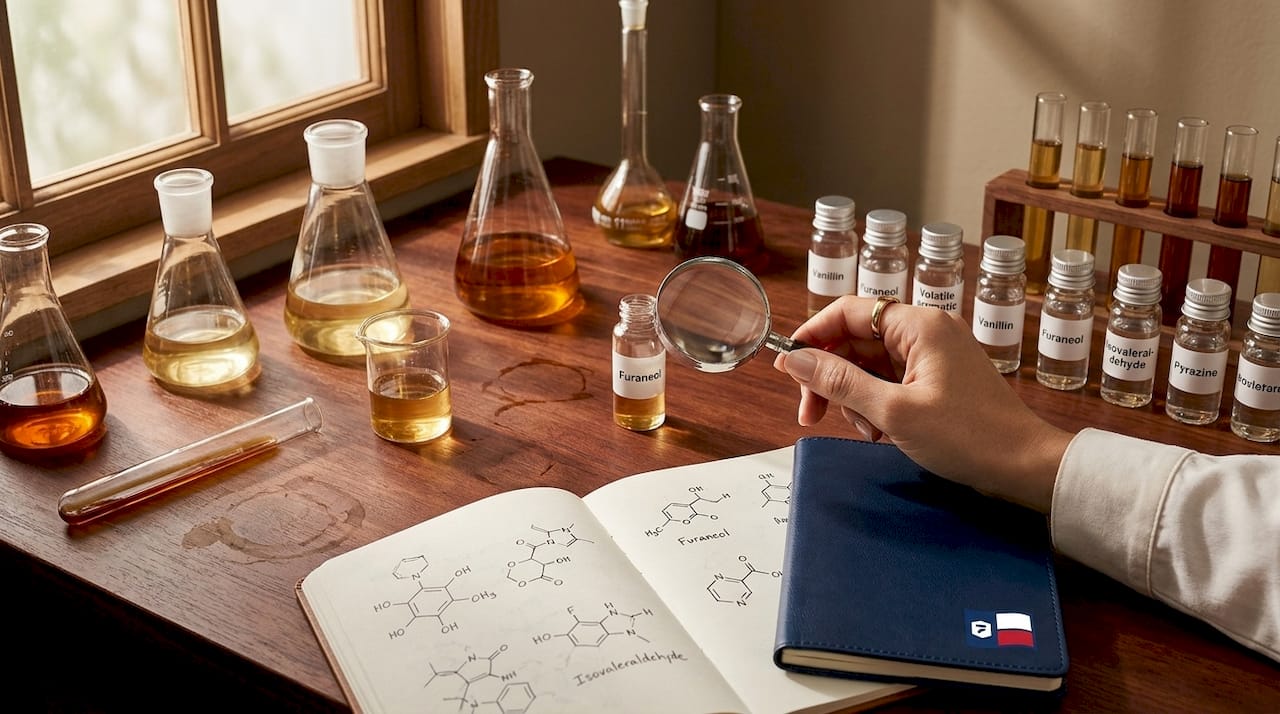
What makes this particularly interesting is the nature of staling itself. Coffee staling is not simple flavor loss. It is a shift in the balance of volatile compounds, which is why a stale coffee can still taste like coffee but lacks the layered sweetness, brightness, and complexity that define a well-sourced, freshly roasted bean. You lose the top notes first. The cup becomes flat, then bitter, then one-dimensional.
The sensory changes follow a predictable arc:
- Aroma reduction: The first and most immediate loss. Volatile compounds escape through the bean’s porous surface.
- Sweetness muting: Fruity and caramel-adjacent notes fade as the aromatic balance shifts.
- Bitterness increase: As complexity drops, bitterness becomes more prominent, often mistaken for a brewing problem.
- Flat finish: The aftertaste shortens and loses distinction.
“Staling is not about coffee becoming undrinkable. It is about coffee becoming ordinary. And for anyone who has tasted a truly fresh cup, ordinary is a significant loss.” — Lincoln Bechard, coffee educator
What causes coffee to lose its freshness?
Four factors drive freshness degradation: oxygen, light, heat, and moisture. Each attacks the bean through a different mechanism, and together they can render a quality roast unremarkable within days.
Oxygen is the primary enemy. Oxidation begins the moment roasted beans are exposed to air, triggering the lipid degradation chain that produces off-flavor aldehydes. This is why the industry developed one-way valve bags, which allow CO2 to escape after roasting without letting oxygen in.
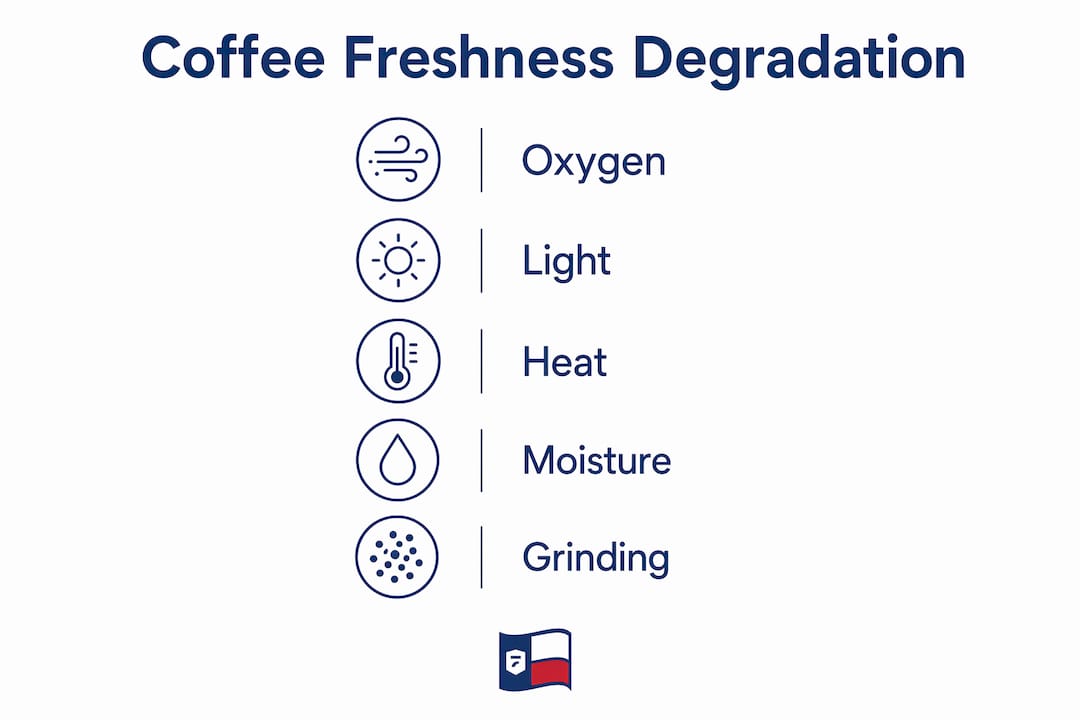
Light accelerates chemical reactions in the bean, particularly photo-oxidation. UV exposure is especially damaging, which is why airtight, opaque containers are the standard recommendation from coffee educators. A clear glass jar on a sunny counter is one of the fastest ways to stale a good bag of beans.
Heat increases the rate of nearly every chemical reaction involved in staling. Storing coffee near an oven, on top of a refrigerator, or in a cabinet above a stove shortens its useful life significantly.
Moisture causes clumping in ground coffee and can promote mold in whole beans. It also accelerates oxidation by acting as a reaction medium.
The degradation rate is not equal across formats. Consider this progression:
- Whole beans in a sealed bag: freshest, slowest to degrade
- Whole beans after opening: peak flavor for about 1 week according to 2026 guidance
- Ground coffee: degrades significantly faster due to increased surface area exposed to air
- Pre-ground coffee in retail packaging: often already stale before purchase
Ground coffee has dramatically more surface area than whole beans, which means oxidation happens faster across every particle simultaneously. This single fact explains why pre-ground coffee, regardless of origin or roast quality, almost always underperforms freshly ground beans from the same source.
How to preserve coffee freshness at home
Preserving freshness at home requires three habits: proper storage, whole-bean purchasing, and grinding immediately before brewing.
- Store in an airtight, opaque container in a cool, dark cabinet. A ceramic canister with a rubber-sealed lid outperforms a clear glass jar every time. Excluding air and limiting light protects the aromatic compounds that define flavor.
- Buy whole beans and grind only what you need per session. Pre-ground coffee sacrifices freshness for convenience, and the trade-off is not worth it if flavor is your priority.
- Purchase in quantities you will use within two weeks of opening. Buying a 2-pound bag to save money makes no sense if the last half sits stale for a month.
- Avoid the freezer for daily-use coffee. Freezing works for long-term storage of sealed, unopened bags, but repeated freeze-thaw cycles introduce moisture and accelerate degradation.
- Check roast dates, not expiration dates. A bag with a roast date from six months ago is stale regardless of the “best by” label.
Pro Tip: Apply the 15-15-15 rule: green beans stay fresh for 15 months, roasted whole beans for 15 days after opening, and the window from grind to brew should be within 15 minutes for the best flavor. Industry roaster Matt Killen developed this framework as a practical guide to coffee freshness timelines that enthusiasts can actually follow.
Retail coffee vs. local roasters vs. roasted-to-order: a freshness comparison
Where you buy your coffee determines how fresh it can realistically be when it reaches your grinder. The supply chain matters as much as the roast quality.
| Source | Typical time from roast to consumer | Freshness outcome |
|---|---|---|
| Supermarket retail | 2 to 6 months | Often stale before purchase |
| Local roaster (in-store) | Days to 2 weeks | Fresh, especially with high turnover |
| Roasted-to-order online | Roasted after order placed | Maximum freshness at delivery |
Retail coffee often reaches consumers weeks or months after roasting, which means the flavor complexity you are paying for has already degraded before the bag is opened. The Daily Grindhouse has built its model specifically around closing this gap, emphasizing roastery-to-consumer timing as the defining freshness variable.
Locally roasted coffee offers a genuine freshness advantage because the supply chain is shorter. A roaster selling directly from their facility or through a tight local distribution network can get beans to you within days of roasting. That timing difference is not marginal. It is the difference between a coffee at peak expression and one that has already passed it.
Roasted-to-order models take this further by not roasting until an order is placed. For enthusiasts who care about the freshness impact on coffee flavor, this model removes the guesswork entirely. Font-mag’s Broken Arrow Reserve follows this philosophy, with small-batch roasting and fast fulfillment designed to minimize the time between roast and your first brew.
Does grinding timing affect freshness and cup quality?
Grinding timing is one of the most underrated freshness variables in home brewing. When you grind coffee, you shatter the bean’s structure and expose an enormous amount of new surface area to oxygen all at once. The aromatic compounds that were protected inside the bean are now fully exposed and begin escaping immediately.
Grinding just before brewing preserves the aroma and flavor complexity that pre-ground coffee has already lost. The aroma you smell when you grind fresh beans is not just pleasant. It is evidence of volatile compounds that will translate directly into cup flavor. If those compounds escape before brewing, they are gone.
Pro Tip: If you do not own a burr grinder yet, a Baratza Encore or Fellow Opus is worth the investment. Blade grinders produce uneven particle sizes that affect extraction consistency, compounding the freshness problem with a brewing problem.
The relationship between grinding and aroma release is direct: grinding unlocks the aromatic signature of the bean, and brewing immediately captures it. Waiting even 30 minutes after grinding results in a measurably less aromatic cup. For origin-forward coffees where floral, fruit, or terroir notes are the point, grinding timing is not optional. It is the practice.
Key takeaways
Coffee freshness is the single most controllable variable between a flat, forgettable cup and one that delivers the full aromatic and flavor complexity the roaster intended.
| Point | Details |
|---|---|
| Freshness is chemical, not subjective | Volatile compound loss and aldehyde buildup are measurable markers of staling, not just taste opinions. |
| Whole beans outlast ground coffee | Whole beans stay fresh for about 1 week after opening; ground coffee degrades significantly faster. |
| Storage method determines shelf life | Airtight, opaque containers in cool, dark spaces protect aromatic compounds from oxygen, light, and heat. |
| Grind immediately before brewing | Grinding just before brewing preserves the volatile aroma that defines cup complexity and flavor. |
| Source timing shapes freshness | Roasted-to-order and local roasters deliver fresher coffee than retail, where delays of months are common. |
The freshness habit most enthusiasts skip
I have tasted thousands of cups across dozens of origins, and the single most consistent finding is this: most enthusiasts over-invest in brewing equipment and under-invest in freshness habits. A $1,200 espresso machine cannot rescue a bag of beans that has been open for three weeks sitting next to the stove.
The shift that changes everything is treating coffee like produce. You would not buy a week’s worth of strawberries and leave them on the counter. The same logic applies to an open bag of beans. Once that seal is broken, the clock is running.
What I find most compelling about the 2026 research on volatile biomarkers is that it validates what experienced tasters have always known intuitively. Staling is not dramatic. It is subtle and cumulative. You do not notice the day your coffee goes stale. You just notice, one morning, that the cup is not as good as it used to be. By then, you have already lost a week of great coffee.
The practical fix is not complicated. Buy less, more often. Store it properly. Grind it fresh. Source from roasters who prioritize timing. These habits cost nothing extra and return more flavor than any equipment upgrade I have seen. If you are serious about the cup, start with the freshness fundamentals before you spend another dollar on gear.
— Rosario
Experience peak freshness with Font-mag
Font-mag was built on the principle that freshness is not a marketing claim. It is a commitment that shows up in every step from roast to your door. Our freshly roasted coffee collection includes small-batch offerings like the Broken Arrow Reserve, sourced and roasted with timing precision so you receive beans at their peak. For those who prefer a caffeine-free option without sacrificing quality, our decaf selection applies the same freshness standards. Beyond coffee, Font-mag also carries vibrant Japanese matcha, MAG Tea loose-leaf selections, and Sweetbird syrups, because peak freshness matters across every cup you brew. Orders over $35 ship free, with fulfillment designed to get fresh product to you fast.
FAQ
How long does coffee stay fresh after opening?
Whole beans stay at peak flavor for about 1 week after opening when stored properly. Ground coffee loses freshness faster due to greater surface area exposure to oxygen.
What is the biggest enemy of coffee freshness?
Oxygen is the primary driver of coffee staling, triggering lipid oxidation that produces off-flavor aldehydes and reduces aromatic complexity. Light and heat accelerate the same process.
Does grinding coffee affect how fresh it tastes?
Grinding exposes the bean’s interior to oxygen and releases volatile aroma compounds immediately. Grinding just before brewing captures those compounds in the cup rather than letting them dissipate into the air.
Is locally roasted coffee fresher than supermarket coffee?
Locally roasted coffee typically reaches consumers within days of roasting, while retail coffee often sits in the supply chain for two to six months. That timing gap directly determines flavor quality.
What container is best for storing coffee beans?
An airtight, opaque container stored in a cool, dark cabinet is the most effective option. Clear glass jars and containers stored near heat sources accelerate oxidation and shorten freshness life.