

Why Locally Roasted Coffee Is Fresher and Tastes Better
Walk into any specialty café and ask why locally roasted coffee is fresher than what sits on a supermarket shelf, and most baristas will say something about “roast date.” That answer is true, but it barely scratches the surface. The real story is chemistry: hundreds of volatile aromatic compounds formed during roasting that begin degrading from the moment the beans cool. The shorter the distance between the roaster and your grinder, the more of those compounds survive intact. This article breaks down the science, the supply chain realities, and what you can actually do to taste the difference.
Table of Contents
- Key Takeaways
- Why locally roasted coffee is fresher: the chemistry behind it
- How time and oxygen steal your coffee’s flavor
- Local coffee vs commercial: what the supply chain difference actually means
- Getting the most from fresh, locally roasted beans
- My take: freshness is not a marketing word
- Discover fresh-roasted coffee at Font-mag
- FAQ
Key Takeaways
| Point | Details |
|---|---|
| Freshness is a chemistry problem | Aromatic compounds degrade through oxygen exposure and time, so fewer days between roast and brew means better flavor. |
| Local roasting cuts exposure time | Shorter transit from roaster to your door reduces the oxygen and heat exposure that cause aroma loss. |
| Roast date beats best-by date | Coffee does not improve past two to three weeks; always check the roast date, not just the expiration date. |
| Storage matters as much as sourcing | Airtight, cool, dry storage is non-negotiable for preserving what local roasting delivers. |
| Local goes beyond freshness | Choosing a local roaster also supports sustainable supply chains, community businesses, and lower transport emissions. |
Why locally roasted coffee is fresher: the chemistry behind it
To understand freshness of roasted coffee, you first need to know what you are actually tasting. Green coffee beans contain hundreds of chemical precursors. Heat does not just dry them out; it transforms them through a series of reactions that create entirely new compounds. The industry term for this transformation is thermal degradation and formation of volatile aromatic compounds, but most roasters simply call it developing the roast profile.
The two most consequential reactions are the Maillard reaction and Strecker degradation. The Maillard reaction occurs between amino acids and reducing sugars at temperatures above roughly 280°F, producing hundreds of volatile compounds including pyrazines, furans, and aldehydes. Pyrazines give you that roasted, nutty character. Furans contribute caramel and sweet notes. Strecker degradation takes those same amino acids further, generating additional aldehydes that round out the aroma profile.
Thiols deserve special attention because they are responsible for the sulfurous, roasty top notes that distinguish a cup of truly fresh coffee from anything else. Volatile compound concentration peaks around a medium roast and then begins declining. Push too dark, and you burn off the very compounds that make specialty coffee worth the price.
- Pyrazines: Earthy, roasted, nutty notes formed through the Maillard reaction.
- Thiols: Sulfury, pungent top notes that signal peak freshness and fade fastest.
- Aldehydes: Sweet, floral, and fruity undertones from Strecker degradation.
- Furans: Caramel and toffee aromas that define medium roast sweetness.
- Acids: Bright, citrusy notes tied to the origin character of the bean.
There is also a physical freshness indicator most people notice without understanding it: the bloom. When you pour hot water over freshly roasted grounds, CO2 releases through degassing, causing the coffee bed to expand and bubble. That bloom is literally the gas produced during roasting escaping the bean structure. No bloom means most of that gas, and much of the volatile aroma, is already gone.
Pro Tip: When buying whole beans, gently press on the bag’s one-way valve. If you smell an intense, layered aroma rush out, the beans are genuinely fresh. Flat or faintly sweet smells indicate staling has already begun.
How time and oxygen steal your coffee’s flavor
Understanding why local roasting matters so much requires one key concept: lipid oxidation. Coffee beans are rich in oils, and those oils are the carriers for aromatic compounds. Once oxygen gets to them, oxidation begins immediately. The result is a flat, cardboard-like taste that no brewing technique can fix.
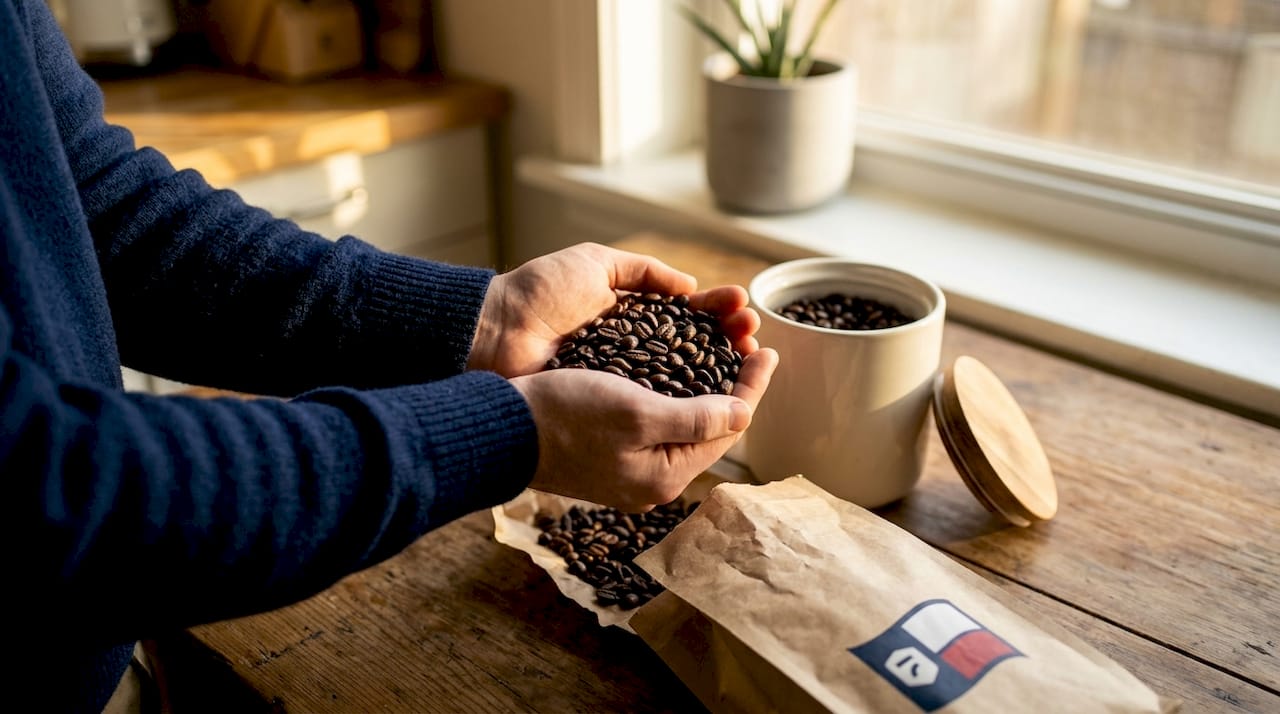
Oxygen exposure and time drive lipid oxidation so aggressively that the difference between a two-day-old roast and a three-week-old roast is not subtle. It is the difference between a cup that tastes alive and one that tastes like it has been sitting in a break room.
Here is how the degradation timeline generally plays out after roasting:
- Days 1 to 3: CO2 is still actively releasing. The coffee can taste sharp or slightly harsh. Most roasters recommend waiting 24 to 72 hours before brewing.
- Days 4 to 14: Peak flavor window. Volatile compounds are still intact, the bloom is strong, and the full aroma profile is accessible.
- Days 15 to 30: Noticeable drop in aroma intensity. Thiols fade first. The cup becomes less complex and more one-dimensional.
- Beyond 30 days: Significant staling. Coffee beyond 2 to 3 weeks will not improve regardless of how carefully you store or brew it.
Mass-market coffee frequently sits in distribution centers and on store shelves for 60 to 90 days post-roast. That is not a guess; it is the structural reality of large-scale distribution. A local roaster can get beans to you within days of roasting. That gap is the entire argument for choosing local.
Storage is where many coffee lovers lose the gains they made by sourcing fresh. Paper bags allow moisture ingress even when the coffee arrived fresh. Refrigerators introduce condensation every time you pull the bag out. The right container is an airtight canister kept in a cool, dark cabinet. Buy in two-week quantities so you are never sitting on old beans.
You can read more about the specific mechanics behind staling in this detailed breakdown of why coffee goes stale.
Local coffee vs commercial: what the supply chain difference actually means
The flavor gap between locally roasted coffee and commercial shelf coffee is not about the roaster’s skill in isolation. It is about time. But the comparison runs deeper than freshness.
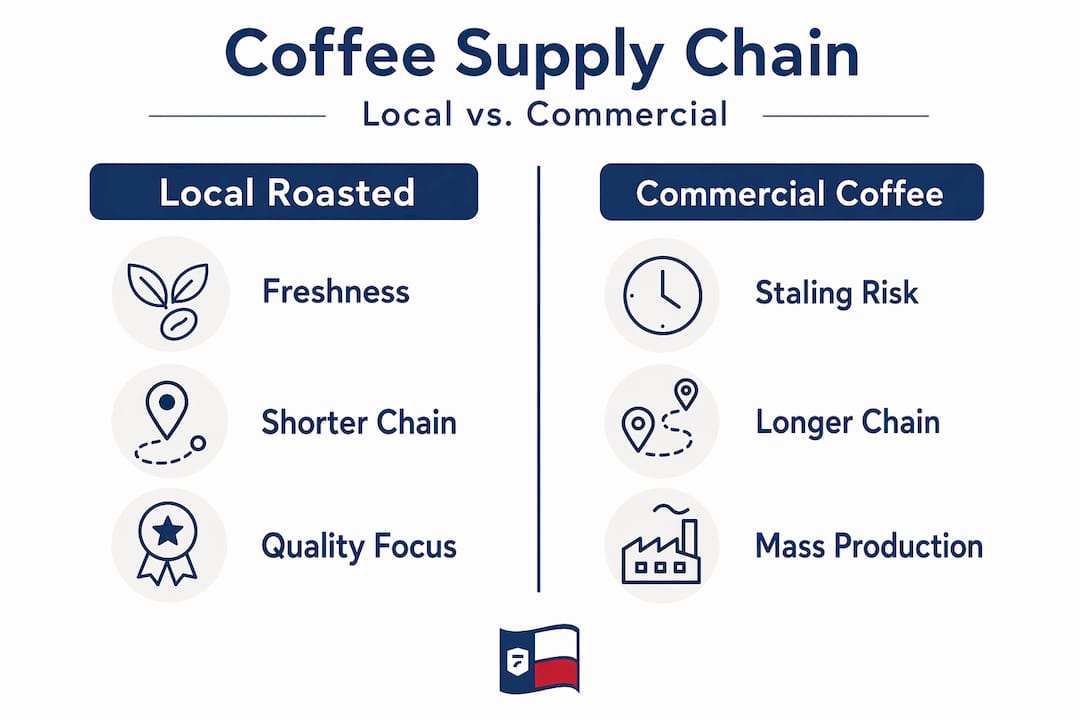
| Factor | Locally Roasted Coffee | Commercial/Mass-Market Coffee |
|---|---|---|
| Time from roast to consumer | 1 to 7 days (typical) | 30 to 90+ days |
| Oxygen exposure window | Minimal | Extended during shipping and storage |
| Traceability | Often single-origin, lot-level | Blended from multiple origins |
| Roast batch size | Small-batch, dial-adjusted | Large-scale, less adaptable |
| Environmental impact | Shorter supply chain, lower transport emissions | Higher carbon footprint from global logistics |
| Community benefit | Supports local economy | Revenue flows to large corporations |
Shorter supply chains minimize the two biggest enemies of coffee quality: oxygen exposure and heat accumulation during transport. A pallet of roasted coffee sitting in a shipping container crossing the Atlantic is experiencing both, continuously.
Local roasters also tend to operate with a different philosophy around sourcing. Because their reputation depends on every bag they sell, many build direct relationships with farms or work through trusted importers who can provide lot-specific information. You know exactly where your coffee came from, when it was harvested, and how it was processed. That traceability is rarely available from mass-market brands.
Beyond freshness, there is a sustainability case for choosing local. Customers who receive coffee roasted that same morning from a local supplier describe a tangible quality difference compared to supermarket stock. That real-world feedback aligns directly with the chemistry.
Pro Tip: Ask your local roaster for the roast date before you buy, not just the “best by” date. Any roaster worth their craft will tell you exactly when the batch was roasted. If they cannot or will not, that tells you something important about their priorities.
Getting the most from fresh, locally roasted beans
Knowing that fresh local coffee tastes better is one thing. Consistently getting that experience into your cup requires a few deliberate habits.
Finding the right local roaster starts with asking the right questions about sourcing. Look for roasters who print the roast date on every bag, rotate their inventory frequently, and can describe the origin and processing method of each coffee they offer. Those details signal that freshness and quality are operational priorities, not just marketing language.
- Buy whole beans. Pre-ground coffee loses volatile compounds dramatically faster once the protective structure of the bean is broken. Grind immediately before brewing.
- Match your brew method to the roast age. Espresso typically benefits from beans that are 5 to 10 days post-roast, while filter coffee often shines at 4 to 8 days.
- Use a scale. Freshly roasted coffee can be more or less dense than older beans depending on degassing. Weighing your dose instead of scooping removes that variable.
- Try a subscription. A well-structured local coffee subscription means you receive beans at the right point in the freshness curve consistently, without having to plan around it.
Once your beans arrive, transfer them to an airtight canister immediately. Keep the canister out of direct sunlight and away from heat sources. Do not freeze unless you are storing beans for longer than a month, and if you do freeze them, let the bag come fully to room temperature before opening to prevent condensation on the beans.
Do not limit your fresh beverage exploration to coffee alone. If you are already invested in quality, Font-mag’s range of premium MAG Tea loose-leaf selections and Japanese matcha offers the same commitment to peak freshness in a completely different format. Great sourcing habits apply across every cup you make.
Pro Tip: If you want to taste the impact of freshness directly, brew the same beans at day 4 and day 21 post-roast using identical parameters. The comparison is more convincing than any article.
My take: freshness is not a marketing word
I’ve spent years tasting coffee at every point in the supply chain, and the single thing that separates a genuinely memorable cup from a forgettable one is almost always freshness. Not origin. Not roast level. Not even brew method.
What surprised me most when I started paying close attention was how quickly staling happens. You can buy outstanding beans from a celebrated origin, store them in a paper bag for three weeks, and produce a cup that tastes duller than a competent medium roast from a good local roaster at peak freshness. The chemistry does not care about the bean’s reputation.
The contrarian position worth making: mass-market brands have gotten better at packaging technology, using nitrogen flushing and one-way valves to slow oxidation. But those technologies buy time. They do not stop the clock. A locally roasted bag that arrives within three days of roasting, stored properly at home, will beat a nitrogen-flushed commercial bag almost every time in direct comparison.
My practical recommendation is simple. Find one local roaster you trust, learn their roast schedule, and build your buying habits around it. Then spend equal attention on how you store and brew. Freshness is perishable. Treat it that way.
— Rosario
Discover fresh-roasted coffee at Font-mag
At Font-mag, freshness is not just a talking point. Built on four generations of Texas craftsmanship, we roast in small batches and ship fast because we know that every day between roast and brew costs you flavor. Our retail coffee collection includes single-origin selections, blends like the celebrated Broken Arrow Reserve, and specialty options roasted to order.
If you want to explore beyond the everyday cup, our flavored coffee collection brings fresh-roasted character to creative, distinctive profiles. Café owners and wholesale buyers can explore our wholesale coffee options with the same commitment to roast-date freshness at scale. Free shipping on all orders over $35. Fresh beans, fast delivery, no compromises.
FAQ
Why is locally roasted coffee fresher than store-bought?
Local roasters ship beans within days of roasting, while commercial coffee typically sits in distribution for 30 to 90 days post-roast. Less time between roast and brew means more volatile aromatic compounds survive intact.
How long does freshly roasted coffee stay fresh?
Coffee quality peaks between 4 and 14 days after roasting and declines noticeably after 3 weeks. Buying local and storing beans in an airtight container keeps them in that peak window longer.
What is the best way to store locally roasted coffee?
Use an airtight canister kept in a cool, dark spot away from heat and moisture. Avoid paper bags, open containers, and refrigerators for short-term storage since each introduces moisture or odor contamination.
Does the roast date matter more than the expiration date?
Yes. Expiration dates on coffee bags are legal requirements, not freshness guides. Always check the roast date on the bag and aim to brew within two weeks of that date for the best flavor.
What chemical compounds make fresh coffee smell so good?
Roasting produces pyrazines, thiols, aldehydes, and furans through Maillard and Strecker reactions. These volatile aromatic compounds define the aroma and flavor of fresh coffee and degrade rapidly with oxygen exposure and time.