

Roast Date and Coffee Quality: Why Freshness Has a Timeline
A roast date puts a bag of coffee on a chemical clock, and that clock predicts when its aroma, acidity, and sweetness will taste the way the roaster intended. Coffee doesn’t hold still after roasting. It degasses, loses volatile compounds, and slowly oxidizes, which means the role of roast date in quality comes down to timing more than most people realize.
Three things to do right now if you want better cups:
- Buy whole bean, not pre-ground, whenever you can.
- Check the roast date on the bag before you check the price.
- Give most coffees a short rest, generally a few days to two weeks, before you brew.
Roast date beats “best by” for judging flavor, mainly because “best by” is a shelf-life marketing figure, not a flavor prediction. A bag can be food-safe for a year and taste flat after six weeks.
Key Takeaways
Roast date determines where a coffee sits on a predictable freshness curve, and matching your brew timing to that curve is the single most reliable lever for better-tasting coffee at home.
| Point | Details |
|---|---|
| Roast date beats best-by | Best-by reflects shelf stability, not flavor peak, so always check the actual roast date. |
| Peak windows vary by process | Washed coffees often peak around day 7, naturals closer to day 11, with day 9 a reasonable default. |
| Degassing drives early change | CO2 loss is most intense in the first 20 days and carries aromatic compounds with it. |
| Roast level shifts timing | Light roasts often need 7 to 14 days to open up, dark roasts often peak within 3 to 5 days. |
| Font-mag ships close to roast date | Font-mag’s specialty coffee subscription and fast shipping help bags arrive while still climbing toward peak. |
Table of Contents
- What Does Roast Date Actually Mean?
- What Happens Inside the Bean After Roasting?
- When Does Coffee Actually Peak After Roasting?
- How Should You Store Coffee to Protect Roast-Date Freshness?
- Does Roast Level Change How Fast Coffee Ages?
- How Do You Brew Around a Bag’s Peak Window?
- Frequently Asked Questions
- Sources
What Does Roast Date Actually Mean?
Roast date is the calendar day the green beans finished roasting, full stop. It’s the single most honest data point on a coffee bag, according to field guidance from Day9, because everything the bean will do chemically from that point forward starts the clock at zero.
“Best by” or “use by” dates are a different animal entirely. Roasters or retailers usually set those to satisfy shelf-stability expectations or retail policy, often 6 to 12 months out, and they say almost nothing about when the coffee will actually taste its best. Distribution channel plays a role too. Direct-to-consumer roasters typically ship within days of roasting, while retail-shelf coffee can sit in a warehouse or on a shelf for weeks or months before it reaches you.
What to look for on a bag:
- “Roast date” or “roasted on”: the actual day of roasting, usually stamped or printed near the seal.
- “Best before” or “best by”: a broad shelf-stability window, not a flavor guarantee.
- No date at all: treat this as a red flag, especially at retail.
At purchase, prioritize a recent roast date, whole bean over ground, and a bag with a one-way degassing valve. Those three details tell you more about eventual cup quality than the label copy ever will.
What Happens Inside the Bean After Roasting?
Roasting doesn’t stop chemistry, it just changes what kind. The moment beans come out of the drum, they start releasing carbon dioxide built up during roasting, a process called degassing, and that CO2 is doing more work than most people assume.
- CO2 forms partly through Strecker degradation during roasting and keeps escaping the bean structure for weeks afterward.
- That gas acts as a carrier for aromatic compounds, so as it escapes, it drags fragrance and flavor volatiles along with it.
- Degassing runs hottest in the first stretch after roast, then tapers off gradually.
Degassing runs most intense during the first few weeks after roasting, according to research summarized by the Specialty Coffee Association, which is why a bag tastes noticeably different in week one than it does in week three. This lines up with work from the Coffee Excellence Center, which found CO2 loss tracks closely with aroma loss, making that early window the most volatile stretch for cup character.
The aromatic compounds themselves form through Maillard reactions and pyrolysis during roasting, the same browning chemistry that gives bread crust its smell. Once the beans cool, those compounds start dissipating into the air or oxidizing on contact with it. Oxidation is slower than degassing but never stops, and it’s the process mainly responsible for the stale, cardboard flavor in coffee that’s sat around too long.
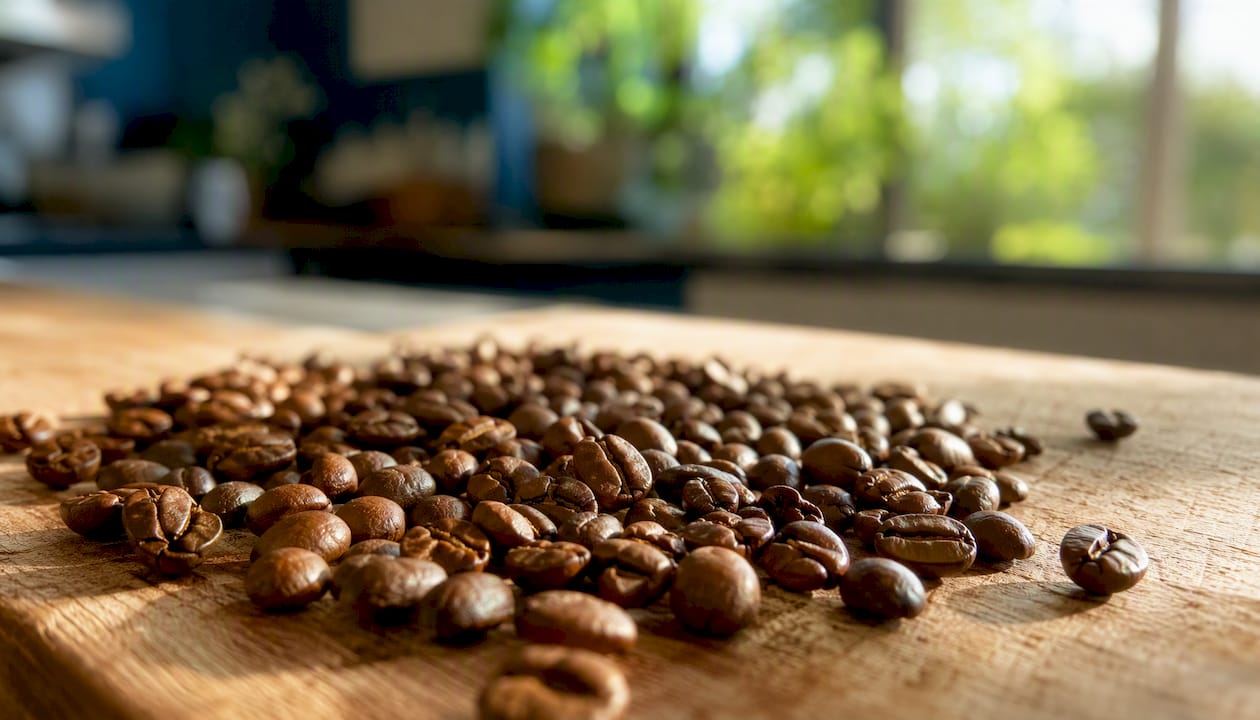
Both processes change how coffee behaves at the brew bar. Fresh, gassy beans produce a thicker bloom and heavier crema on espresso, sometimes to the point of instability, while beans past their degassing peak brew flatter and can taste muted even with correct technique. Grinding accelerates all of this. Whole beans protect their interior chemistry reasonably well; ground coffee exposes vastly more surface area to oxygen, which is why a ground bag ages in days what a whole-bean bag ages in weeks.
When Does Coffee Actually Peak After Roasting?
Peak freshness isn’t a single day, it’s a window, and where that window falls depends on processing, roast level, and how you plan to brew.
| Days after roast | What’s happening in the cup |
|---|---|
| 0–3 days | Heavy CO2 presence, unstable extraction, muted or sharp aromatics |
| 3–14 days | Degassing settling, aromatics opening up, generally the sweet spot for most methods |
| 14 days | Gradual aroma loss, flavors still pleasant but less vivid |
| 1–3 months | Noticeable flattening, oxidation starting to dominate over aromatic complexity |
| Beyond 3 months | Stale, cardboard-like notes likely, especially if the bag has been opened |
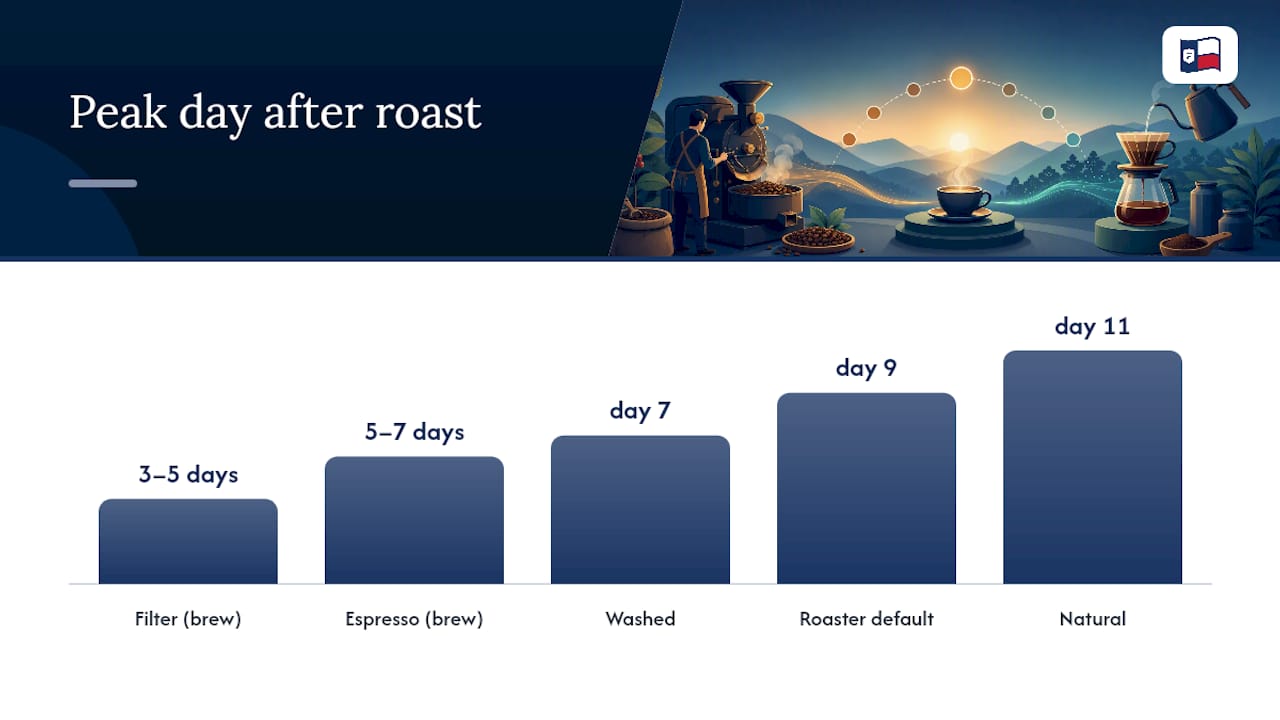
Processing method shifts that curve. Washed coffees tend to peak earlier, often around day 7, while natural-processed coffees, with their denser sugar and fruit compound structure, often peak closer to day 11. Many roasters treat day 9 as a sensible default starting point for tasting when you don’t know a coffee’s exact profile.
Brew method matters just as much as processing. Common conventions put filter coffee at its best around 3 to 5 days post-roast, while espresso often needs 5 to 7 days for the crema and extraction to stabilize, a pattern backed by SCA guidance on fresh coffee. Cold brew is more forgiving of a wider window since the long, cold extraction smooths over some of the volatility that a fast, hot espresso shot exposes. Denser beans and lighter roasts tend to stretch these windows further, sometimes holding peak character for two or three weeks longer than a darker, more porous roast.
- Filter/pour-over: rest 3–5 days minimum, longer for light roasts.
- Espresso: rest 5–7 days to let crema and body settle.
- Cold brew: more tolerant, can work well from day 3 through several weeks.
Pro Tip: Buy two bags of the same coffee and taste one every 3 to 4 days, logging aroma, acidity, and sweetness in a notes app. Most home brewers are surprised to find their favorite cup isn’t at day 1, it’s usually somewhere between day 7 and day 14.
How Should You Store Coffee to Protect Roast-Date Freshness?
Packaging does real chemical work, not just cosmetic work. A one-way valve lets built-up CO2 escape without letting oxygen in, which slows oxidation while still allowing the bean to degas naturally. Sealed bags with oxygen scavengers push that protection further, which is part of why direct-from-roaster bags often outperform open bins at a grocery store.
At home, the storage rules are simple:
- Keep beans at room temperature, sealed, away from direct light.
- Avoid opening the bag more times than necessary, each opening lets in fresh oxygen.
- Skip the fridge and freezer for beans you’ll use within a few weeks, condensation on thawing does more damage than the cold prevents.
- Only consider freezing for long-term storage of unopened bags you won’t touch for a month or more, and let them come fully to room temperature before opening.
Grinding is the single biggest freshness decision you control. A whole bean holds its aromatic compounds inside a relatively protective structure for weeks. Grind it, and you expose that same coffee to oxygen across thousands of times more surface area, meaning weeks of shelf life can collapse into minutes of real aroma. Grind immediately before brewing whenever possible, and if you must grind ahead, keep the window as short as you can and the container as sealed as possible.
Does Roast Level Change How Fast Coffee Ages?
Roast level changes the bean’s physical structure, and that structure changes how fast gas escapes and oxygen gets in. Lighter roasts stay denser because they spend less time in the drum breaking down cell walls, so they tend to hold onto flavor compounds longer and often need more rest to taste balanced. Research on roast color and sensory outcomes backs this up: roast degree is a stronger predictor of flavor than total roast time, though development time still shapes acidity and bitterness independent of color.
Quick rules of thumb:
- Light roasts: denser structure, slower degassing, often need 7 to 14 days to fully open up.
- Medium roasts: moderate density, usually hit their stride around 5 to 10 days.
- Dark roasts: more porous, degas faster, and can peak within 3 to 5 days before starting to lose oils and aromatics to oxidation sooner.
A light roast from a high-grown, dense-bean origin might not show its full sweetness until nearly two weeks out, while a dark roast bought the same day could already be past its best by the time the light roast catches up. That’s the practical payoff of understanding how roast level shapes flavor: the ideal roast date isn’t fixed, it shifts with the roast itself.
How Do You Brew Around a Bag’s Peak Window?
Turning roast-date awareness into better cups means running your own small experiment, and it’s simpler than it sounds. Start with a tasting checklist covering four things: acidity (bright versus dull), sweetness (present versus flat), body (thin versus full), and aromatics (vivid versus muted). Taste the same coffee brewed the same way every few days and log what changes.
Grind and dose adjustments help compensate for where a bag sits on its curve. Very fresh, gassy beans often need a slightly coarser grind and a touch more contact time, since trapped CO2 interferes with even saturation and can cause channeling in filter brews or fast, uneven shots on espresso. Coffee further past peak sometimes needs a finer grind or higher dose to make up for aromatics that have already faded. For espresso specifically, a slower shot and a longer pre-infusion tend to tame excess crema instability from very fresh beans, a detail worth knowing if you’re dialing in beans for an espresso machine.
- Log roast date, days rested, grind size, and brew ratio for every session.
- Score each cup on acidity, sweetness, body, and aromatics.
- Compare notes across a week to spot your personal peak window.
Pro Tip: Keep the log simple, a notes app or a small notebook by the grinder works fine. After two or three bags, patterns emerge fast: you’ll start to know whether you personally prefer coffee at day 5 or day 12, and that’s more useful than any generic rule.
A Roaster’s Note on Roast Dating
At Font Coffee Roasters, we date every bag the day it comes out of the drum, not the day it ships, because that’s the only number that actually means something to your palate. Four generations of craftsmanship taught our team that resting time isn’t a formality, it’s part of the recipe, and we build our shipping speed around getting beans to your door while they’re still climbing toward peak instead of sliding past it. Beyond the roastery, we apply that same freshness standard to our matcha and loose-leaf tea selections, since volatile aromatics fade in green tea and matcha for many of the same chemical reasons they fade in coffee.
Get Freshly Dated Coffee Delivered Before It Peaks
Font-mag solves the exact problem this article just walked through: retail shelf coffee often sits for weeks before you buy it, but ordering direct means your bag ships close to its roast date instead of months past it.
Our specialty coffee collection lists roast dates plainly, and a subscription keeps fresh bags arriving on a schedule instead of leaving you guessing when the last one went stale. Roast-date logic applies to decaf too, so don’t assume decaf gets a pass on freshness. If you’re branching out, our matcha and loose-leaf tea lines carry the same attention to freshness, and orders over $35 ship free. Start with a bag of the specialty roast that matches your usual brew method, and build your own peak-window log from day one.
Frequently Asked Questions
Does roast date really matter more than the type of bean? Both matter, but roast date is the variable you control at purchase time. Origin and processing set the coffee’s chemical starting point, while roast date tells you where it currently sits on the freshness curve.
Is coffee bad after its best-by date? Not necessarily unsafe, but flavor is a different question. Coffee past its best-by date can still taste fine, and coffee well before that date can already taste flat if the roast date is old.
Can pre-ground coffee ever be fresh? Only briefly. Grinding exposes far more surface area to oxygen, so pre-ground coffee loses its aromatic edge within days regardless of when the beans were roasted.
Should I avoid coffee that doesn’t list a roast date? Treat it with caution. A missing roast date usually means the seller doesn’t prioritize freshness tracking, which is a reasonable signal to look elsewhere.
Does freezing coffee ruin it? Freezing unopened bags for long-term storage is fine, but repeated freezing and thawing introduces condensation that damages flavor faster than time alone would.
Sources
- Coffee Decoded: What is “freshly roasted” coffee? — Specialty Coffee Association
- Time and colour in coffee roasting: relative effects on sensory properties — Beverages (MDPI)
- Day9