

Sustainable Coffee Farming: What It Means for Buyers
Sustainable coffee farming means growing coffee in ways that protect ecosystems, maintain soil and water health, and deliver fair economic outcomes for the farmers who produce it. It pairs environmental stewardship — shade-grown agroforestry, reduced agrochemical use, water-efficient processing — with social and economic mechanisms like price stability, worker rights, and cooperative support. Neither pillar holds without the other. A farm with pristine biodiversity but a farmer who cannot cover costs will eventually cut shade trees to plant more rows. A cooperative with fair wages but degraded soils faces a shrinking harvest within a generation.
Three things to remember:
- Sustainable coffee farming covers both ecological practice and economic fairness, not just one or the other.
- Coffee is grown on a large global area across many farms worldwide, making supply-chain decisions at scale genuinely consequential.
- Certifications help, but farmer-led agroecology and long-term buyer relationships often produce more durable outcomes than labels alone.
Table of Contents
- What does sustainable coffee farming actually mean?
- What on-farm practices actually make coffee sustainable?
- How does sustainability connect to farmer livelihoods?
- Which certifications and labels should you know?
- What are the real challenges in scaling sustainable coffee?
- How do sustainable practices build climate resilience?
- How can buyers and roasters verify sustainable sourcing?
- Why farmer-led agroecology produces better outcomes
- What do successful programs look like in practice?
- Key Takeaways
- The part most sourcing guides skip
- Font-mag sources coffee the way this guide describes it
- Useful sources for further reading
What does sustainable coffee farming actually mean?
Conservation International describes sustainably sourced coffee as combining production methods that minimize environmental harm with supply-chain practices that improve producer well-being. The catch: definitions vary across organizations, labels, and buyers, which is why understanding the two core pillars matters more than memorizing any single definition.
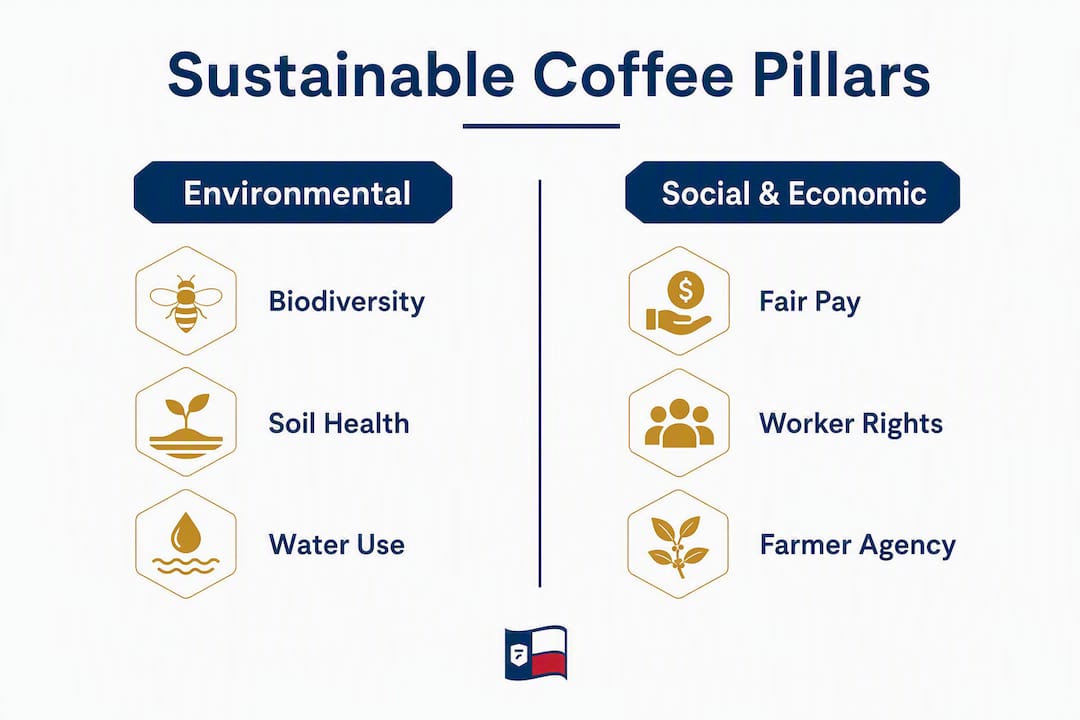
The environmental pillar covers biodiversity protection, soil health, water conservation, avoided deforestation, and reduced agrochemical impact. Coffee grown under a diverse canopy of shade trees supports far more bird and insect species than sun-grown monocultures, and those trees also protect soil from erosion and moderate temperature extremes. Deforestation for coffee expansion remains one of the sector’s most documented harms, particularly in tropical regions where Arabica thrives at altitude.
The social and economic pillar covers fair pay, price stability, worker rights, and farmer agency. Farmers who cannot earn a living wage from coffee have no real choice but to cut corners on environmental practice or abandon the crop entirely. Community resilience, access to training, and the ability to make decisions about their own land are just as central to sustainability as soil organic matter.
The two pillars reinforce each other. Environmental actions without fair economics are fragile. Income guarantees without sound environmental practice create long-term production risk. The Coffee Sustainability Reference Code from the Global Coffee Platform sets a sector baseline covering both dimensions, identifying five critical practices including no deforestation and the elimination of the worst forms of child labor as non-negotiable minimums.
What on-farm practices actually make coffee sustainable?
Sustainable coffee production at the farm level comes down to a cluster of interconnected practices. None of them works in isolation.
- Shade-grown agroforestry: Growing coffee under a diverse canopy of trees moderates microclimate, reduces erosion, and supports pollinators and birds. Diversified shade species also provide farmers with timber, fruit, and additional income streams.
- Soil-building: Mulching with coffee pulp and organic matter, composting, and cover crops rebuild soil structure and reduce dependence on synthetic fertilizers. Field evidence from smallholder plots in Embu County, Kenya shows that no-tillage combined with continuous mulching, composting, and Indigenous Microorganisms (IMOs) can increase yields and reduce Coffee Leaf Rust and Coffee Berry Disease incidence compared with conventional systems.
- Integrated pest management (IPM): Combining biological controls, resistant varieties, and targeted chemical applications only when thresholds are crossed reduces pesticide load on soil and water.
- Balanced fertilizer strategies: Mixing mineral and organic inputs is often necessary because many small farms lack sufficient on-site organic residues to meet crop nutrient needs through compost alone. Soil testing guides the balance.
- Water-efficient processing and wastewater treatment: Wet processing generates significant wastewater. Closed-loop systems and constructed wetlands reduce contamination of local waterways.
- Reduced tillage and on-farm nurseries: Minimal soil disturbance preserves microbial communities. On-farm nurseries for shade trees and coffee seedlings reduce input costs and keep genetic diversity local.
The GCP RegenCoffee Guidance frames regenerative coffee as outcome-focused: improving soil, water, and biodiversity to enhance farmer resilience and long-term profitability. Transitioning to these systems often increases labor demands and may temporarily reduce yields before soil health delivers longer-term gains. Financial support and stable pricing are what make that transition viable for most smallholders.
Pro Tip: When a farmer or cooperative describes their transition, listen for specifics: which shade species they planted, how they handle coffee pulp, whether they’ve shifted fertilizer ratios. Vague claims about “going natural” without those details are a red flag.
How does sustainability connect to farmer livelihoods?
Low coffee prices are one of the most consistent drivers of unsustainable practice. When commodity prices crash, farmers cut shade trees to increase sun-exposed yield, reduce labor on soil management, or abandon coffee for other crops. Historic price volatility and disease outbreaks have left many producers economically vulnerable, and structural market reforms are necessary to make sustainable transitions viable at scale.
Cooperatives change that equation. When farmers pool resources, they gain negotiating power, access to shared processing equipment, collective certification costs, and technical training they could not afford individually. Price floors and premiums, whether through certification standards or direct buyer agreements, give farmers the income predictability to invest in soil health and tree planting rather than chasing short-term yield.

Diversified income matters too. Shade trees that produce timber, fruit, or medicinal plants reduce a farmer’s exposure to coffee price shocks. Food crops grown between rows improve household food security. These aren’t just nice additions; they’re often what keeps a family farming sustainably through a bad harvest year.
Farmer agency is the piece that top-down programs most often miss. When external organizations design sustainability programs without meaningful farmer input, adoption tends to be shallow and compliance-driven. Locally led agroecology, where farmers adapt practices to their specific soils, microclimates, and economic realities, consistently produces more durable outcomes.
Which certifications and labels should you know?
Five labels appear most often in sustainable coffee sourcing conversations. Each protects something different, and each has real limits.
| Label | Primary focus | Traceability | Farmer cost/access | Enforcement | Consumer recognition |
|---|---|---|---|---|---|
| Rainforest Alliance | Biodiversity, ecosystem services, some social standards | Third-party audit, farm-to-roaster | Moderate audit fees; accessible to cooperatives | Annual third-party audit | High |
| Fair Trade USA | Price floor, labor rights, community premiums | Third-party audit, cooperative-level | Certification fees; cooperative structure often required | Third-party audit | High |
| USDA Organic | Soil health, no synthetic pesticides/fertilizers | Third-party audit, input-level | High certification cost; significant barrier for small farms | USDA-accredited certifier | High |
| Smithsonian Bird Friendly | Biodiversity, shade canopy standards | Third-party audit, farm-level | Requires prior USDA Organic; highest bar | Smithsonian-approved certifier | Low to moderate |
| Direct Trade | Traceability, relationship quality, price transparency | Buyer-declared; no third-party standard | No formal fees; depends on buyer commitment | Self-declared; no universal standard | Growing |
A few things worth knowing about each:
Rainforest Alliance merged with UTZ in 2018 and now covers a broad range of farms globally. Its scope is wide, which means enforcement depth can vary. The Bird Friendly certification from the Smithsonian Migratory Bird Center sets the most rigorous shade canopy standards in the industry, but it requires prior USDA Organic certification, which prices out many smallholders.
Fair Trade USA guarantees a price floor and a community development premium, but it does not require the same ecological standards as Rainforest Alliance or Bird Friendly. Cooperatives must meet labor standards, but individual farm-level environmental practices vary.
USDA Organic prohibits synthetic pesticides and fertilizers and requires documented soil management, but it says nothing about shade cover, biodiversity, or fair wages. A sun-grown monoculture can be certified organic.
Direct Trade is not a certification at all. It’s a sourcing model where a roaster buys directly from a farm or cooperative, often paying above Fair Trade minimums, and publishes pricing and sourcing details. The quality of that commitment depends entirely on the buyer. For a deeper look at how direct trade works as a sourcing model, the mechanics matter as much as the label.
Pro Tip: When reading a label claim, ask two questions: Who audited it, and what exactly does it cover? “Sustainably sourced” with no certification name behind it is marketing copy, not a standard.
What are the real challenges in scaling sustainable coffee?
Sustainable coffee farming faces barriers that are structural, not just technical.
- Transition costs: Moving from conventional to agroecological systems requires upfront investment in shade trees, composting infrastructure, and labor. Yields may dip during the transition period before soil health improves.
- Certification burden: Audit fees, paperwork, and compliance requirements are proportionally heavier for small farms. A cooperative with 200 members can spread costs; a single-family farm often cannot.
- Market access and premium capture: Certified coffee commands a premium in theory. In practice, premiums don’t always reach the farmer. Middlemen, export taxes, and cooperative overhead can absorb a significant share.
- Labor intensity: Shade-grown systems, hand-picking, and composting require more labor than mechanized sun systems. In regions with labor shortages or rising wages, this creates real pressure.
- Land conversion dynamics: When coffee prices fall, farmers in some regions convert forest to Robusta, which tolerates sun and produces higher volumes at lower prices. This dynamic is one of the most direct links between market failure and deforestation.
A warning worth taking seriously: Low farmgate prices are not just an economic problem. Poverty drives many of the practices that certification programs try to prevent. Addressing price floors and buyer commitments is not separate from environmental sustainability — it is central to it.
Practical mitigations exist: blended finance programs that cover transition costs, phased adoption timelines that let farmers shift practices incrementally, cooperative purchasing that aggregates certification costs, and multi-year buyer commitments that give farmers the income security to invest in long-term soil health. For café operators and foodservice buyers, connecting sustainability sourcing to broader operational practices is increasingly part of responsible procurement.
How do sustainable practices build climate resilience?
Climate change is shrinking the geographic range suitable for Arabica coffee. Shade and agroforestry systems moderate farm-level microclimates, reducing temperature extremes that stress coffee plants during flowering and fruit development. Improved soil organic matter from composting and mulching increases water retention, which matters enormously during drought years.
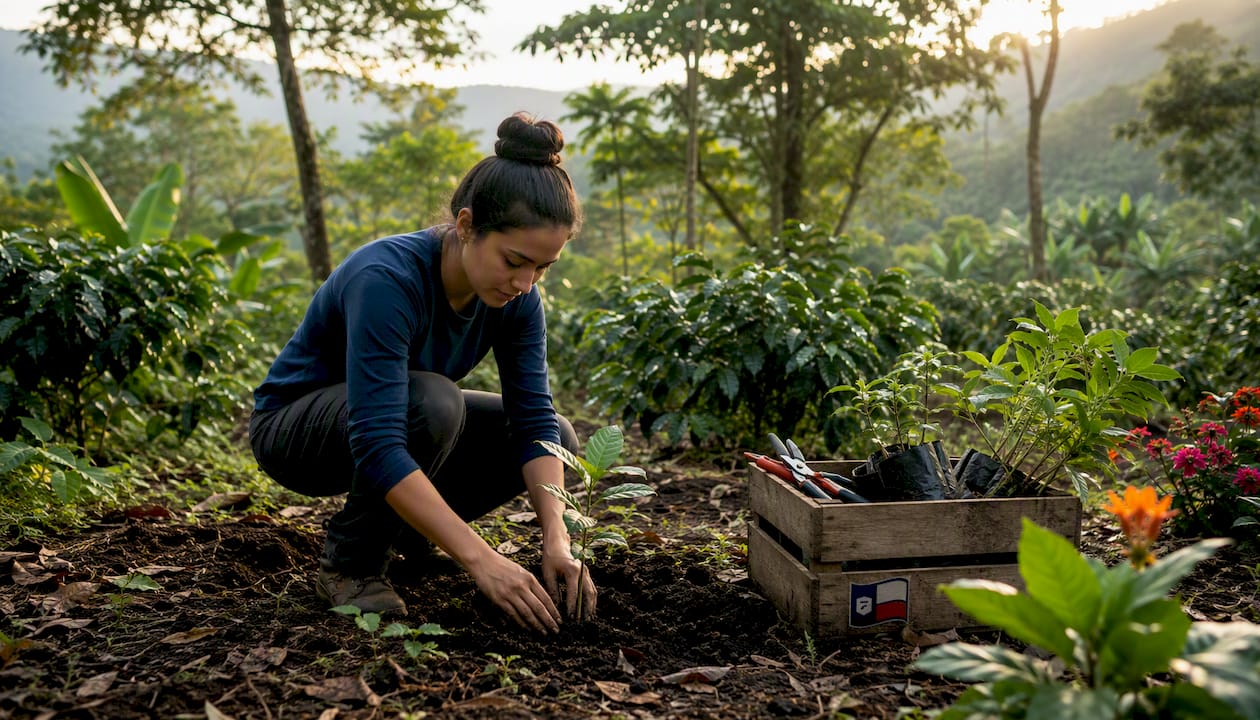
Diversified income from shade trees and food crops reduces a farmer’s financial exposure when a drought or disease outbreak cuts coffee yields. Genetic diversity, including the use of disease-resistant varieties suited to local conditions, adds another layer of resilience.
Research on coffee farming systems in Latin America shows that conventional intensification, specifically sun systems with high fertilizer and pesticide use and shade removal, accelerates biodiversity loss, contributes to regional deforestation, and increases nutrient flow pressures on local waterways. Multifunctional agroforestry systems can restore those ecosystem services and support long-term farm viability.
The RegenCoffee framework from the Global Coffee Platform explicitly links regenerative practices to carbon sequestration. Shade trees store carbon above ground; improved soils store it below. These are not just environmental benefits — they are increasingly relevant to buyers and roasters with their own carbon-neutral commitments downstream in the supply chain.
How can buyers and roasters verify sustainable sourcing?
Verification requires asking specific questions, not just reading labels. Here’s a numbered checklist you can use directly with suppliers:
- Ask for traceability to farm or cooperative. Can the supplier name the farm, region, and cooperative? Lot-level traceability is the baseline.
- Identify which certification or standard applies and what it covers. Ask specifically what the certification audits: environmental practices, labor standards, or both.
- Request pricing and premium arrangements. What did the farmer receive per pound? Is it above the Fair Trade floor? Is there a documented premium?
- Ask about multi-year sourcing commitments. One-season purchases give farmers no incentive to invest in long-term soil health. Ask whether the buyer has committed to purchasing from the same source for multiple years.
- Ask about farmer training and technical assistance. Does the program include agronomic support, or just a price premium?
- Request audit reports or cooperative transparency reports. Third-party audit summaries should be available on request from any credibly certified supplier.
- Ask about landscape-level interventions. Is the farm part of a broader watershed or biodiversity corridor program?
For a practical guide to reading origin sourcing labels, the details behind the label matter as much as the label itself.
Why farmer-led agroecology produces better outcomes
A PMC systematic review of coffee sustainability initiatives found that sustainability programs in coffee are diverse, spanning at least eleven distinct types of intervention, and that locally led agroecology programs can improve outcomes by shifting power dynamics in the supply chain. Top-down certification schemes sometimes miss those dynamics entirely.
The MDPI planetary health review reinforces this from an ecological angle: conventional intensification raises biodiversity loss and contributes to regional deforestation, while agroecological systems reduce both environmental and human-health pressures. The implication for buyers is direct. Supporting farmer leadership, funding technical assistance, and prioritizing longer-term sourcing relationships produces better ecological and social outcomes than simply purchasing certified coffee from a broker.
Pro Tip: Structure buyer commitments around three things: multi-year contracts that give farmers income security, co-investment in technical training, and transparent pricing that documents what the farmer actually received. Those three elements together create the conditions for genuine agroecological transition.
What do successful programs look like in practice?
A few examples show what sustainable coffee farming looks like when it works at scale.
Nespresso’s AAA Sustainable Quality Program, developed in partnership with the Rainforest Alliance, works with farmers in over a dozen countries to improve agronomic practices, provide technical training, and connect farmers to premium markets. The program combines third-party verification with direct farmer support, which is closer to the farmer-led model than standard certification alone.
Cooperative-led agroecology in Kenya offers some of the clearest field evidence. Paired-plot comparisons in Embu County showed that an integrated ecological management package, combining no-tillage, continuous mulching, composting, and IMOs, increased yields and reduced Coffee Leaf Rust and Coffee Berry Disease incidence compared with conventional systems. These results came from smallholder farms, not research stations, which makes them directly applicable.
The Global Coffee Platform’s RegenCoffee initiative provides guidance for farms transitioning to regenerative systems, with a focus on soil health, water management, and biodiversity as measurable outcomes rather than input restrictions. The framework is designed to be adapted to local conditions rather than applied as a universal checklist.
The common thread across successful programs: downstream buyers committed to multi-year purchasing, technical assistance that reaches the farm level, and farmer participation in program design. Scale matters too. Landscape-level coordination between farms, buyers, and local institutions delivers stronger biodiversity outcomes than isolated farm-level compliance.
Key Takeaways
Sustainable coffee farming requires both environmental stewardship and economic fairness working together, because neither pillar holds without the other over the long term.
| Point | Details |
|---|---|
| Both pillars are required | Environmental practice without fair economics fails; income guarantees without sound ecology create long-term production risk. |
| Agroforestry is the core practice | Shade-grown systems protect biodiversity, moderate microclimate, and build soil health simultaneously. |
| Certifications have real limits | Labels vary in what they audit; ask what a certification covers before treating it as proof of full sustainability. |
| Farmer leadership matters | Locally led agroecology with multi-year buyer commitments produces more durable outcomes than top-down compliance. |
| Font-mag sources with traceability | Font-mag prioritizes small-batch, traceable coffees and offers a full range of specialty beverages, from coffee to matcha and teas, for buyers who want to source with intention. |
The part most sourcing guides skip
Most writing about sustainable coffee stops at certifications and practices. The harder conversation is about power.
Certifications are useful tools, but they were largely designed by buyers, NGOs, and standards bodies in consuming countries. Farmers in producing countries often participate as compliance subjects rather than decision-makers. That’s not a cynical reading; it’s what the research consistently shows. The PMC review found that farmer-led programs shift outcomes precisely because they shift who holds decision-making authority.
The practical implication for anyone buying coffee, whether you’re a café owner placing a wholesale order or a home enthusiast choosing a bag, is that the most meaningful thing you can do is support roasters who publish what they paid, name the cooperative or farm, and commit to buying from the same source year after year. A label tells you a standard was met at the time of audit. A multi-year sourcing relationship tells you a buyer is invested in what happens next.
Font-mag’s sourcing approach reflects that. The focus on small-batch coffees with documented origins, combined with direct relationships with cooperative partners, is closer to the farmer-led model than purchasing certified commodity lots. That’s the difference between sustainability as a marketing claim and sustainability as a supply-chain commitment.
Font-mag sources coffee the way this guide describes it
Font-mag selects coffees based on traceability, small-batch partnerships, and cooperative relationships, which is exactly the sourcing model this guide argues produces the best outcomes for farmers and ecosystems. The Downshift Decaf is one example: a single-origin Colombia roast with documented sourcing, available in a 16oz bag for home or café use.

Beyond coffee, Font-mag carries a full range of specialty beverages for café owners and home enthusiasts who want quality across the board. The matcha collection includes Rishi Tea’s Barista Matcha and Sweet Matcha, both sourced with the same attention to origin and quality. The syrups range from the Sweetbird collection covers everything from classic vanilla to seasonal flavors, and the iced tea selection rounds out a complete beverage program. Free shipping on orders over $35 makes stocking up straightforward. Browse the full range at font-mag.com and order with confidence knowing the sourcing story is part of the product.
Useful sources for further reading
The sources below are the most authoritative references used in this article. Each covers a different layer of the topic.
-
Sustainable coffee: A review of the diverse initiatives and governance dimensions of global coffee supply chains — (PMC) — The most comprehensive academic review of coffee sustainability initiative types. Use this to understand the full range of intervention models and why farmer-led programs outperform top-down compliance.
-
GCP RegenCoffee Guidance — (Global Coffee Platform) — Practical farm-level guidance for regenerative transitions. Covers soil, water, biodiversity, and farmer resilience as measurable outcomes.
Recommended
- What Is Bird Friendly Coffee? Benefits and Buying Guide – Font Coffee Roasters
- How to Read Coffee Origin Sourcing Labels: A Buyer’s Checklist – Font Coffee Roasters
- Ethically Sourced Coffee: Your 2026 Conscious Guide – Font Coffee Roasters
- Direct Trade Coffee: What It Is and Why It Matters – Font Coffee Roasters