
Direct Trade Coffee: What It Is and Why It Matters
Direct trade coffee is a sourcing relationship, not a certification. A roaster buys green coffee directly from a farmer or cooperative, negotiates price face-to-face, pays a premium tied to quality, and maintains that relationship across multiple harvests. No third-party body issues a stamp. No audit confirms the claim. The roaster’s own transparency is the only proof.
Here is what authentic direct trade typically looks like in practice:
- Named farms or cooperatives, not just a country of origin
- Published FOB (free-on-board) prices showing what the roaster actually paid
- Repeat purchases across multiple crop years
- Cupping scores and processing notes shared publicly
- Origin trip reports or transparency PDFs available to buyers
Table of Contents
- What does “direct trade coffee” actually mean?
- How direct-trade sourcing actually works
- What are the real benefits of direct trade?
- Where direct trade falls short
- How has direct trade evolved as a business model?
- Direct trade vs. Fair Trade: a side-by-side comparison
- What authentic direct-trade sourcing looks like in practice
- How to evaluate a roaster’s direct-trade claim
- Key Takeaways
- A note from Font-mag
- Useful sources and further reading
What does “direct trade coffee” actually mean?
Direct trade is a sourcing model where specialty roasters build long-term relationships with individual farmers or cooperatives, pay above-market premiums linked to quality, and maintain traceable supply chains down to the farm or lot level. The definition sounds clean, but in practice it stretches across a wide spectrum.
On one end, you have a roaster who flies to Ethiopia every harvest, cups alongside the producer, agrees on a price that reflects the lot’s score, and publishes every detail in an annual report. On the other end, you have a roaster who bought one lot through a broker, slapped “direct trade” on the bag, and never went back. Both call it the same thing.
The model has no central standard and no required audits. That is not inherently a flaw. It allows roasters to tailor partnerships to specific growing regions, local infrastructure, and producer needs in ways a rigid certification cannot. But it shifts the verification burden entirely onto the buyer.
Pro Tip: The clearest signal of authentic direct trade is a combination of three things together: a named producer, a documented FOB price, and evidence of repeat purchases across at least two harvest years. Any one of those alone is easy to fake. All three together are not.
How direct-trade sourcing actually works
The process usually starts with an origin trip or a broker introduction. The roaster visits a farm or cooperative, cups samples, and assesses quality. If the coffee scores well, price negotiation begins, often with FOB transparency so the producer knows exactly what the roaster is paying versus what the market offers.
From there, the steps look roughly like this:
- Origin contact: Trip, introduction, or sample request from a known producer network
- Quality assessment: Cupping and scoring, often with feedback on processing methods
- Price negotiation: FOB price set above commodity market rates, tied to cup score
- Logistics: Export handled through local dry mills, washing stations, and freight forwarders
- Repeat contracts: Multi-year agreements that give producers planning certainty
That logistics point matters. Even authentic direct-trade relationships rely on local processing and logistics partners. A roaster using a washing station or a dry mill is not automatically compromising the direct relationship. What matters is whether the buyer-producer relationship itself remains direct and transparent.
A first-year relationship often involves a single lot purchase with detailed feedback. By year three or four, the roaster may be co-investing in processing equipment or funding agronomic training, with quality gains tied directly to measured cup scores.

What are the real benefits of direct trade?
The benefits split three ways, and they compound when the model is executed honestly.
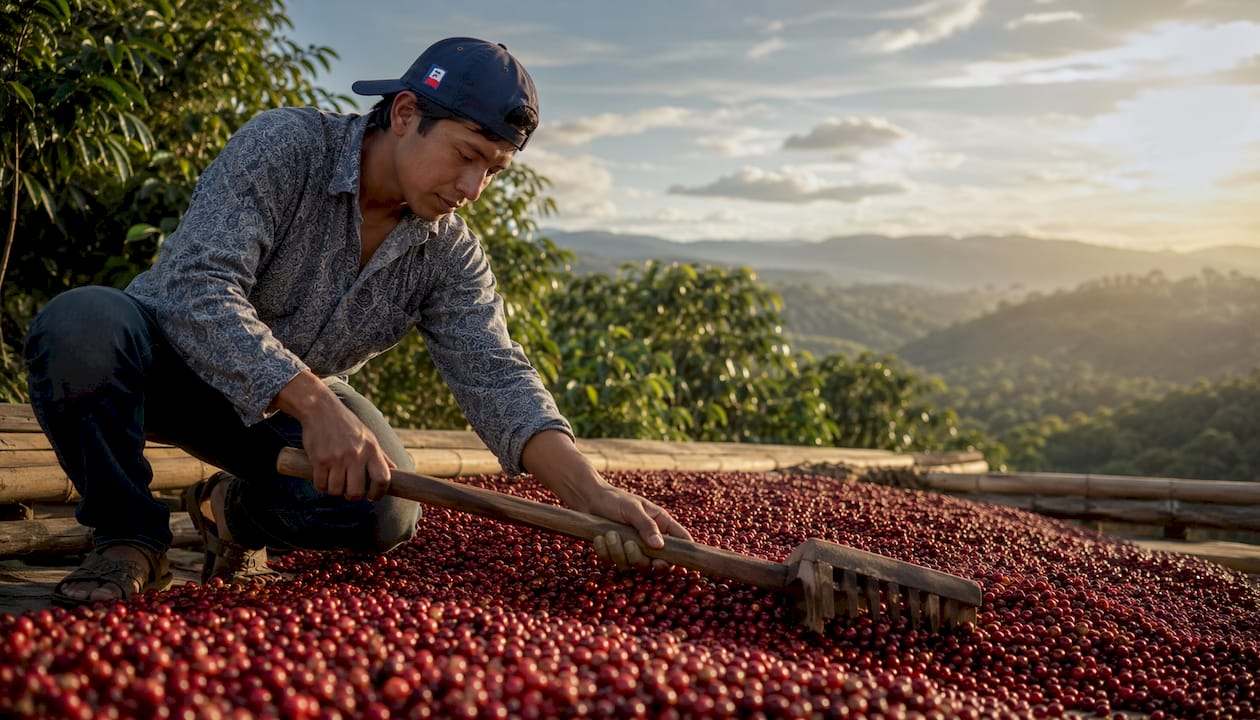
For farmers: Higher premiums for quality create a direct financial incentive to invest in better processing. Faster feedback loops, where a roaster tells a producer exactly why a lot scored 86 instead of 90, give producers actionable guidance. Over multiple years, that feedback can translate into measurably higher income tied to cup quality rather than commodity price swings.
For roasters: Tighter quality control comes from knowing exactly which farm, which lot, and which processing method produced a given coffee. Direct trade functions as a risk-mitigation strategy as much as an ethical one, giving roasters supply-chain resilience against commodity price volatility and access to differentiated specialty lots competitors cannot easily replicate.
For consumers: You get traceable coffees with real origin stories. Research also shows that consumers pay more for public-good attributes like transparency and community benefit than for purely private benefits like flavor alone. When you buy a direct-trade lot with a named farm and published price, you are paying for something verifiable, not just a marketing claim.
Where direct trade falls short
The absence of a standard definition is the model’s most significant structural weakness. Experts describe the unregulated label as a double-edged sword: flexible enough to fit diverse partnerships, but nearly impossible for consumers to verify without doing their own research.
Common problems include:
- Vague origin labeling: “Sourced from small farms in Colombia” with no farm name
- No price transparency: Premium claims with zero documentation
- One-off purchases labeled as relationships: A single lot buy described as a “long-term partnership”
- Scalability limits: Small roasters struggle to maintain multiple direct relationships simultaneously; large roasters struggle to keep them genuinely personal
- Producer risk in low-yield years: When premiums are tied only to exceptional quality, a difficult harvest can leave a producer without the income they planned around
Pro Tip: Annual transparency reports and independent third-party audits are the gold standard. Counter Culture Coffee pioneered this practice in specialty coffee, publishing audited transparency reports that document FOB prices and producer relationships. When a roaster does this, it is a meaningful signal. When they do not, ask why.
How has direct trade evolved as a business model?
Direct trade started as a niche ethics project among a handful of pioneering roasters. Intelligentsia Coffee, Stumptown Coffee Roasters, and Counter Culture Coffee were among the earliest to formalize the model, building it around transparency and producer relationships rather than certification compliance.
Industry analysis now positions direct trade as a mainstream business strategy, not just a social mission. Roasters use it to manage price volatility, secure access to limited specialty lots, and build supply-chain resilience. The ethics and the economics have converged.
| Dimension | Direct Trade | Fair Trade |
|---|---|---|
| Standard-setting body | None (roaster-defined) | Fairtrade International |
| Third-party audits | Optional (some roasters self-audit) | Required |
| Farmer participation | Hundreds to thousands per roaster | More than 812,500 coffee farmers from 30 countries participate in Fairtrade coffee (https://gala.gre.ac.uk/id/eprint/20005/7/20005 NELSON_Fairtrade_Coffee_A_Study_to_Assess_the_Impact_of_Fairtrade2016.pdf) |
| Evidence base | Practitioner-reported | 19 studies reviewed, majority showing positive longer-term effects |
The Fairtrade evidence mapping found multi-study support for sustainable, resilient, and fairer supply chains. Direct trade lacks that research depth, but its traceability to individual farms is something certification models rarely match.
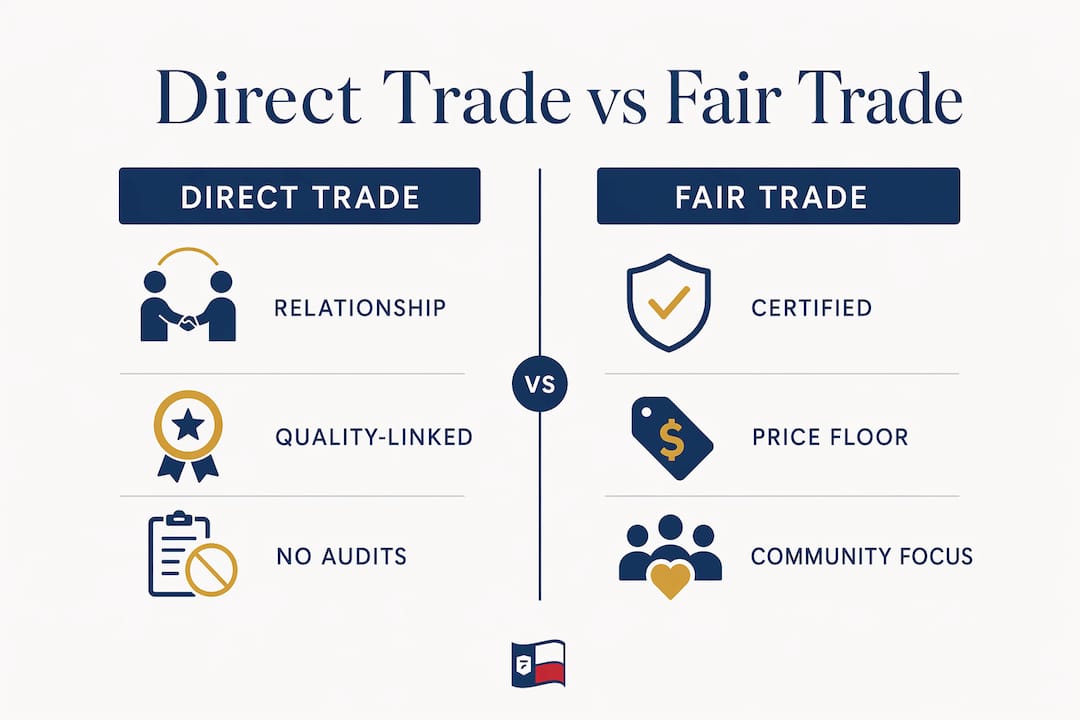
Direct trade vs. Fair Trade: a side-by-side comparison
These two models are not competitors. They solve different problems.
| Dimension | Direct Trade | Fair Trade Certified |
|---|---|---|
| Definition | Relationship-based, roaster-defined | Audited certification with published standards |
| Verification | Roaster transparency (FOB, reports, visits) | Third-party audit by certification body |
| Who benefits | Individual farms or cooperatives in relationship | Producer organizations and co-ops at scale |
| Scale | Limited to roaster’s direct network | Global |
| Price floor | None (quality-driven premium) | Minimum price floor plus fixed premium |
| Documentation | Varies widely by roaster | Standardized, publicly available |
When to prefer Fair Trade: you want a guaranteed price floor for producers, audited labor standards, and community development funds. The Fair Trade Certified program also prohibits forced and child labor and supports environmental sustainability through its standards.
When direct trade may serve you better: you want traceability to a specific farm, quality-linked premiums, and a roaster who can tell you exactly what they paid and why. For ethically sourced specialty coffee buyers who care about cup quality as much as ethics, direct trade often delivers more specificity.
Both models can coexist. Some roasters hold Fair Trade certification for certain lots while maintaining direct relationships for others.
What authentic direct-trade sourcing looks like in practice
The roasters who built direct trade as a practice set a documentation standard that still holds. Look for these elements on a roaster’s website or bag copy:
- Named farm or cooperative with a country, region, and producer name
- Published FOB price showing what the roaster paid at origin
- Year-over-year purchases from the same producer
- Cupping scores with tasting notes tied to specific lots
- Origin trip reports or photos showing actual producer visits
- Transparency PDFs covering multiple farms and harvest years
A roaster who supports local sourcing relationships and publishes this kind of documentation is doing the work. One who uses the phrase without the paperwork is not.
Pro Tip: If a roaster’s website lists only a country of origin with no farm name, no price data, and no repeat-purchase history, that is not direct trade. That is marketing.
How to evaluate a roaster’s direct-trade claim
Use this checklist before you buy:
- Farm or cooperative name is listed (not just a country)
- FOB or producer price is published somewhere on the site
- Purchase history shows at least two consecutive harvest years from the same producer
- Cupping scores and processing notes are available
- Origin trip reports or photos exist
- Independent verification or annual transparency report is published
Red flags to watch: vague origin language (“small farms in Guatemala”), no price transparency anywhere, one-off buys described as ongoing partnerships, and heavy use of “direct trade” in marketing copy with zero sourcing documentation behind it.
Pro Tip: Email the roaster’s customer service or wholesale team and ask for a sourcing PDF or FOB price breakdown. Serious roasters respond with documentation. Roasters using the label as marketing tend to go quiet.
Key Takeaways
Direct trade is a relationship-based sourcing model with no central certification, where the roaster’s own transparency, including named farms, published prices, and repeat purchases, is the only reliable proof of authenticity.
| Point | Details |
|---|---|
| Not a certification | Direct trade has no auditing body; credibility depends entirely on roaster transparency. |
| Three core trust signals | Named producer, documented FOB price, and repeat purchases across harvest years confirm authentic claims. |
| Fair Trade serves a different goal | Fair Trade offers a price floor and audited standards at scale; direct trade offers farm-level traceability and quality-driven premiums. |
| Greenwashing is common | Vague origin labels and no price documentation are the clearest red flags for hollow direct-trade claims. |
| Benefits compound over time | Multi-year direct relationships produce measurable quality gains and more stable producer income than one-off purchases. |
A note from Font-mag
Sourcing transparency is something we think about across our entire product range, not just coffee. Whether you are exploring our specialty coffee collection for traceable single-origin lots, stocking a café through our wholesale program, or branching into something different like MAG Tea loose-leaf selections or Sweetbird syrups, the standard is the same: know what you are buying and where it came from.
If you are curious about functional coffee alternatives, mushroom coffee is worth a look for a different kind of specialty beverage experience. And if you want to explore Font’s full range, from iced teas to café essentials, the shop covers more ground than most people expect.
The verification steps in this guide apply whether you are buying a bag for home or sourcing at volume. Ask for documentation. Expect answers.
Useful sources and further reading
- Fair Trade Certified Coffee — Fairtrade America — Primary source for Fair Trade standards, price floors, and certification requirements
- What is Direct Trade Coffee? — Roasters App — Definition and trust-signal framework used in the definition and evaluation sections
- What does “direct trade” really mean? — Perfect Daily Grind — Industry analysis of the label’s flexibility and verification gaps
- Direct trade isn’t a social project, it’s good business — Coffee Intelligence — Business-strategy framing and consumer willingness-to-pay research
- What direct trade means for the farmer — CoffeeGeek — Practitioner evidence on quality feedback loops and producer income
- The Fairtrade Effect — evidence-mapping summary — 19-study review of Fair Trade’s longer-term supply-chain impacts
- Fairtrade Coffee Impact Study — University of Greenwich — Historical farmer participation data and impact assessment
Recommended
- Why Independent Roasters Beat Corporations: 2026 Guide – Font Coffee Roasters
- Coffee Processing Methods Explained for Every Brewer – Font Coffee Roasters
- Texas Craft Roasting Heritage: What Coffee Lovers Must Know – Font Coffee Roasters
- What Is Coffee Extraction and How It Shapes Flavor – Font Coffee Roasters