

The Coffee to Water Ratio That Fixes a Weak or Bitter Cup
Start at a 1:16 coffee to water ratio by weight. That’s 15 grams of coffee to 240 grams of water, which lands you close to an 8 oz cup. It’s the single most reliable starting point across drip, pour-over, and French press, and it’s exactly where most well-known ratio charts converge.
Most brewed methods work somewhere in the 1:15 to 1:18 range, with espresso and cold brew as the two big exceptions since both run far more concentrated. The variable that makes any of this repeatable isn’t a fancier grinder or bottled water. It’s a $15 to $20 digital scale.
- Baseline: 1:16 by weight (15 g coffee : 240 g water for an 8 oz cup)
- Range to explore: 1:15 (stronger) to 1:18 (lighter)
- Exceptions: espresso (roughly 1:2) and cold brew concentrate (1:5 to 1:8)
- Buy this first: a scale accurate to 1 gram, not measuring spoons
Key Takeaways
A 1:16 coffee to water ratio by weight, measured on a gram scale, produces consistent brewed coffee regardless of method, and small 1-gram adjustments fine-tune strength from there.
| Point | Details |
|---|---|
| Start at 1:16 | 15 g coffee to 240 g water is the reliable default for an 8 oz cup. |
| Stay within 1:15 to 1:18 | This is the accepted range for most brewed methods outside espresso and cold brew. |
| Weigh, don’t scoop | A gram-accurate scale removes the variability that spoons and machine markings introduce. |
| Adjust by 1 gram | Change one variable at a time and taste after each small tweak. |
| Buy the tools that support it | Font-mag’s retail coffee and equipment like Cafiza cleaner make consistent, gram-based brewing easy to maintain at home. |
Table of Contents
- What Is a Coffee to Water Ratio, and Why Does It Matter?
- What’s the Best Ratio Range for Brewed Coffee?
- Coffee Ratio Chart by Brewing Method
- How Do You Measure Coffee and Water Correctly?
- Why Does My Coffee Taste Weak or Bitter?
- Quick Coffee Ratio Recipes You Can Brew Right Now
- Sources
What Is a Coffee to Water Ratio, and Why Does It Matter?
A coffee to water ratio, written as 1:X, tells you how many grams of water to use per gram of coffee. A 1:16 ratio means 16 grams of water for every gram of coffee. That’s it. No mystery, no barista secret code.
What that number controls is strength, not flavor balance. Brewing science splits coffee into two separate measurements: total dissolved solids (TDS), which is how strong the cup tastes, and extraction yield, which is what percentage of the coffee’s soluble material actually made it into your cup. Published brewing research puts a well-balanced TDS around 1.15% to 1.35%, with extraction yield typically falling between 18% and 22%. Ratio moves the first number. Grind size, water temperature, and brew time move the second.
- Ratio too low (more coffee) → strong, sometimes muddy
- Ratio too high (more water) → thin, sometimes sour or flat
- Grind, time, and temperature control whether the coffee tastes “cooked” or underdeveloped, independent of strength
Volume measures fail here because a tablespoon of finely ground coffee weighs more than a tablespoon of coarsely ground coffee. Weighing in grams removes that variable entirely.
What’s the Best Ratio Range for Brewed Coffee?
The reference range for brewed coffee sits between 1:15 and 1:18, and 1:16 works as a dependable default because it splits that range down the middle. It’s strong enough to taste like coffee, light enough not to overwhelm most roasts, and forgiving if your grind isn’t perfectly dialed.
From there, taste dictates small moves in either direction:
- Want more body? Try 1:14 to 1:15. This suits darker roasts or anyone who drinks coffee with milk.
- Want something lighter and more tea-like? Try 1:17 to 1:18. Light roasts with bright acidity often shine here.
- Change one variable at a time. If you adjust ratio and grind size in the same brew, you won’t know which change caused the difference.
- Move in 1-gram increments. Small steps prevent you from overshooting a good ratio into a bad one.
Specialty guidance varies slightly depending on who you ask. The Specialty Coffee Association’s “golden cup” standard points closer to 55 grams per liter, which works out to roughly 1:17 to 1:18, while many specialty cafés actually brew closer to 1:15 to 1:16 for more body. That spread is normal. It’s a starting point, not a rule carved in stone.
Pro Tip: Log your gram amounts somewhere, even just a sticky note on the canister. “15g/240g, too weak” saved as a note beats trying to remember what worked three mornings later.
Coffee Ratio Chart by Brewing Method
Every brew method has its own comfort zone, and knowing where each one sits keeps you from applying a pour-over ratio to a French press and wondering why the result tastes wrong.
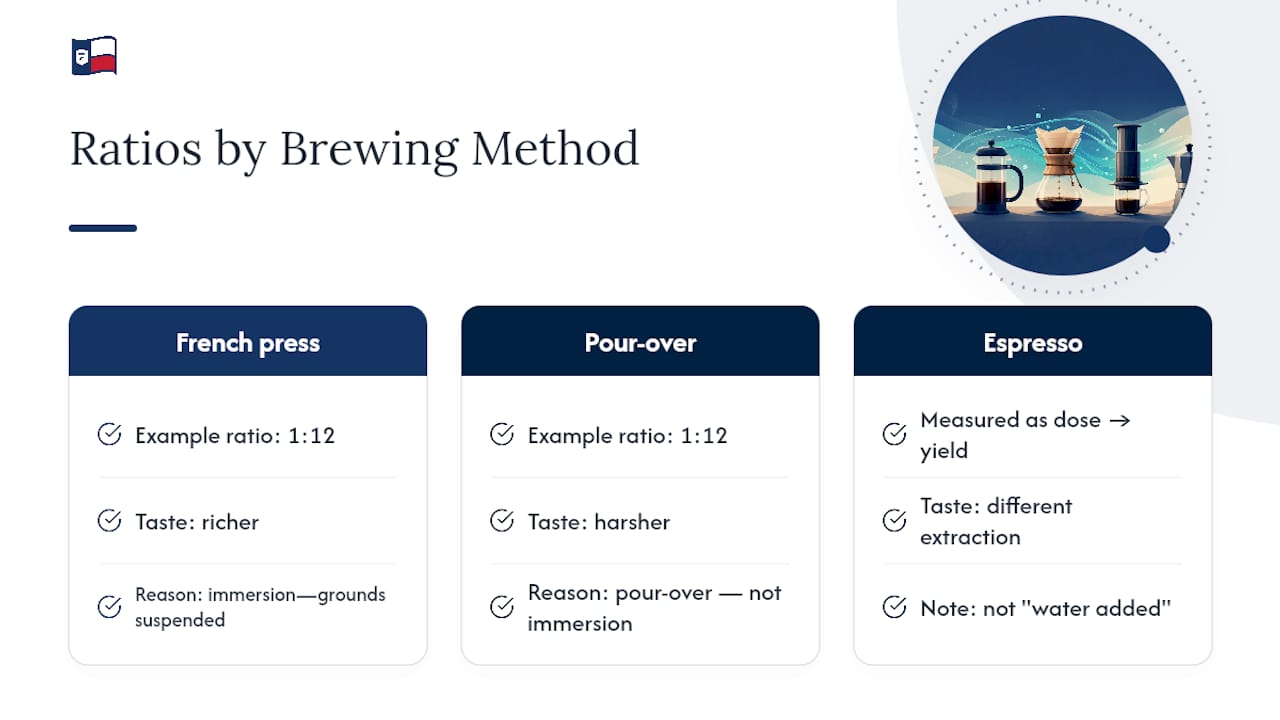
The French press ratio sits noticeably richer than pour-over because immersion brewing keeps grounds suspended in water for the full brew time, so a 1:12 cup won’t taste as harsh as a 1:12 pour-over would. Espresso works differently altogether. You’re not measuring water poured over the puck. You’re measuring what comes out the other side, which is why baristas talk in dose and yield rather than a “water added” figure.
How Do You Measure Coffee and Water Correctly?
A gram of water equals roughly a milliliter of water, which makes converting cup sizes to weight simple once you know the target ratio. Here’s the math for a 1:16 brew:
- 8 oz cup: use around 15 grams of coffee for about 240 grams of water
- 12 oz cup: use roughly 22 grams of coffee for about 355 grams of water
- 16 oz cup: use close to 30 grams of coffee for about 475 grams of water
- Tare your vessel first. Place your empty carafe, dripper, or AeroPress on the scale and zero it out before adding anything.
- Weigh the coffee grounds directly in the dripper or basket, then tare again before pouring water, so the final number reflects water weight alone, not the combined total.
A reliable brewing scale that reads in 1-gram increments removes nearly all the guesswork machine markings introduce. Many drip machines label a “cup” as 5 or 6 oz rather than the 8 oz Americans actually use for a mug, which is a common reason a “4-cup” batch tastes weaker than expected. Weigh water. Don’t trust the carafe lines.
Why Does My Coffee Taste Weak or Bitter?
If your coffee tastes thin or watery, the fix usually isn’t a different bean. Decrease the ratio number, meaning add about 1 gram more coffee for the same water amount, and taste again before making another change.
If it tastes bitter or harsh, the instinct is to blame the ratio, but check grind size and water temperature first. Over-extraction (too fine a grind, water too hot, or brew time too long) pulls out compounds that taste bitter regardless of how much coffee you used. Try raising the ratio slightly (more water, same coffee) while also coarsening your grind by a small step.
- Weak cup: add 1 g coffee, keep water the same, re-taste
- Bitter or harsh cup: check grind size and temperature before touching the ratio
- Sour or underdeveloped cup: grind finer or brew slightly longer
- Inconsistent results day to day: stop using scoops or machine cup markings
Pro Tip: If two brews taste completely different despite using “the same scoop,” the scoop is the problem. Ground coffee density changes with grind size, so a scoop of fine grounds weighs more than a scoop of coarse ones. That’s an easy 3 to 4 gram swing you never see coming.
Quick Coffee Ratio Recipes You Can Brew Right Now
Skip the math entirely with these 1:16 recipes, already worked out for common cup sizes:
- 8 oz cup: 15 g coffee, 240 g water
- 12 oz cup: 22 g coffee, 355 g water
- 16 oz cup: 30 g coffee, 475 g water
- 4-cup pot (roughly 20 oz total): 37 g coffee, 590 g water, same 1:16 ratio scaled up
- Cold brew concentrate: 100 g coarse-ground coffee, 500 g water (1:5), steeped 12 to 18 hours, then diluted roughly 1:1 with water or milk before drinking
Rosario’s Guides Behind This Ratio Advice
- French press ratio guide for immersion brewing specifics
- Coffee extraction explained for the science behind grind and time
- Espresso dose-to-yield guide for concentrated brewing
A Morning Routine Built Around One Ratio
Every batch starts the same way: tare the scale, weigh 15 grams of a Font single-origin, weigh 240 grams of water, brew, taste. If it runs flat, the next cup gets 16 grams instead of 15. That single-gram nudge, repeated over a few mornings, is really the whole method.
— Rosario
Start Brewing by Weight Tonight
A scale changes more about your coffee than a new bag of beans ever will, and that’s really the whole case for starting here instead of chasing a “better” roast. Font-mag’s retail coffee collection gives you the beans to test the ratios in this guide, and a starter setup of coffee, a gram-accurate scale, and Cafiza cleaner for your gear covers what you need to brew consistently from day one. Orders over $35 ship free.
If you’re branching out beyond coffee, the same weigh-and-adjust logic applies to matcha. Font-mag’s matcha collection and the bamboo whisk work the same way: precise ratios, small adjustments, consistent results. Pick up the beans, grab a scale, and brew your next cup by weight instead of by guess.
Sources
- Coffee-to-Water Ratio Explained — Coffee Studies
- Peer-reviewed brewing science (PMC article)
- What’s the Ideal Coffee-to-Water Ratio? - Food Network