

Your French Press Coffee Ratio Guide: Brew It Right
Start with 1 gram of coffee for every 15 grams of water. That’s the 1:15 ratio, and it’s the most reliable baseline for a full-bodied, balanced cup. For a standard 34 oz (1 liter) press, that corresponds to a proportionate amount of coffee to water following the 1:15 ratio. For a smaller 17 oz (500 ml) press, use a corresponding amount of coffee and water following the 1:15 ratio.
Want it stronger? Drop to 1:13 or 1:14. Prefer something lighter? Stretch to 1:16 or 1:17. The National Coffee Association puts the workable range at roughly 1:10 to 1:16, so there’s room to move once you’ve nailed the baseline.
What you need to brew the 500 ml recipe right now:
- The appropriate amount of coarsely ground coffee according to your ratio and press size
- 500 g of water at 200°F (93°C)
- A timer set to 4 minutes
- A French press and a spoon for stirring
- A scale (strongly recommended)
Key Takeaways
The most reliable French press result starts with a 1:15 coffee-to-water ratio, 200°F water, a coarse grind, and a 4-minute steep followed by immediate decanting.
| Point | Details |
|---|---|
| Start with 1:15 ratio | Use 1 g of coffee per 15 g of water; adjust to 1:13–1:17 for strength preference. |
| Grind coarse, not medium | Target sea-salt texture; finer grinds cause silt and bitterness even at a correct ratio. |
| Brew at 200°F for 4 minutes | Let boiled water rest 30–45 seconds off heat; steep exactly 4 minutes with a timer. |
| Change one variable at a time | Adjust ratio for strength, grind for clarity, time or temperature for fine-tuning. |
| Font-mag retail coffee | Font’s small-batch roasts are well-suited to French press; free shipping on orders over $35. |
Table of Contents
- How do you scale French press recipes to different press sizes?
- What equipment and grind size does a French press actually need?
- How do you brew French press coffee step by step?
- Why do ratio, grind, time, and temperature all affect the same cup?
- Should you use a scale or scoops for French press coffee?
- How do you fix a weak, bitter, or muddy French press?
- How do you clean and maintain a French press?
- Why the beans you choose matter as much as the ratio
- Font-mag has the beans and beyond for your next brew
- Sources
How do you scale French press recipes to different press sizes?
The table below scales the 1:15 ratio (and a lighter 1:16 option) to three common press sizes. All weights are in grams; water volume is approximate.
No scale? Tablespoons work as a fallback, though they’re less precise. One level tablespoon of whole-bean or coarsely ground coffee weighs roughly 5–7 g depending on roast and grind density. Coffeenatics recommends the 1:15–1:17 range and provides tablespoon charts for common sizes.
Quick conversions for common brew volumes:
- 8 fl oz (240 ml): about 16 g coffee, or roughly 2.5–3 level tablespoons
- 12 fl oz (355 ml): about 24 g coffee, or roughly 3.5–4 level tablespoons
- 16 fl oz (475 ml): about 32 g coffee, or roughly 4.5–5 level tablespoons
Use them when you’re traveling or in a pinch, not as your daily standard.
What equipment and grind size does a French press actually need?
Equipment checklist:
- French press (glass or stainless steel)
- Burr grinder (not blade)
- Gooseneck or standard kettle
- Kitchen scale
- Timer
- Long spoon or stirring stick
The grind is where most home brewers quietly go wrong. You want coarse ground coffee, roughly the texture of coarse sea salt or coarse breadcrumbs. Each particle should be distinct and chunky, not powdery or sandy. A fine grind lets particles slip through the metal mesh filter, producing a muddy, silty cup and pushing extraction toward bitterness. Barista At Home flags this as one of the most common causes of bad French press coffee.
A blade grinder produces uneven particles, which means some grounds over-extract while others under-extract. A burr grinder, even an entry-level model, gives you a consistent particle size that the French press method genuinely needs. Check out the home barista ingredients guide for a broader look at what makes a reliable home setup.
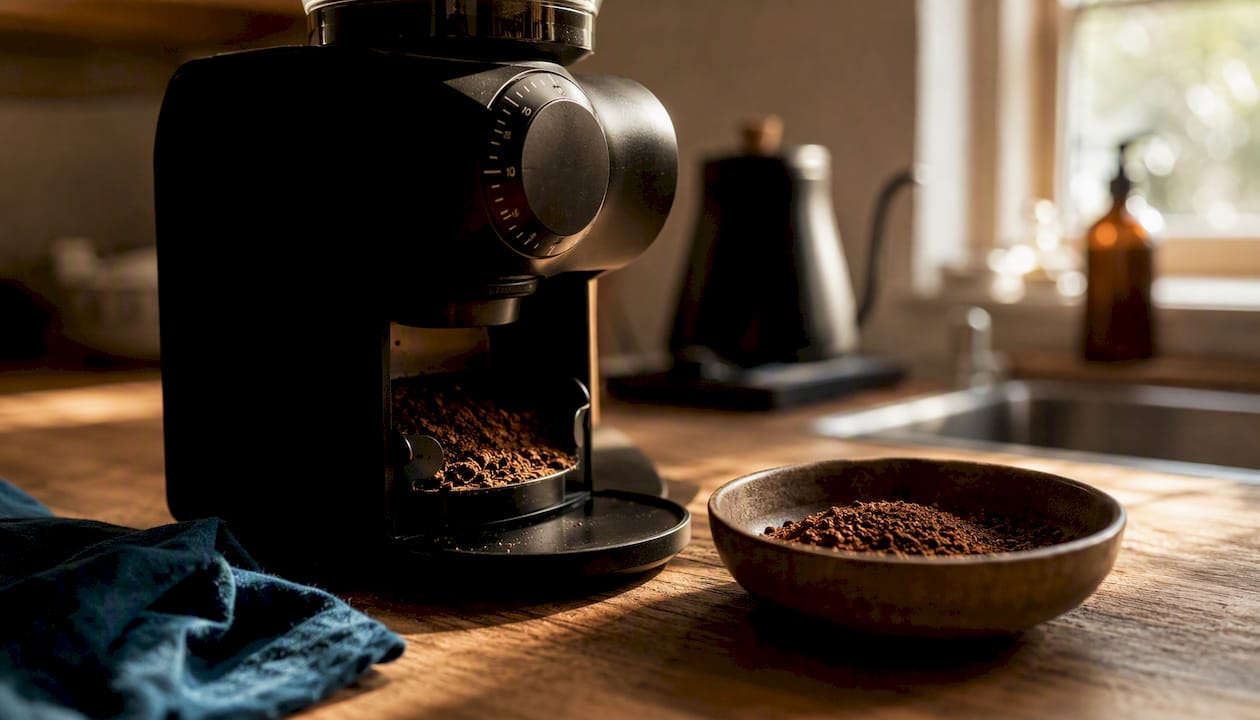
Pro Tip: If you’re stuck with a blade grinder, pulse in short 1-second bursts and shake the grinder between pulses. It won’t match a burr grinder, but it reduces the fine particle concentration enough to cut down on silt.
How do you brew French press coffee step by step?
This method uses 33 g of coffee and 500 g of water, following the 1:15 baseline recipe at 200°F / 93°C with a 4-minute steep.
- Grind your coffee. Set your burr grinder to coarse. Grind 33 g immediately before brewing. Fresh-ground coffee makes a noticeable difference in aroma and clarity.
- Heat your water. Bring water to 200°F (93°C). No thermometer? Bring it to a full boil, then let it sit off heat for 30–45 seconds. That drops it close enough.
- Preheat the press. Pour a small amount of hot water into the empty press, swirl, and discard. This stabilizes the brew temperature.
- Add coffee and bloom. Add your 33 g of grounds. Pour about 60–70 g of water over the grounds (just enough to saturate them), wait 30 seconds. This bloom releases CO₂ and primes the grounds for even extraction.
- Pour the remaining water. Add the rest of your 500 g total, pouring slowly and evenly. Place the lid on with the plunger pulled up.
- Stir gently. Give the slurry one slow stir to make sure all grounds are submerged.
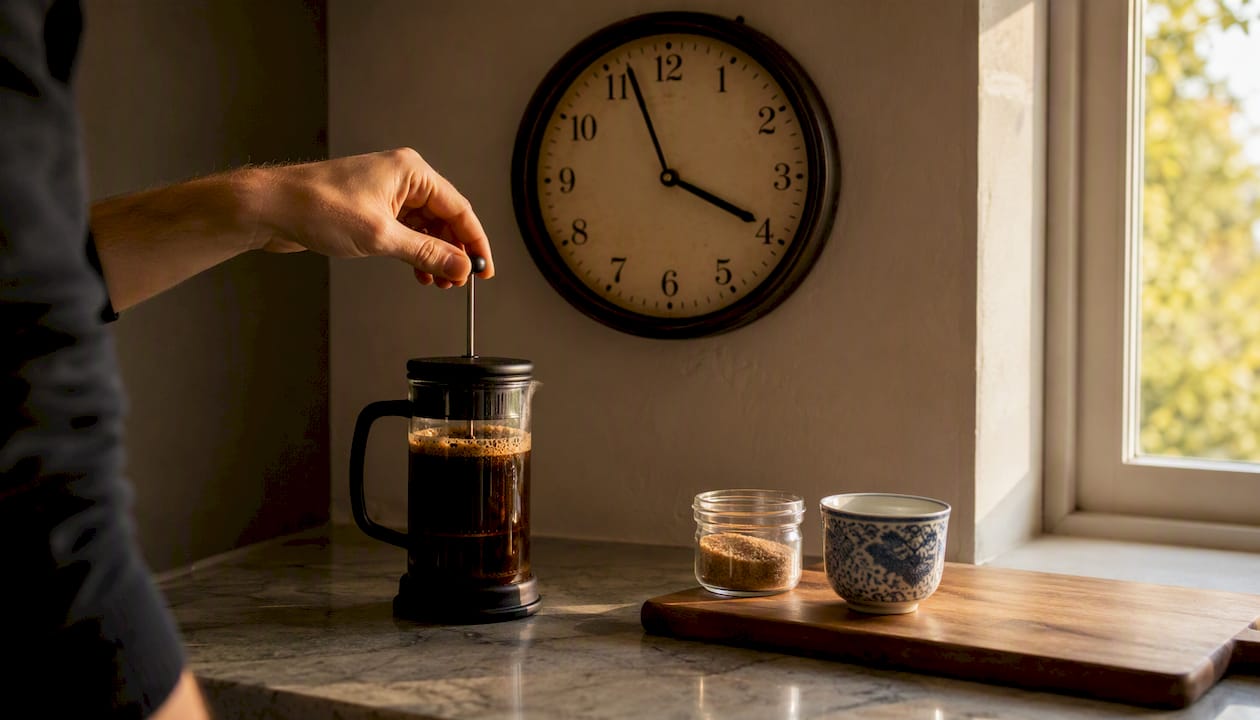
- Steep for 4 minutes. Set your timer. Don’t guess.
- Press slowly. Apply steady, even downward pressure over about 20–30 seconds. If it resists hard, your grind is too fine. If it drops with no resistance, it’s too coarse.
- Decant immediately. Pour all the coffee into a separate carafe or cups right away. Leaving it in the press continues extraction and turns the cup bitter within minutes.
Pro Tip: A slow, controlled press keeps the grounds packed below the filter. Pressing fast forces fine particles through the mesh and into your cup.
The 4-minute steep is the standard, and Serious Eats backs consistent timing as one of the most reliable ways to avoid sour or harsh results.
Why do ratio, grind, time, and temperature all affect the same cup?
Strength is how concentrated your coffee tastes. Extraction is how much of the coffee’s soluble compounds actually dissolved into the water. They’re related but not the same thing, and each variable pulls a different lever.
Understanding coffee extraction helps you diagnose problems faster. Here’s how each variable behaves in practice:
- Ratio controls strength directly. More coffee relative to water = more concentrated cup. Less coffee = thinner, weaker cup. This is your first adjustment.
- Grind size controls extraction rate. Finer grind = faster extraction, higher risk of bitterness and silt. Coarser grind = slower extraction, risk of sourness if too coarse. This is your second adjustment.
- Steep time fine-tunes extraction. Longer steep = more extraction. Shorter = less. Adjust in 15–30 second increments.
- Temperature affects how quickly compounds dissolve. At 200°F, you get full extraction of desirable flavors. Below 185°F, the cup often tastes flat and underdeveloped.
The practical troubleshooting rule is to change one variable at a time. Adjust ratio first if the cup is too weak or too strong. Move to grind if the texture or clarity is off. Touch time or temperature last, in small steps.
When you’re dialing in a new bean or a new grinder setting, this sequence keeps you from chasing your tail. Change two things at once and you won’t know which one fixed it.
Should you use a scale or scoops for French press coffee?
A scale wins every time, and the math shows why. One level tablespoon of coffee can weigh anywhere from 5 g to 7 g depending on roast level, grind coarseness, and how loosely you fill the spoon. For a 500 ml brew at 1:15, you need 33 g. At 5 g per tablespoon, that’s 6.6 tablespoons. At 7 g, it’s 4.7 tablespoons. That’s nearly two full tablespoons of difference from the same “scoop” method.
Tablespoon fallbacks (approximate):
- 1 level tablespoon ≈ 5–7 g of coarsely ground coffee
- 500 ml brew (33 g target): use 5–6 level tablespoons as a starting point
- 1 L brew (67 g target): use 10–11 level tablespoons
Coffeenatics notes that spoon measures vary by bean and roast, making a small digital scale the single most reliable upgrade a home brewer can make. A basic kitchen scale costs under $15 and removes the biggest source of daily inconsistency. If you’re serious about repeatable results, it’s the first thing to buy.
How do you fix a weak, bitter, or muddy French press?
Most bad cups come from one fixable mistake. Match your symptom to the cause below and make one change.
- Weak or watery: Too little coffee or too much water. Add 2–3 g more coffee next brew, or reduce water by 30 g. Don’t extend steep time as a first fix; it adds extraction without adding strength.
- Sour or sharp: Under-extracted. Grind slightly finer (one click on a burr grinder), or extend steep time by 30 seconds. Check that your water is reaching 200°F.
- Bitter or harsh: Over-extracted. Coarsen the grind by one click, or shorten steep time by 30 seconds. Also check that you decanted immediately after pressing.
- Muddy or silty: Grind is too fine, or you pressed too fast. Coarsen the grind and slow your press. Let the grounds settle for 30 seconds before pressing.
- Flat or dull: Water temperature too low. Brew closer to 200°F and check that you’re not letting the kettle cool too long before pouring.
Barista At Home and Tea or Coffee both treat immediate decanting as non-optional. Leaving coffee sitting on the grounds in the press is the most common cause of bitterness that home brewers blame on their beans.
How do you clean and maintain a French press?
Daily routine:
- Remove the plunger and discard grounds immediately after decanting. Letting wet grounds sit accelerates oil buildup.
- Rinse all parts with hot water. Don’t let grounds dry inside the press.
- Air dry with the plunger removed so moisture doesn’t trap stale oils in the mesh.
Weekly deep clean:
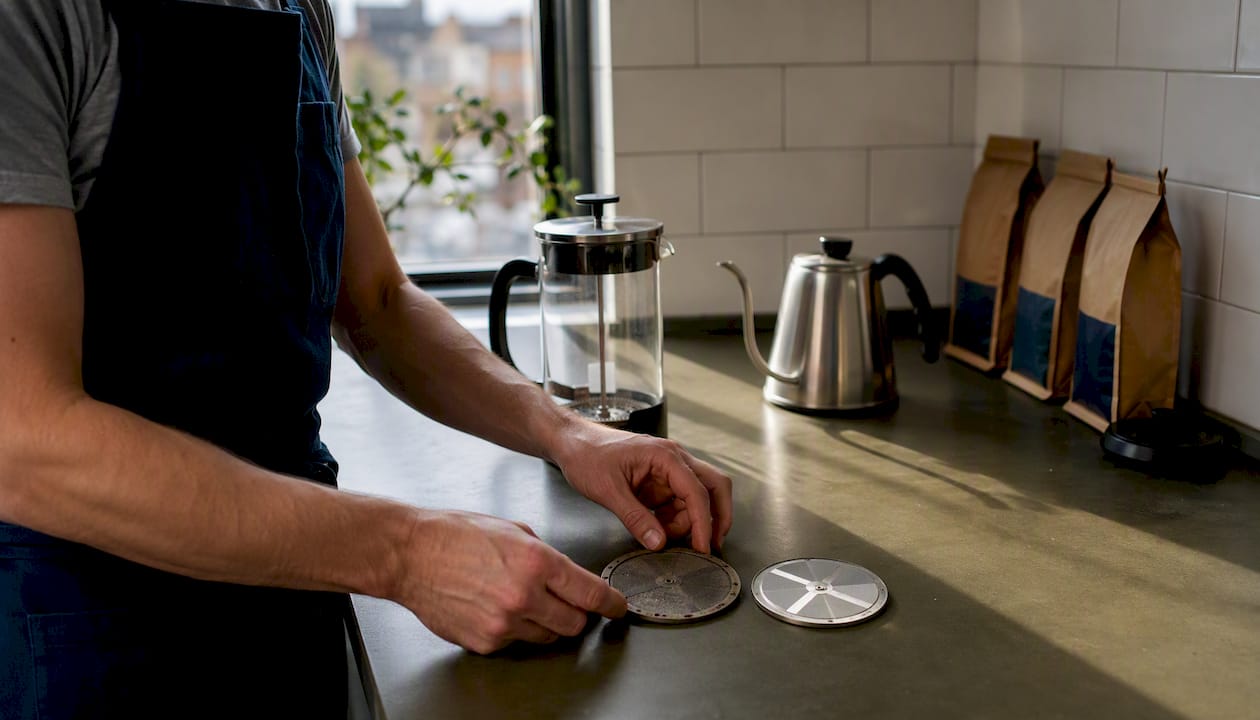
- Disassemble the plunger fully: unscrew the mesh screen, cross plate, and spiral plate.
- Scrub each piece with warm soapy water and a soft brush.
- Rinse the carafe with a small amount of baking soda dissolved in hot water to cut through coffee oils.
- Reassemble and let everything dry completely before storing.
Coffee oils go rancid over time and leave a bitter, musty taste in every subsequent brew. A press that looks clean can still carry weeks of oil residue in the mesh. If your coffee tastes off even with fresh beans and a correct ratio, the press itself is usually the culprit.
Replace the mesh screen when it shows visible damage, bent wires, or when excessive fines consistently pass through despite a correct coarse grind. Replacement screens are inexpensive and widely available.
Why the beans you choose matter as much as the ratio
Medium to dark roasts are the natural fit for French press. Their lower density and more developed cell structure extract evenly during full-immersion brewing, and they produce the body and richness the method is known for. Light roasts can work beautifully too, especially single-origin coffees where you want brightness and clarity, but they’re less forgiving of minor temperature or timing errors.
Bean freshness matters more than most home brewers realize. Coffee degasses CO₂ for several days after roasting, and that gas affects how evenly water saturates the grounds. Beans roasted within the past two to four weeks will bloom visibly and extract more evenly than stale coffee. The coffee origins guide is worth a read if you want to understand how origin affects what you taste in the cup.
One thing worth saying plainly: the ratio in this guide is a framework, not a rule. Once you’ve brewed the baseline recipe a few times and understand how your grinder and press behave, you’ll start adjusting instinctively. That’s the point.
French press is also just one of many ways to enjoy a morning ritual. If you’re curious about something completely different, Font’s matcha collection is worth exploring. A bowl of properly prepared Japanese matcha, whisked with a bamboo whisk, has its own kind of meditative precision that coffee lovers often find surprisingly satisfying. And if you’re into flavored drinks, the Sweetbird syrups work beautifully in both coffee and tea, with exact dosing guidance in the latte syrup ratio guide.
Font-mag has the beans and beyond for your next brew
Font Coffee Roasters’ retail coffee collection is sourced and roasted specifically for home brewers who care about what’s in their cup. Small-batch roasts like the Broken Arrow Reserve are built for methods like French press, where the full-immersion process rewards a well-developed bean. Free shipping on orders over $35 means stocking up on your weekly grind doesn’t cost extra.
Beyond coffee, Font’s lineup covers the full spectrum of specialty beverages. The MAG Tea loose-leaf collection and Rishi Barista Matcha give you a reason to reach for something different on mornings when you want a change of pace. Browse the full store at Font-mag and find your next favorite cup.
Sources
- French press coffee - NCA - About Coffee
- How to Use a French Press: Step-by-Step Guide | Barista At Home
- How to make better French press coffee - Serious Eats
- How to Make French Press Coffee (No Bitter, No Sludge)
- French Press Ratio by Cup Size: An Easy Brew Chart - Coffeenatics