

The Role of Biodiversity in Coffee Farms: What the Science Shows
Diverse, shade-rich coffee systems raise biodiversity and deliver ecosystem services that protect yield and improve cup quality, according to converging evidence from field experiments and meta-analyses. A 2024 meta-analysis found that farms with more than 30% shade cover host significantly higher species diversity than sun-grown farms with 0 to 5% shade cover. Bird and bee activity together can prevent a substantial yield loss from pests, and forest-adjacent pest control has been valued between $75 and $310 per hectare per year.
Here’s the roadmap for what follows:
- The strength and limits of the shade-biodiversity evidence
- How pollination and pest control actually protect yield
- What biodiversity means for organoleptic quality
- Practical canopy and groundcover strategies
- A season-ready checklist for farmers and advisors
Key Takeaways
Diverse, shade-rich coffee farms consistently support higher biodiversity and deliver measurable ecosystem services that protect yield and often improve cup quality.
| Point | Details |
|---|---|
| Shade drives diversity | Farms with over 30% shade cover host significantly more species than sun farms with 0 to 5% shade. |
| Pollinators and predators compound | Excluding both birds and bees cut yields by an average of 24.7% in field trials. |
| Pest control has real dollar value | Forest-adjacent pest control has been valued between $75 and $310 per hectare per year. |
| Quality follows ecology, not just shade percentage | Microclimate moderation and nutrient cycling, not shade alone, explain higher organoleptic scores. |
| Sourcing choices reflect this science | Font-mag’s small-batch coffees, including the Broken Arrow Reserve, are selected with these farm-level factors in mind. |
Table of Contents
- What the Research Says About Biodiversity in Coffee Agroecosystems
- How Pollinators and Predators Protect Coffee Yields
- Does Biodiversity Actually Improve Coffee Quality?
- Farm Practices That Build Biodiversity Without Sacrificing Yield
- When Biodiversity and Yield Actually Compete
- The Research Behind These Findings and Where the Gaps Remain
- A Season-by-Season Checklist for Building Farm Biodiversity
- Sources
What the Research Says About Biodiversity in Coffee Agroecosystems
The clearest signal in coffee ecology research comes from comparing shade levels directly. The meta-analysis referenced above pooled results across dozens of farm studies and found a consistent pattern: high-shade systems (over 30% canopy cover) support meaningfully more species than sun farms with minimal shade.
Three groups benefit most:
- Birds gain nesting habitat and insect prey, with richness climbing as canopy complexity increases.
- Insects, including pollinators and predatory species, track flowering diversity in the shade layer.
- Epiphytes and mammals depend on structural features, like bark texture and canopy connectivity, that monoculture sun farms simply don’t offer.
Statistic Callout: Coffee farms with shade cover above 30% show significantly greater species diversity than farms with 0 to 5% shade, across insects, birds, mammals, and epiphytes.
Abundance and richness don’t always move together, though. A farm can host large numbers of a few tolerant species while losing the rarer specialists that indicate real ecological health. And the evidence base itself has a geography problem: most robust studies come from Latin America, while Africa and Asia remain comparatively understudied, so extrapolating shade thresholds to those regions carries real uncertainty.
How Pollinators and Predators Protect Coffee Yields
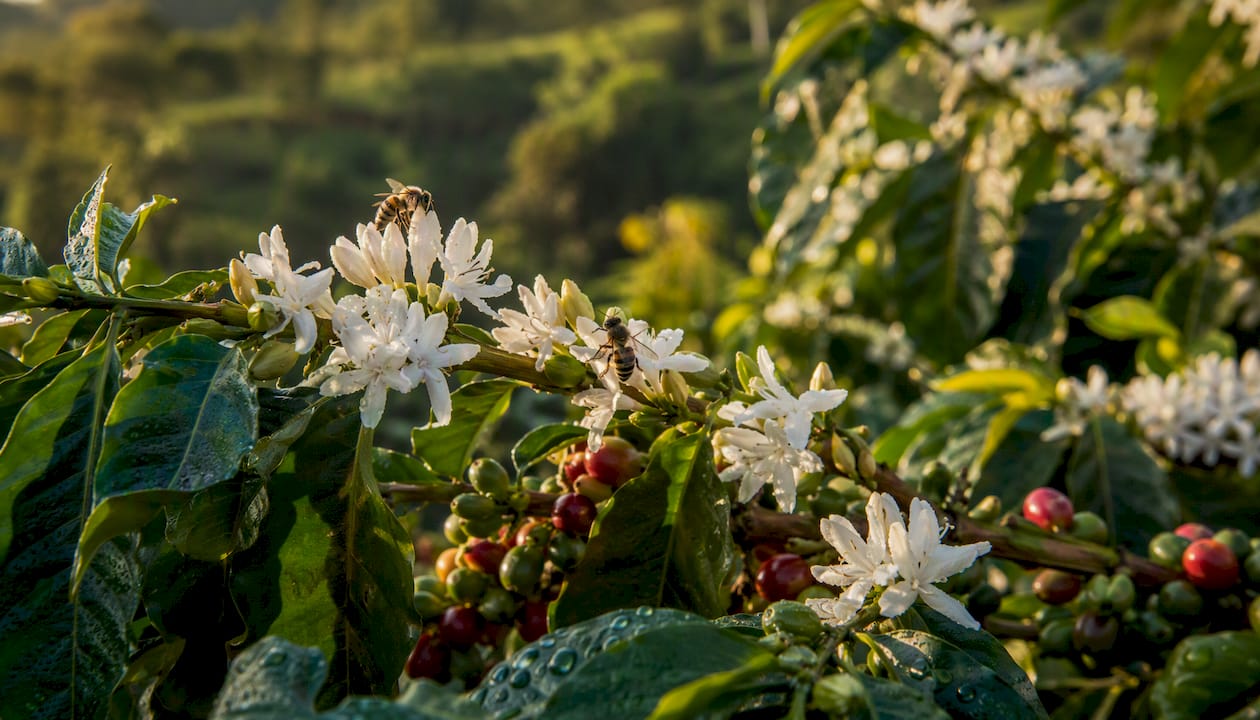
Biodiversity earns its keep through specific, measurable jobs. Pollination and pest control are the two that matter most on a working farm, and they don’t operate independently.
A field experiment in Costa Rica tested what happens when birds and bees are excluded from coffee plots, separately and together. Birds suppress the coffee berry borer and other insect pests; bees improve fruit set through pollination. Together, they compound each other’s benefits.
- Bird predation reduces borer infestation rates, particularly near forest edges.
- Bee pollination increases fruit set and can improve bean uniformity.
- Forest patches and landscape connectivity can double pest-control value, with benefits estimated at $75 to $310 per hectare per year.
- Root systems and leaf litter from diverse canopies support soil fertility and water infiltration.
- Deeper-rooted shade trees moderate soil moisture swings during drought, a form of climate buffering that pure sun systems lack.
None of this works as well in isolation. A farm with plenty of pollinators but no pest predators, or vice versa, still leaves yield on the table.
Does Biodiversity Actually Improve Coffee Quality?
Yes, generally, though not by a fixed formula. A review of ecological quality research found that beans from diverse, shade-grown plantations tend to score higher on organoleptic assessments than beans from simplified or unshaded systems, according to research on ecological quality as a coffee quality enhancer. But the effect varies by altitude and region, so a blanket “more shade equals better cup” rule doesn’t hold everywhere.
The mechanisms matter more than the shade percentage itself:
- Shade moderates microclimate swings, slowing cherry ripening and allowing more even sugar development.
- Diverse canopies improve water-use efficiency during dry spells, reducing stress-related defects.
- Leaf litter and root diversity support nutrient cycling that feeds bean development.
For buyers and roasters, the practical takeaway is to treat biodiversity indicators as one quality signal among several, not a substitute for cupping. A farm’s flavor profile still depends heavily on origin-specific factors like varietal and processing method. Biodiversity shifts the odds toward a better cup; it doesn’t guarantee one.
Farm Practices That Build Biodiversity Without Sacrificing Yield
Effective biodiversity management on a coffee farm comes down to species choice, structure, and patience.
- Plant native, mixed-species canopies rather than a single shade tree. Research consistently shows that diverse agroforestry using native trees provides conservation value that single-species shade additions can’t match.
- Target shade cover above 30% as a starting benchmark, then adjust based on local trials. Regional rainfall, elevation, and pest pressure all shift the optimal number, so treat 30% as a reference point, not a rule.
- Add groundcover and mulch between rows. Cover crops reduce erosion, suppress weeds, and slowly build soil organic matter.
- Retain nearby forest patches and hedgerows. Landscape connectivity feeds pest-control value directly, since forest bolsters bird abundance and pest control in adjacent plots.
- Install artificial nest sites for beneficial insects. Experiments show that adding nest structures in shaded farms increases twig-nesting ant colonization, a low-cost intervention with measurable results.
Pro Tip: Phase in new shade trees over two or three seasons rather than converting a whole block at once. This lets you track fruit set and pest levels as canopy cover increases, so you can catch an over-shading problem before it costs you a full harvest.
Farmers already reducing agrochemical inputs will find a lot of overlap with pesticide-free coffee practices, since both approaches lean on natural predator populations instead of sprays.
When Biodiversity and Yield Actually Compete
Trade-offs are real but not automatic. Shade-grown systems often show synergies rather than conflicts: research on agroforestry and ecosystem services found that increased canopy cover correlates with higher carbon storage and greater resilience to hurricane damage, alongside biodiversity gains.
Yield losses usually trace back to management mistakes, not shade itself:
- Choosing fast-growing but ecologically weak shade species instead of native trees
- Letting canopy density climb past the point of adequate light for fruit set
- Pruning shade trees at the wrong time in the fruiting cycle, disrupting flowering
Farmers should track a few concrete numbers each season: broca (berry borer) infestation rates, fruit set percentage, bean size and defect counts, and net income per hectare. Watching these together, rather than shade percentage alone, tells you whether your system is actually working.
The Research Behind These Findings and Where the Gaps Remain
The core claims in this article rest on two research approaches working together. Meta-analyses pool results across many independent farm studies to identify consistent patterns, like the shade-diversity relationship. Field experiments, by contrast, isolate specific mechanisms, such as the Costa Rica study that physically excluded birds and bees to measure their combined yield effect.
Both approaches have limits worth naming plainly.
- Shade definitions vary across studies, some measure canopy cover, others measure tree density, which complicates direct comparisons.
- Geographic sampling skews heavily toward Latin America, leaving open questions about how these findings translate to African and Asian coffee regions.
- Extension officers testing new practices locally should run small paired plots (shaded versus unshaded) before recommending changes farm-wide.
Researchers increasingly argue that pollination and pest control should be evaluated together rather than separately, since their combined benefit on yield tends to exceed what either service delivers alone.
A Season-by-Season Checklist for Building Farm Biodiversity
Start with a diagnostic before changing anything:
- Measure your current shade percentage across different plots, not just an average for the whole farm.
- Map nearby forest patches or remnant vegetation within a few hundred meters.
- Record your main pest pressures over the last two seasons, especially broca rates.
- Add native, nitrogen-fixing, or fruit-bearing trees in gaps rather than converting entire blocks.
- Establish hedgerows along field borders to improve landscape connectivity.
- Install a handful of artificial nest boxes or nesting structures in shaded sections.
- Introduce cover crops or mulch in rows showing erosion or compaction.
- Set a quarterly check-in on broca infestation, fruit set, bean defects, and new tree survival rates.
Small, monitored changes beat a full-farm overhaul every time. You catch problems while they’re still cheap to fix.
What Buying Biodiversity-Minded Coffee Actually Supports
Font-mag sources small-batch coffee, including the Broken Arrow Reserve, with attention to how farms are managed, not just how the beans taste in the cup. That connection between farm practice and final flavor is exactly what the research above describes: bird-friendly growing conditions and sustainable sourcing decisions aren’t marketing add-ons. They reflect the same shade and biodiversity factors documented across the studies cited here.
Bring That Same Curiosity to Your Cup
You’ve just read what makes a coffee farm ecologically resilient. Now’s a good moment to taste where that thinking leads.

Font-mag built its lineup around the idea that sourcing decisions show up in the final product, whether that’s a single-origin roast or a syrup blended for a café menu. Beyond the coffee itself, Font-mag carries premium loose-leaf tea, Japanese matcha, and the Sweetbird collection of syrups, so a shop supporting biodiverse, shade-grown sourcing doesn’t have to be a one-product relationship. If the ecological story behind your coffee matters to you, browse the flavored coffee collection and see which roast fits your morning routine, with free shipping on orders over $35.
Sources
- Effect of shade on biodiversity within coffee farms: A meta-analysis
- Ecological quality as a coffee quality enhancer. A review
Recommended
- What Is Bird Friendly Coffee? Benefits and Buying Guide – Font Coffee Roasters
- Sustainable Coffee Farming: What It Means for Buyers – Font Coffee Roasters
- Regenerative Coffee Farming: How It Rebuilds Farms – Font Coffee Roasters
- Why Freshness Matters in Coffee: Flavor Science Explained – Font Coffee Roasters