

Regenerative Coffee Farming: How It Rebuilds Farms
Regenerative coffee farming is an outcome-focused approach to growing coffee that actively restores soil health, biodiversity, and water cycles rather than simply maintaining them, building farms that are more resilient and productive over the long term. According to the GCP RegenCoffee Guidance 2025, it represents a recommended sector-level common language for coffee producers and buyers who want measurable environmental and social outcomes, not just a label.
Why does it matter right now?
- Soil health: Conventional coffee farming depletes topsoil over decades. Regenerative practices rebuild organic matter and microbial life, which directly supports yield stability.
- Climate resilience: Farms with diverse tree canopies and healthy soil absorb more water and withstand drought and temperature swings better than monoculture plots.
- Farmer livelihoods: Diversified income streams, from intercropped fruit trees to beekeeping, reduce the income volatility that makes smallholder farming so precarious.
- Long-term supply security: A degraded farm eventually stops producing quality coffee. Regenerative systems protect the supply chain at its source.
The sections below break down exactly what these practices look like on the ground, which certifications and brands are building programs around them, and how you can support regenerative sourcing as a shopper or café buyer.
Key Takeaways
Regenerative coffee farming is the most outcome-focused approach in the industry, combining soil restoration, biodiversity, and farmer income diversification into a single farm-level strategy backed by growing modeling evidence.
| Point | Details |
|---|---|
| Definition | Regenerative coffee farming restores soil, water, and biodiversity rather than simply maintaining them. |
| Core practices | Agroforestry, cover cropping, composting, reduced tillage, and income diversification are the most common on-farm tools. |
| Modeled benefits | TechnoServe’s 2025 modeling projects a 62% average farmer income increase and 3.5 million tons CO₂e reduction across 9 countries. |
| Key trade-offs | Upfront costs, training gaps, and short-term yield dips are real barriers; site-specific agronomic support is necessary. |
| Consumer action | Look for ROC® certification, producer transparency, and programs that fund agronomy, not just price premiums. |
Table of Contents
- What is regenerative coffee farming, and how does it differ from organic?
- What practices do regenerative coffee farmers actually use?
- What are the real benefits of regenerative coffee farming?
- What are the challenges and trade-offs of going regenerative?
- Which certifications and brands are leading on regenerative coffee?
- How can you support regenerative coffee as a shopper or café buyer?
- What does the research actually say about regenerative coffee’s impact?
- Why regenerative sourcing matters to Font-mag
- Sources
What is regenerative coffee farming, and how does it differ from organic?
Regenerative coffee farming treats the farm as a living ecosystem rather than a production unit. The goal is not just to avoid harm but to actively improve the land with each growing cycle. Soil gets healthier, not just maintained. Water retention improves. Biodiversity expands. That outcome-first framing is what separates it from most other sustainability labels.
The distinction matters because “organic,” “sustainable,” and “regenerative” are often used interchangeably in marketing copy, but they describe genuinely different commitments. Organic certification primarily governs what inputs are prohibited — synthetic pesticides, certain fertilizers — without requiring that the farm improve over time. Sustainable farming is broader still, often meaning “do less harm” without specifying how or measuring whether conditions actually got better.
Regenerative agriculture, by contrast, is defined by outcomes. As the WUR discussion on quality trade-offs notes, there is no single legally binding definition of “regenerative agriculture,” which creates real labeling confusion. Industry bodies like the Global Coffee Platform are working to standardize language and trackable KPIs precisely because the term can otherwise be claimed by anyone.
| Dimension | Organic | Sustainable | Regenerative |
|---|---|---|---|
| Primary goal | Avoid prohibited inputs | Reduce negative impact | Actively restore ecosystems |
| Rules vs. principles | Rules-based (input lists) | Principles-based (varies widely) | Outcomes-based (measurable KPIs) |
| Input restrictions | Strict (no synthetics) | Varies by standard | Flexible; inputs judged by effect |
| Typical outcomes | Reduced chemical load | Maintained productivity | Improved soil, biodiversity, resilience |
Coffee is a particularly strong candidate for regenerative interventions. Because it is a perennial crop with a woody structure, it integrates naturally with shade trees and diverse plant communities. The CGIAR resource on regenerative practices in coffee highlights that coffee’s perennial structure and capacity to incorporate trees make it one of the better crops for agroforestry systems that deliver measurable microclimate and biodiversity benefits.
What practices do regenerative coffee farmers actually use?
The Alliance Bioversity International practical guidebook is clear on one point: there is no universal recipe. Practice selection must be site-specific, and farmers need skilled agronomic support to combine principles effectively. That said, a consistent set of practices shows up across most regenerative coffee programs.
-
Agroforestry and shade management. Planting shade trees above coffee creates a multi-layered canopy that moderates temperature, reduces evaporation, and provides habitat for birds and beneficial insects. It also produces additional income from timber or fruit. If you want to understand how this connects to biodiversity certification, the bird-friendly coffee buying guide covers the habitat angle in detail.
Pro Tip: *Ask a roaster whether their shade-grown claim is verified by canopy cover measurements or just a farm-level self-report.
-
Cover cropping. Growing plants between coffee rows protects bare soil from erosion, adds organic matter as they decompose, and can fix atmospheric nitrogen. The 2025 agronomy review in Agronomy Journals identifies cover cropping as one of the practices with consistent evidence for improving soil health and yield stability in coffee systems.
-
Composting and organic amendments. Returning coffee pulp, cherry skins, and other organic waste to the soil closes the nutrient loop and feeds soil microbes. Well-managed compost can reduce dependence on purchased fertilizers over time.
-
Reduced tillage and minimized soil disturbance. Tilling breaks up fungal networks and releases stored carbon. Keeping soil disturbance low preserves the structure that holds water and supports root systems.
-
Optimized nutrient management. Regenerative does not always mean zero synthetic inputs. It means using inputs strategically, based on soil tests, to avoid over-application that leaches into waterways. Some programs allow targeted fertilizer use where organic sources alone cannot meet crop demand.
-
Bioinputs and microbial inoculants. Applying beneficial bacteria and mycorrhizal fungi to soil or seedlings can improve nutrient uptake and plant resilience. These are increasingly common in Latin American coffee programs.
-
Water management and erosion control. Contour planting, terracing, and vegetated buffer strips along waterways slow runoff and keep topsoil on the farm. This matters especially on steep hillside plots common in Central America and Ethiopia.
-
Diversified income streams. Intercropping with plantain, avocado, or cacao, or integrating beekeeping, gives farmers revenue that does not depend entirely on coffee prices. This is one of the most underappreciated elements of regenerative systems: economic resilience is part of the model, not an afterthought.
What are the real benefits of regenerative coffee farming?
The benefits of regenerative coffee are strongest when practices are combined and sustained over multiple seasons. A single cover crop season does not transform a farm. But the evidence from field studies and modeling is compelling.
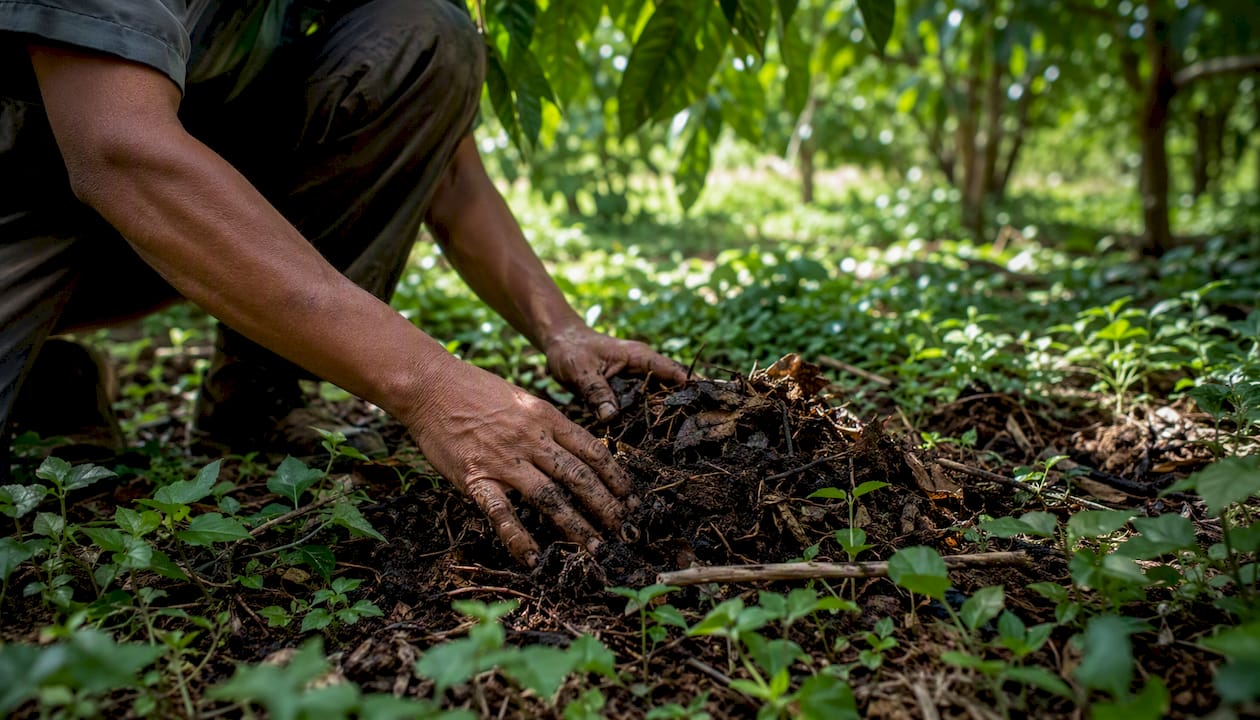
Soil health is the foundation. The 2025 agronomy review synthesizes field studies showing that agroforestry, composting, and cover cropping measurably improve soil organic matter, microbial diversity, and water-holding capacity in coffee systems. Healthier soil means plants can access nutrients more efficiently and recover faster from stress events like drought.
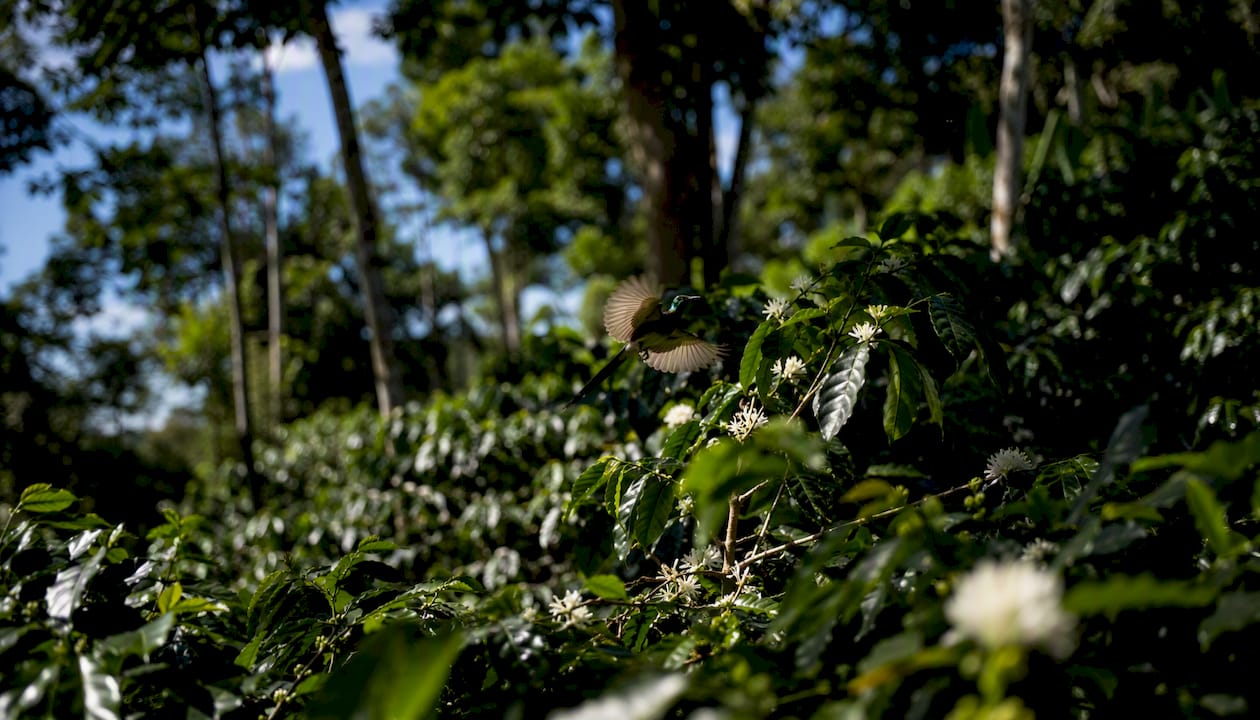
Biodiversity follows from canopy complexity. Shade-grown coffee farms support significantly more bird and insect species than sun-grown monocultures, and those species provide pest control and pollination services that reduce input costs. The CGIAR research specifically calls out agroforestry’s microclimate benefits, which buffer coffee plants from temperature extremes.
Climate resilience is increasingly the headline argument. Farms with diverse canopy layers and high soil organic matter absorb more rainfall, reducing both flood risk and drought stress. This matters for a crop already under pressure from rising temperatures in traditional growing regions.
Farmer income and stability may be the most consequential benefit. Diversified farms are less exposed to coffee price crashes. When a farmer also harvests fruit, timber, or honey, a bad coffee year does not necessarily mean a bad year overall. TechnoServe’s 2025 modeling estimated that transitioning 3.2 million smallholders across nine countries could produce an average modeled income increase of 62%, alongside modeled reductions of approximately 3.5 million tons of CO₂e, though TechnoServe is explicit that these figures depend on investment levels and implementation assumptions.
Modeled impact (TechnoServe, 2025): Transitioning 3.2 million smallholders to regenerative practices across nine countries could increase average farmer incomes by a modeled 62% and reduce greenhouse gas emissions by an estimated 3.5 million tons CO₂e cumulatively, subject to investment and implementation conditions.
What are the challenges and trade-offs of going regenerative?
Regenerative farming is not a cost-free upgrade. The barriers are real, and honest programs acknowledge them.
- Upfront costs and financing gaps. Planting shade trees, buying compost inputs, or installing erosion controls requires capital that most smallholders do not have on hand. Without financing support, the transition stalls before benefits materialize.
- Knowledge and training needs. Combining practices effectively requires agronomic expertise that many farming communities lack access to. A farmer who plants shade trees without understanding spacing and species selection can inadvertently reduce yields.
- Short-term yield trade-offs. During the transition period, yields can dip before soil health improvements take hold. This is a genuine risk for farmers whose income depends on every harvest.
- Post-harvest quality risks. Improved soil and microclimate conditions can change bean moisture and fermentation dynamics in ways that require adapted drying and processing. The WUR discussion notes that some post-harvest quality risks can emerge during transitions unless handling is adjusted alongside field practices. For a deeper look at how processing intersects with farm-level changes, the coffee processing methods guide is worth reading.
- Greenwashing risk. Because “regenerative” has no legally binding definition, any brand can use the word. Programs vary enormously in rigor, transparency, and actual farm-level investment.
- Scaling and traceability limits. Verifying regenerative outcomes across thousands of smallholder farms is logistically difficult. Supply-chain traceability systems are improving but remain a bottleneck.
Pro Tip: When evaluating a brand’s regenerative claim, look for programs that combine agronomy training with multi-year purchase commitments and financing support. A program that only pays a price premium without investing in farmer capacity is unlikely to produce lasting outcomes.
Which certifications and brands are leading on regenerative coffee?
The most rigorous third-party certification currently available is Regenerative Organic Certified® (ROC®), developed by the Regenerative Organic Alliance. ROC® builds on USDA Organic as a baseline and adds requirements across three pillars: soil health and land management, animal welfare, and farmer and worker fairness. It is tiered (Bronze, Silver, Gold), which means farms can enter at a lower level and improve over time. That structure makes it more accessible than a single pass/fail standard while still demanding measurable progress.
Beyond ROC®, several programs and organizations are shaping how regenerative coffee farming scales:
- Pachamama Coffee: A farmer-owned cooperative that integrates regenerative practices into its supply chain and gives growers direct ownership of the brand. Their model ties farmer economic empowerment directly to land stewardship.
- Equator Coffees: A California-based specialty roaster with long-standing direct-trade relationships and documented investment in farm-level sustainability programs, including agroforestry support.
- NESCAFÉ (Nescafé Plan / Nespresso AAA): At the corporate scale, Nestlé’s programs fund agronomic training, input support, and sourcing commitments across hundreds of thousands of farmers. The Nespresso AAA Sustainable Quality Program works with the Rainforest Alliance and includes regenerative practice components. Scale and transparency vary, and these programs should be evaluated on measurable farm outcomes, not brand claims alone.
- TechnoServe: A nonprofit that frames regenerative adoption as an economic strategy. Their 2025 investment case models the financial returns of funding regenerative transitions at scale, making the case that training and finance investments pay back through income gains and supply-chain stability.
- Global Coffee Platform (GCP): The GCP’s 2025 RegenCoffee Guidance provides a sector-level common language and standardized KPIs so that buyers and producers can track outcomes consistently rather than relying on self-reported labels.
Brand programs vary significantly in scope. A multinational sourcing program and a small direct-trade roaster are both using the word “regenerative,” but the depth of farm-level investment, the transparency of reporting, and the actual outcomes on the ground can be very different. Reading program claims critically, and looking for third-party verification, is the most reliable approach.
How can you support regenerative coffee as a shopper or café buyer?
Supporting regenerative coffee does not require a degree in agronomy. It requires asking better questions and knowing what to look for.
- Look for ROC® certification on the bag. It is the most rigorous third-party standard currently available and requires USDA Organic as a baseline.
- Check for producer transparency. Does the roaster name the farm, cooperative, or region? Traceable supply chains are a minimum condition for any credible regenerative claim.
- Ask whether the program funds agronomy. A price premium alone does not change farming practices. Training, technical assistance, and multi-year purchase commitments do.
- Look for multi-year sourcing relationships. Regenerative transitions take three to five years to show measurable soil improvements. A roaster who switches suppliers annually cannot support that process.
- Ask about farm diversification. Does the program encourage or support intercropping, shade trees, or other income streams? If the answer is “we pay a fair price,” that is not the same thing.
Pro Tip: Greenwashing in coffee often hides behind vague language like “sustainably sourced” or “eco-friendly.” Ask specifically: Does your sourcing partner invest in farmer training? Do you have multi-year contracts with producers? Can you share farm-level outcome data? A roaster who cannot answer those questions specifically probably does not have a meaningful regenerative program.
For café operators thinking about how regenerative sourcing fits into a broader responsible procurement strategy, the food service sustainability guide from Wild Foodz covers how operators can integrate sourcing values across their full menu.
Font-mag’s broader product range, including premium loose-leaf teas, Japanese matcha, and Sweetbird syrups, reflects the same sourcing-conscious approach that makes regenerative coffee worth seeking out.
What does the research actually say about regenerative coffee’s impact?
The strongest recent evidence comes from modeling studies rather than large-scale field trials, which means results should be read as estimates of potential rather than guaranteed outcomes.
TechnoServe’s 2025 investment case is the most cited recent analysis. TechnoServe frames this explicitly as an economic argument: the investments required in training and finance are projected to pay back through income gains and supply-chain stability, not just environmental benefits.
The 2025 agronomy review in Agronomy Journals synthesizes field-level studies and finds consistent evidence that agroforestry, cover cropping, composting, and integrated pest management improve soil health indicators, support biodiversity, and contribute to yield stability in coffee systems. These are measured outcomes from real farms, not models, which makes them a useful complement to the TechnoServe projections.
The GCP’s 2025 guidance adds a methodological point: standardized KPIs are needed so that buyers and producers can track outcomes without relying solely on label names. Without agreed metrics, “regenerative” remains a marketing claim rather than a verifiable commitment.
How to read these studies: modeling estimates show what is possible under favorable conditions with adequate investment. Field study results show what has been measured on real farms, often under specific conditions that may not generalize. Both matter, and neither should be read as a guarantee.
Why regenerative sourcing matters to Font-mag
At Font-mag, we pay attention to where coffee comes from because it directly shapes what ends up in the cup. Regenerative farming produces beans from healthier soil, more complex microclimates, and more stable farm systems, and those conditions show up in flavor. The connection between farming practice and cup quality is real, and the coffee terroir guide explains the science behind it.

Our commitment to quality sourcing extends across everything we carry, from small-batch roasts to our matcha and tea selections. Supporting regenerative supply chains is part of how we think about what it means to offer genuinely premium products.
Browse our specialty roasted coffees to find options from roasters with transparent sourcing practices, or explore our matcha and tea collection for the same sourcing-conscious approach applied to the full beverage range.

Sources
- GCP RegenCoffee Guidance 2025
- Regenerative agriculture for low-carbon and resilient coffee farms: A practical guidebook | Alliance Bioversity International - CIAT
- Report: Regenerative coffee could boost farmer incomes and the environment | TechnoServe (2025)
- Regenerative agricultural practices in coffee plantations: A review of techniques, benefits, and pathways for sustainable cultivation (Agronomy Journals, 2025)
- WUR discussion on regenerative agriculture and quality trade-offs
- CGIAR resource on regenerative practices in coffee
Recommended
- Sustainable Coffee Farming: What It Means for Buyers – Font Coffee Roasters
- Why Independent Roasters Beat Corporations: 2026 Guide – Font Coffee Roasters
- What Is Bird Friendly Coffee? Benefits and Buying Guide – Font Coffee Roasters
- Farm to Cup Texas Coffee Guide for True Enthusiasts – Font Coffee Roasters