

What Is a Barista Style Syrup? A Home Barista's Guide
A barista-style syrup is a concentrated, viscosity-engineered flavored sweetener formulated for precise dosing into espresso and milk drinks. Unlike the thin 1:1 simple syrup you stir together at home, these syrups are built to cling to steamed milk foam, integrate evenly through a latte, and deliver consistent flavor every single time. For most home applications, a standard dose runs 1–2 pumps per 12 oz drink, with each pump delivering a measured volume. If you only take one thing from this guide: use a calibrated pump or measure by milliliter, not by eye.
Table of Contents
- What exactly is a barista-style syrup?
- What’s actually inside a barista syrup?
- How barista syrups differ from simple homemade syrup
- How baristas measure and dose syrup
- Three go-to recipes you can make right now
- DIY vs. commercial syrups: what actually matters
- How to store syrups safely
- Calories, sugar, and sugar-free options
- Key Takeaways
- The part most guides skip
- Why viscosity is the real story
- Font-mag has what you need to do this right
- Useful sources and further reading
What exactly is a barista-style syrup?
The term covers flavored syrups designed to be added to brewed coffee and milk drinks, not to be confused with coffee concentrate syrup, which is a coffee-forward base used to make a coffee drink from scratch. These are two distinct products that behave very differently in recipes. A barista-style flavoring syrup adds sweetness, flavor, and body to an already-brewed espresso or cold brew. A coffee concentrate replaces the espresso entirely.
Barista syrups serve four jobs in a drink:
- Flavor — vanilla, caramel, hazelnut, chocolate, and seasonal rotations
- Controlled sweetness — a measured dose replaces guesswork with a spoon of sugar
- Mouthfeel and viscosity — the syrup’s thickness affects how a drink feels on the palate
- Recipe repeatability — every cup tastes the same regardless of who made it
Those uses extend well beyond coffee. Botanical and tea-friendly syrups work beautifully in iced teas, lemonades, and even cocktails. Font-mag’s MAG Tea lineup and Sweetbird collection are built exactly for this kind of cross-beverage versatility.
What’s actually inside a barista syrup?
The ingredient list is where barista syrups part ways with a basic pot of dissolved sugar. Here’s what you’ll typically find and why each component matters:
| Ingredient | Role | Found In |
|---|---|---|
| Sucrose (1:1 ratio) | Base sweetness, easy dissolution | Simple syrup, entry-level barista syrups |
| Sucrose (2:1 ratio) | Thicker body, longer shelf life | Rich syrups, some commercial blends |
| Invert sugar | Resists crystallization, smoother texture | Commercial barista syrups |
| Glycerin (humectant) | Mimics mouthfeel in sugar-free versions | Sugar-free syrups |
| Natural/artificial extracts | Flavor delivery | All flavored syrups |
| Stabilizers/rheology modifiers | Controls viscosity for foam integration | Commercial formulas |
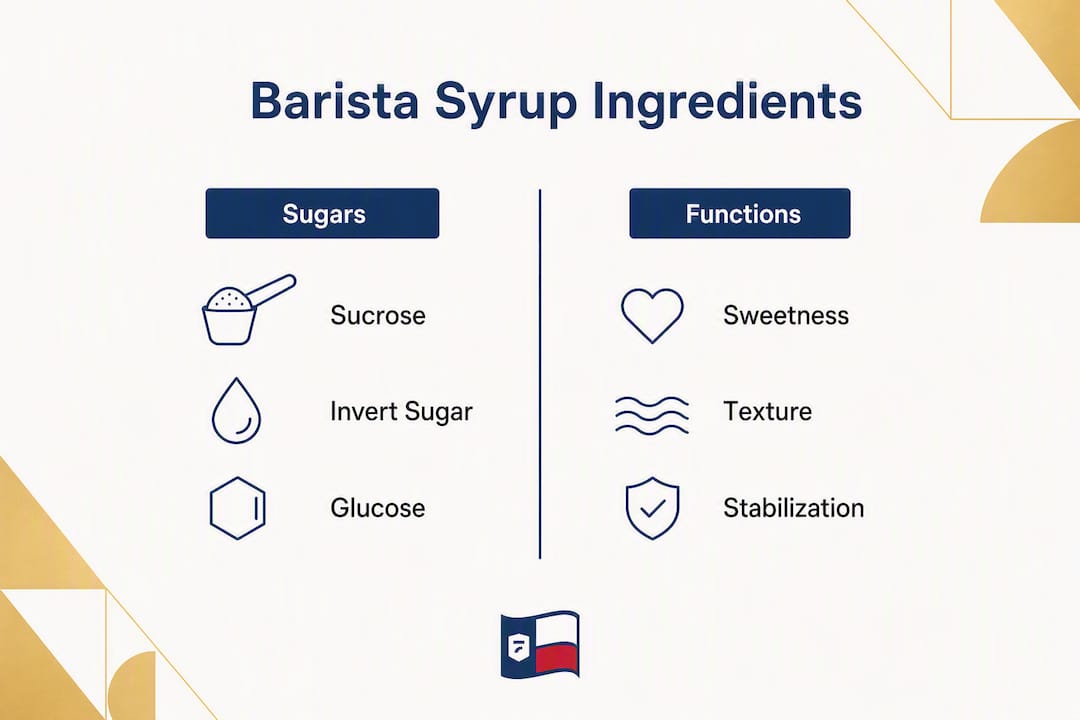
Invert sugar is the ingredient most home recipes skip, and it’s the one that makes the biggest difference. It’s produced by splitting sucrose into glucose and fructose, which resists crystallization and gives the syrup a silkier texture. Higher sugar ratios (2:1) achieve some of the same crystallization resistance without the chemistry, which is why a rich syrup keeps longer in your fridge.
Commercial formulas use specific sugar blends and stabilizers to prevent crystallization and maintain texture over time. Stabilizers also act as rheology modifiers, meaning they control how the syrup flows. A syrup engineered to the right viscosity clings to foam and integrates evenly into drinks rather than pooling at the bottom of the cup.
Pro Tip: When reading a commercial syrup label, look for “invert sugar,” “glycerin,” or a listed Brix percentage (sugar concentration). These signal a syrup formulated for professional use, not just sweetness.
How barista syrups differ from simple homemade syrup
The gap between a jar of homemade simple syrup and a commercial barista syrup is wider than most home baristas expect.
| Property | 1:1 Simple Syrup | Barista-Style Syrup |
|---|---|---|
| Viscosity | Thin, watery | Engineered for body and cling |
| Flavor potency | Mild | Concentrated, consistent per pump |
| Crystallization risk | Moderate | Low (invert sugar or stabilizers) |
| Shelf life (refrigerated) | 3–4 weeks | 6+ months (commercial, unopened) |
| Dosing method | Spoon/pour | Calibrated pump or measured ml |
| Hot drink behavior | Dissolves quickly | Integrates and coats evenly |
| Iced drink behavior | Can dilute unevenly | Holds texture through ice |
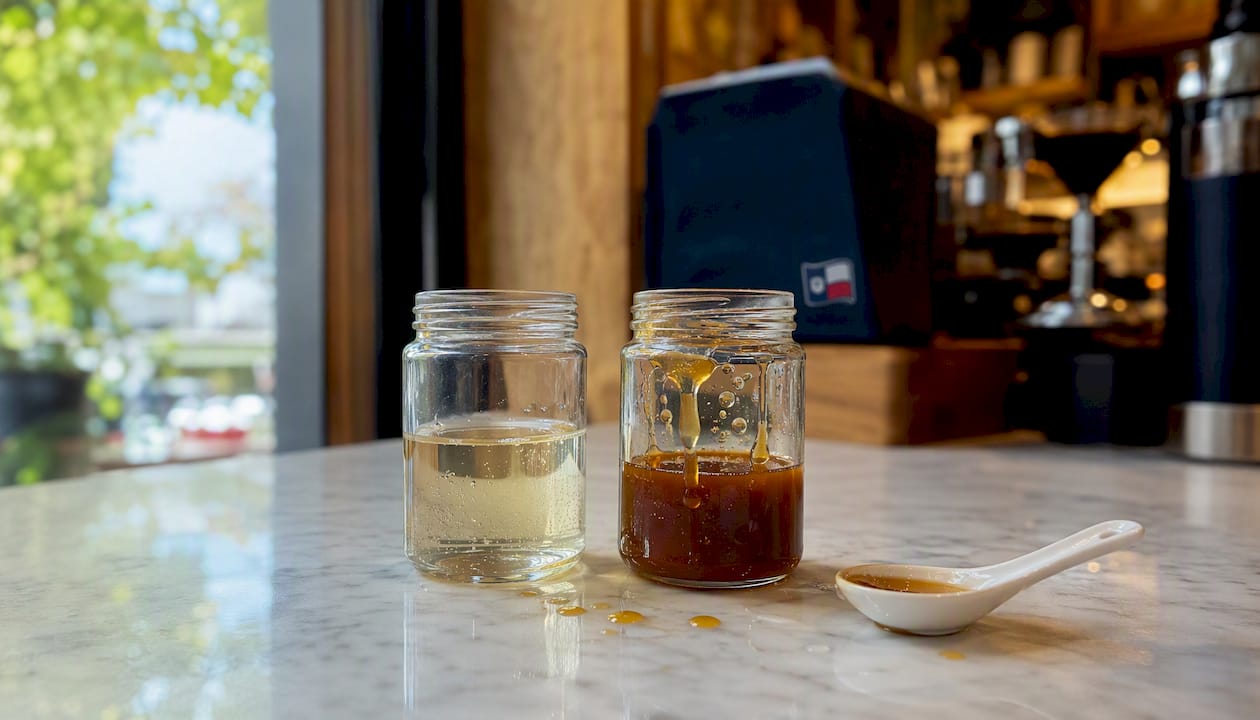
The workflow difference matters in a café setting. A barista pulling 200 drinks a day cannot measure a spoon of syrup per cup. A calibrated pump delivers the same volume every press, which is why standardized pump measurements are the practical secret behind consistent flavor across shifts. At home, that same logic applies: one pump is one dose, no tasting required.
For label reading, the signals to look for are “invert sugar,” a listed percentage of sugar solids, the presence of glycerin or other humectants, and the word “concentrate.” Any of those flags tells you the syrup was formulated for professional dosing, not casual pouring.
How baristas measure and dose syrup
Industry-standard pump volumes typically range between 7.5 ml and 10 ml per pump press. Most cafés set a standard of 1 pump per certain volume of drink, scaling up for larger sizes, with typical dosages increasing for larger cups.
Calibrating your pump at home:
- Press the pump once into a small measuring cup or graduated syringe.
- Note the volume in milliliters.
- If it falls outside 7.5–10 ml, adjust the pump depth or switch to a measured pour.
- Record your pump’s exact volume and use it as your dosing unit going forward.
The Font-mag Republic of Tea Pump #70100 is a calibrated pump that fits standard syrup bottles and takes the guesswork out of this entirely.
Sequence matters as much as volume:
- For hot drinks: add syrup to the cup first, then pull the espresso shot directly onto it. The heat and pressure dissolve and integrate the syrup immediately.
- For iced drinks: combine syrup and espresso before adding ice to prevent the syrup from clinging to the ice or settling unevenly.
Pro Tip: For cold foam, add syrup directly to the cold milk before frothing. The syrup’s viscosity helps the foam hold its structure longer.
Three go-to recipes you can make right now
These cover the range from basic to café-close. Each one has a specific use case.
Recipe 1: Basic 1:1 simple syrup
Ingredients: 1 cup granulated sugar, 1 cup water
Method: Combine in a saucepan over medium heat. Stir until sugar fully dissolves (about 3–4 minutes). Do not boil. Cool completely before bottling.
Use: General sweetening for iced coffee, cold brew, and iced tea. Thin enough to dissolve in cold drinks without stirring.
Shelf life: 3–4 weeks refrigerated in a clean, sealed bottle.
Recipe 2: 2:1 rich barista syrup
Ingredients: 2 cups granulated sugar, 1 cup water
Method: Same as above, but stir longer (5–6 minutes) until fully dissolved. The result is noticeably thicker.
Use: Closer to commercial barista syrup behavior. Better mouthfeel in lattes, holds up in iced drinks, and lasts longer. 1:1 is pourable and dissolves instantly in cold drinks; 2:1 is thicker and lasts longer refrigerated.
Shelf life: 6–8 weeks refrigerated.
Recipe 3: Vanilla-infused flavored syrup
Ingredients: 1 cup sugar, 1 cup water, 2 split vanilla beans (or 2 tsp pure vanilla extract added off heat)
Method: Make a 1:1 syrup, add vanilla beans during heating, steep for 20 minutes off heat, strain, and bottle.
For more flavor ideas and step-by-step methods, the Font-mag guide to flavored simple syrups covers ten recipes worth trying.
Pro Tip: To extend shelf life without industrial preservatives, use a 2:1 ratio, sterilize your bottles with boiling water before filling, and always use a clean, dry spoon or pump. Never pour used syrup back into the bottle.
DIY vs. commercial syrups: what actually matters
DIY syrups win on cost and ingredient control. Commercial syrups win on everything else that matters at scale.
Where DIY falls short:
- Viscosity is hard to replicate without invert sugar or stabilizers
- Shelf life is shorter, even with a 2:1 ratio
- Precise low-volume dosing is difficult without a calibrated pump
- Flavor consistency batch-to-batch varies with ingredient quality
Where commercial syrups pull ahead:
- Standardized pump dosing means every drink is identical
- Invert sugar blends resist crystallization through temperature swings
- Consistent viscosity integrates with steamed milk and foam predictably
- Longer shelf life reduces waste in a café or home setup
The decision rule is simple: DIY if you want to experiment with unusual flavors or control every ingredient. Buy commercial if you want low-effort repeatability, you’re serving drinks to others, or you’re running any kind of small beverage business. For a deeper look at premium options, the Font-mag guide to espresso syrup alternatives compares the field honestly.
How to store syrups safely
Storage is where most home baristas lose syrup to spoilage before it’s used up.
Homemade syrups:
- Store in glass bottles with tight-fitting lids (mason jars work; flip-top bottles are better)
- Sterilize bottles before first use by filling with boiling water for 60 seconds
- Always refrigerate after making, even 2:1 syrups
- 1:1 simple syrup: 3–4 weeks refrigerated
- 2:1 rich syrup: 6–8 weeks refrigerated
- Flavored infusions: treat as 1:1 unless made with a 2:1 base
Commercial syrups:
- Unopened: shelf-stable per manufacturer date (typically 12–24 months)
- After opening: refrigerate and use within the manufacturer’s recommended window
- Pump bottles should be wiped clean after each use to prevent syrup buildup and contamination
Signs a syrup has gone bad: cloudiness that wasn’t there before, a fermented or “off” smell, visible mold, or unexpected crystallization in a syrup that previously poured smoothly. When in doubt, discard. Syrup is inexpensive; a ruined drink or a sick customer is not.
Pro Tip: Label every bottle with the date it was made or opened. A piece of masking tape and a marker takes five seconds and saves you from the “is this still good?” guessing game.
Calories, sugar, and sugar-free options
Sugar-based syrups add meaningful calories per serving. A typical 10 ml pump of a standard 1:1 syrup delivers roughly 20–25 calories and about 5–6 grams of sugar. A 2:1 rich syrup at the same volume runs closer to 30–35 calories. Those numbers add up quickly in a 3-pump vanilla latte.
Sugar-free syrups address the calorie load but introduce tradeoffs:
- Mouthfeel — without sugar’s viscosity, manufacturers add glycerin or other humectants to mimic body. The result is close but not identical.
- Aftertaste — sweeteners like sucralose, stevia, or erythritol each carry distinct aftertastes that interact differently with espresso’s bitterness.
- Foaming behavior — sugar supports foam structure; sugar-free versions can produce slightly less stable cold foam.
For readers managing carb intake, commercial sugar-free syrups need humectants like glycerin to mimic mouthfeel, and the best ones use a blend of sweeteners to minimize any single aftertaste. Pairing a sugar-free syrup with oat milk or whole milk adds natural sweetness that softens the aftertaste noticeably. For a full breakdown of low-carb drink options, the keto guide to low-carb drinks covers compatible syrup choices in detail.
For non-dairy drinkers, the Font-mag round-up of plant-based syrups covers vegan-friendly options that work across coffee and tea applications.
Key Takeaways
A barista-style syrup is a viscosity-engineered, concentrated flavored sweetener that doses precisely, integrates evenly into espresso and milk drinks, and delivers consistent flavor that basic simple syrup cannot replicate.
| Point | Details |
|---|---|
| Calibrate your pump | Industry pumps deliver 7.5–10 ml per press; measure yours once and use that as your dosing unit. |
| Match syrup type to the drink | Use 1:1 for cold drinks needing easy dissolution; use 2:1 or commercial syrups for lattes and foam-based drinks. |
| Store cold and label everything | Homemade 1:1 syrups last 3–4 weeks refrigerated; 2:1 rich syrups last 6–8 weeks. |
| Go sugar-free with intention | Sugar-free syrups need glycerin for mouthfeel and work best paired with naturally sweet milk alternatives. |
| Font-mag for supplies | Font-mag stocks calibrated pumps, the Sweetbird syrup collection, and MAG Tea for cross-beverage syrup use. |
The part most guides skip
Why viscosity is the real story
Most articles about barista syrups focus on flavor. Vanilla versus caramel, classic versus seasonal. That’s fine, but it misses the point entirely. The reason a café latte tastes different from a home latte made with the same beans and the same flavoring is almost never the flavor itself. It’s the texture.
A thin homemade syrup sinks. It pools at the bottom of the cup, and the first third of the drink tastes sweet while the last third tastes like plain coffee. A properly viscous barista syrup distributes through the drink as the espresso hits it, coats the milk, and stays in suspension. That’s not a minor sensory detail. It’s the difference between a drink that tastes balanced and one that tastes like an afterthought.
The home barista community tends to treat viscosity as a commercial concern, something only cafés need to worry about. But if you’re pulling espresso at home and spending money on good beans, the syrup is the last variable standing between you and a genuinely café-quality drink. A 2:1 rich syrup gets you most of the way there. A commercial barista syrup with invert sugar gets you the rest.
Font-mag has what you need to do this right
The difference between a good home latte and a great one often comes down to having the right tools on hand. Font-mag carries the Sweetbird collection of barista syrups alongside a calibrated pump that fits standard bottles and delivers a consistent dose every press. For readers who want to pair syrups with great beans, the flavored coffee collection is a natural starting point.
Beyond coffee, Font-mag’s MAG Tea lineup and iced tea selection open up the same syrup techniques to cold tea drinks, which are genuinely underrated as a canvas for flavored syrups. And for keeping your equipment clean between uses, Cafiza espresso cleaner handles syrup residue in pump mechanisms and portafilters. Orders over $35 ship free, with fast fulfillment from Font-mag’s Texas operation.
Useful sources and further reading
- Coffee syrup recipe — CoffeeExplore
- Barista syrup guide — Summerstirs
- Coffee syrup recipes — Barista At Home
Pro Tip: For deeper reading on sugar-free formulation and invert sugar chemistry, search for food science resources on Brix measurement and sucrose inversion. These topics go well beyond home barista use but explain exactly why commercial syrups behave the way they do.