

Dry Process Coffee: Flavor, Method, and What to Expect
Dry process coffee, also called natural or unwashed coffee, is made by drying whole, intact coffee cherries in the sun before hulling, so the bean ferments inside the fruit the entire time it dries. That extended contact with the pulp is what gives natural coffees their signature character: fuller body, heightened sweetness, and fruit-forward notes that can range from ripe strawberry and cherry to something almost wine-like.
Here’s the short version of what that means for you:
- What it is: Whole cherries dried intact; the bean never touches water until after hulling.
- How it tastes: Fuller body, elevated sweetness, intense fruit and berry notes, sometimes jammy or fermented tones.
- Who uses it: Producers in water-limited regions (Ethiopia, parts of Brazil) and specialty roasters chasing fruit intensity.
- Main risk: Microbial spoilage if drying is slow, uneven, or interrupted by rain.
- Buyer tip: Look for “natural” or “dry process” on the bag, plus tasting notes like berry, cherry, or wine.
Table of Contents
- What does “dry process coffee” actually mean?
- How dry process coffee is made, step by step
- Which drying method works best for producers?
- What does dry-processed coffee taste like?
- Dry vs. washed vs. honey: what’s the real difference?
- What are the main risks in dry processing?
- How to find and brew dry-processed coffee
- Key Takeaways
- The case for naturals that most guides miss
- Try naturally processed coffees from Font-mag
- Useful sources
What does “dry process coffee” actually mean?
The dry processing method is the oldest way to turn a coffee cherry into a green bean ready for roasting. You’ll see it labeled several ways: natural process, dry process, unwashed, or simply natural. They all mean the same thing: the whole cherry, skin and pulp intact, goes straight to the drying beds after harvest.
That distinguishes it immediately from the washed process, where the skin and pulp are removed before drying, and from the honey process, which removes the skin but leaves varying amounts of sticky mucilage on the bean. The dry method dries the whole cherry and hulls it only after drying is complete.
On a bag of specialty coffee, “natural” is the most common label in the U.S. market. Roasters often pair it with tasting notes like “blueberry,” “strawberry jam,” or “winey” to signal what’s in the cup. One caveat worth knowing: “natural” on a bag doesn’t guarantee quality. A poorly managed dry process can produce earthy, fermented, or musty flavors that some roasters market as complexity. The tasting notes and the roaster’s sourcing transparency tell you more than the label alone.
How dry process coffee is made, step by step
The process is straightforward in concept and demanding in execution. Every step from harvest to export affects what ends up in your cup.
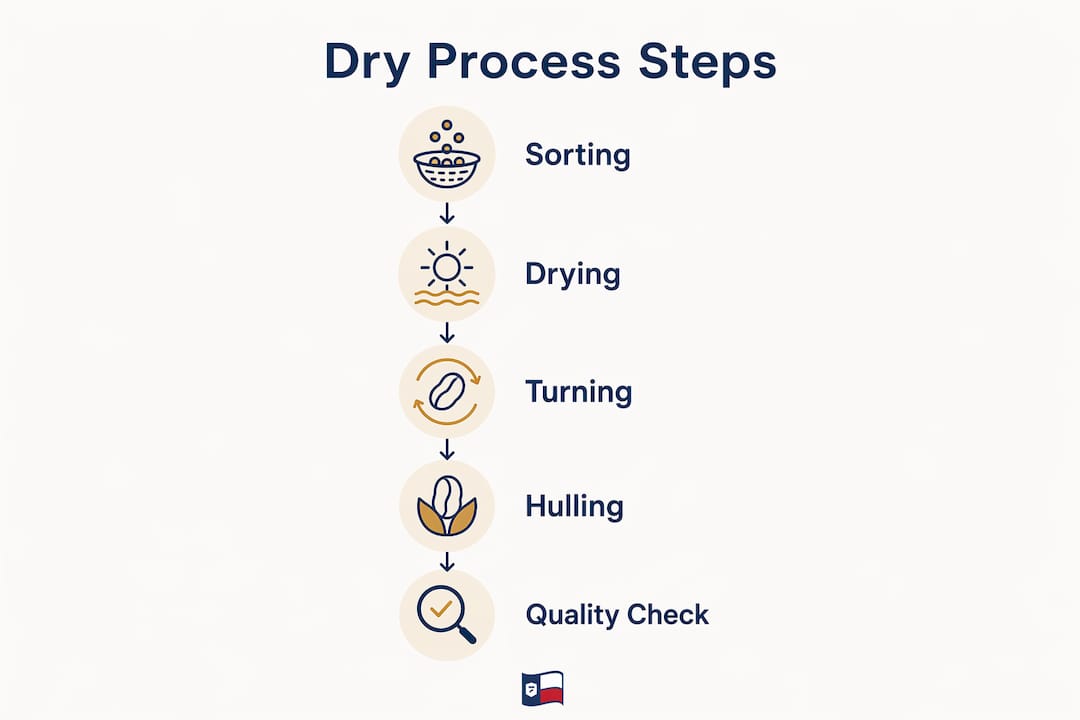
- Selective harvesting. Producers hand-pick only ripe, red cherries. Unripe or overripe fruit introduces off-flavors that no amount of careful drying can fix. This step is where quality is won or lost before drying even starts.
- Sorting and cleaning. Freshly picked cherries are sorted by winnowing with a large sieve to remove leaves, twigs, and damaged fruit. Flotation in water channels near the drying area separates floaters (underripe or hollow) from sinkers (dense, ripe cherries).
- Spreading on drying surfaces. Sorted cherries are spread in a single layer on patios or raised beds. Thin, even layers are critical; piling cherries creates hot spots and uneven fermentation.
- Turning and monitoring. Cherries are raked or turned by hand throughout the day to promote even drying, then covered at night or when rain threatens. Sun-drying to a safe storage moisture typically takes several days to weeks under good conditions.
- Moisture testing. Producers use a handheld moisture meter to confirm the target range before moving coffee to storage. Overdrying makes beans brittle and prone to breakage during hulling; insufficient drying leaves them vulnerable to fungal and bacterial attack.
- Hulling and grading. Once dried, the whole cherry husk is removed by a hulling machine to reveal the green bean. Beans are then graded by size and density, defects sorted out, and the coffee bagged for storage or export.
| Stage | Key metric | Why it matters |
|---|---|---|
| Sorting | Ripe cherry ratio | Unripe fruit causes astringency and off-flavors |
| Drying duration | typically 18–20 days | Shorter risks under-drying; longer risks mold |
| Moisture target | 11–12.5% | Safe for storage without spoilage or brittleness |
| Hulling | Breakage rate | Overdried beans shatter, creating defective fragments |
Pro Tip: Raised drying beds, sometimes called African beds, allow airflow under the cherries, reducing underside rot compared to concrete patios. If you’re sourcing from a producer, ask whether they use raised beds — it’s one of the clearest signals of quality intent.
Which drying method works best for producers?
The setup a producer uses depends on budget, climate, available labor, and the quality tier they’re targeting. Each method has real trade-offs.
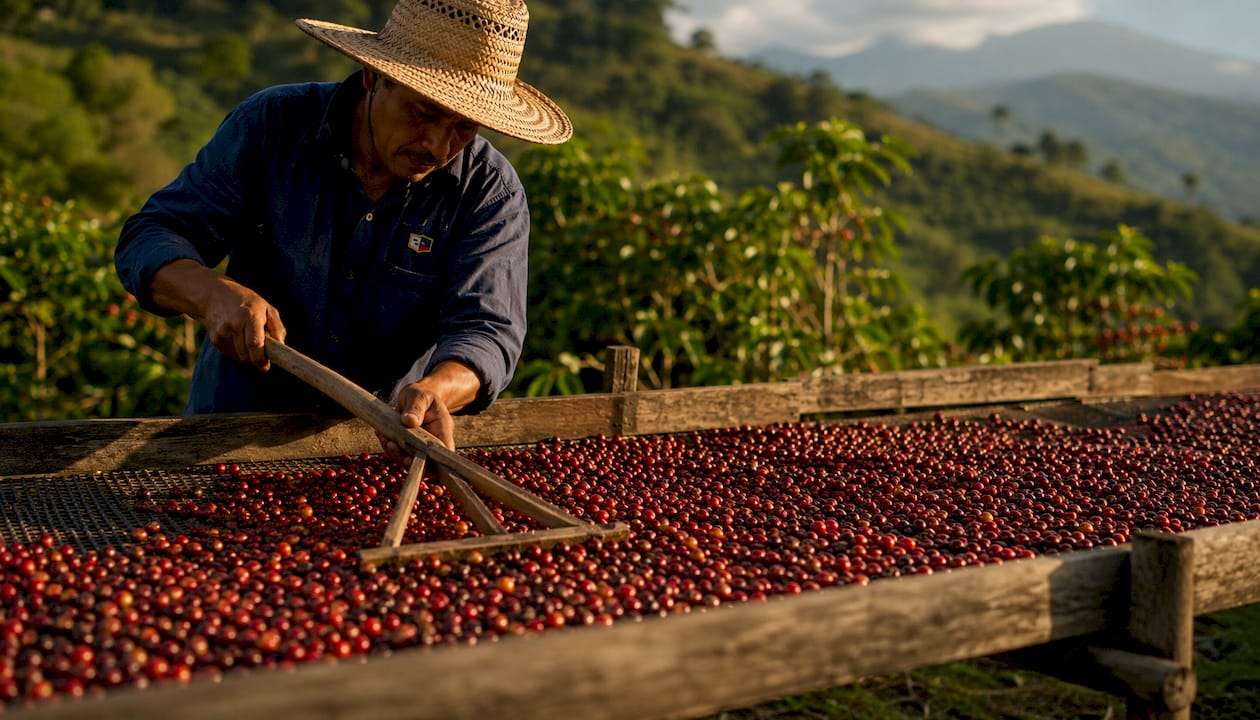
Concrete or brick patios are the most common setup worldwide. They’re durable and inexpensive to maintain, but airflow is zero underneath the cherries, which means the bottom layer dries slower and is prone to rot. Workers must turn the coffee frequently, sometimes every 30–60 minutes during peak sun.
Raised mesh beds (African beds) solve the airflow problem. Cherries dry from all sides, drying is more even, and underside rot drops significantly. The trade-off is higher upfront cost and more surface area needed per kilogram. For specialty-grade naturals, raised drying beds and hand-sorting are the standard best practice.
Mechanical dryers are used on larger operations to shorten drying time after a few days of sun pre-drying. The risk is speed: too-rapid mechanical drying can case-harden the outer layer of the cherry, trapping moisture inside the bean. That trapped moisture causes uneven fermentation and cup defects that show up months later.
Covered tunnels and greenhouse drying offer weather protection and some temperature control. They’re common in regions with unpredictable rainfall and are increasingly used by producers targeting consistent specialty lots.
Dry processing uses as little as one gallon of water per kilogram of dried parchment, compared with roughly ten gallons for wet processing. In water-scarce regions across Ethiopia, Yemen, and parts of Brazil, that difference isn’t a stylistic choice — it’s a practical necessity that shapes the entire coffee culture of those origins.
Pro Tip: Keep a simple drying log: date, weather, turning frequency, and moisture readings every few days. A stable, gradual drying rate is the single best predictor of a clean, fruit-forward cup. Erratic readings are your early warning for mold or case hardening.
What does dry-processed coffee taste like?
The flavor difference is real and it’s significant. Because the bean spends weeks in direct contact with fermenting fruit pulp and mucilage, it absorbs sugars and fermentation byproducts that a washed coffee never encounters. The result is fuller body, higher perceived sweetness, and intense fruit-forward flavors — strawberry, cherry, blueberry, and wine-like notes are the most commonly cited.
Specialty roasters often describe well-executed naturals as “fruit bombs,” and that’s not an exaggeration. A high-quality Ethiopian natural from Yirgacheffe or Guji can taste more like blueberry compote than anything you’d expect from a coffee bean. Brazil produces naturals at enormous scale, and while they tend toward chocolate and stone fruit rather than the bright berry notes of Ethiopian lots, they’re prized for their smooth, heavy body and low acidity.

The caveat is that the same fermentation creating those desirable notes can also go wrong. Over-fermentation produces a sharp, vinegary sourness or a barnyard mustiness that some drinkers find unpleasant. These off-flavors are a sign of poor drying control, not an inherent feature of the method. How origin interacts with terroir matters here too — the same dry process applied in Ethiopia versus Brazil produces noticeably different cups.
Common tasting notes in well-executed naturals:
- Strawberry, blueberry, raspberry, cherry
- Dark chocolate and stone fruit (especially Brazilian lots)
- Wine-like, jammy, or syrupy sweetness
- Full body with lower perceived acidity than washed coffees
- Occasionally: fermented, earthy, or musty notes (a sign of quality issues)
Dry vs. washed vs. honey: what’s the real difference?
| Dry (natural) | Washed (wet) | Honey | |
|---|---|---|---|
| Fruit removed | After drying | Before drying | Skin removed; mucilage left on |
| Water use | Very low | High | Low to moderate |
| Flavor | Fruity, sweet, full body | Clean, bright, balanced | Between natural and washed |
| Fermentation | Extended, inside fruit | Controlled, in tanks | Partial, on bean surface |
| Main risk | Microbial spoilage | Over-fermentation in tanks | Stickiness, uneven drying |
| Best for | Water-limited origins, fruit intensity | Clarity and consistency | Sweetness with cleaner cup |
The practical upshot for buyers: if you want a clean, bright, origin-expressive cup where acidity and clarity are the point, washed is your method. If you want sweetness, body, and fruit complexity, natural is the better bet. Honey sits in between, offering some fruit character without the full fermentation intensity of a natural.
Dry processing dominates Arabica production in Brazil and is a traditional method used in much of Ethiopia. Nearly all Robusta globally is dry-processed. Washed processing is the standard in East Africa’s specialty sector and across Central America, where water infrastructure and quality-consistency demands drive the choice.
What are the main risks in dry processing?
The greatest quality risk is microbial spoilage when drying is slow or interrupted. Wet cherries sitting in a pile are an ideal environment for fungal and bacterial growth, and a single rain event without proper covering can compromise an entire drying lot.
The other major risks:
- Uneven fermentation: Thick layers or infrequent turning create hot spots where some cherries over-ferment while others under-dry.
- Ground contact contamination: Patios expose the bottom layer of cherries to soil bacteria and moisture.
- Case hardening: Drying too fast (especially mechanically) seals the outer layer while the interior stays moist, leading to defects that don’t show up until cupping.
- Weather dependency: Dry processing is essentially impossible during a rainy season without covered infrastructure.
Producer best practices that separate quality naturals from commodity lots:
- Hand-sort at harvest to remove unripe and damaged fruit before it reaches the drying bed
- Use raised beds whenever possible to prevent underside rot
- Turn cherries at least twice daily during peak sun hours
- Cover beds at night and at the first sign of rain
- Test moisture every few days with a calibrated meter; target 11–12.5% before moving to storage
- Stage storage in breathable grain bags in a cool, dry facility
Pro Tip: When buying naturals, ask your roaster whether the producer used raised beds and what their post-drying QA process looks like. A roaster who can answer that question specifically is sourcing with traceability — and that traceability is the clearest predictor of a clean, well-executed natural in the bag.
How to find and brew dry-processed coffee
Identifying a natural at the point of purchase is straightforward once you know what to look for.
Buying checklist:
- Look for “natural,” “dry process,” or “unwashed” on the bag
- Check tasting notes: berry, cherry, wine, jammy, or chocolate are all natural-process signals
- Prioritize origins known for quality naturals: Ethiopia (Yirgacheffe, Guji, Sidama), Brazil (Cerrado, Sul de Minas), and Yemen
- Ask whether the producer used raised beds and hand-sorting
- Commodity-grade naturals are cheap and often earthy; specialty-processed naturals cost more and deliver the fruit intensity worth seeking out
- Fresh roast date matters: naturals’ fruit notes fade faster than washed coffees once the bag is open
Brewing to highlight the fruit character:
For filter brewing (pour-over, drip), use water around 200°F and a medium-coarse grind. A slightly longer brew time pulls out more of the body and sweetness without pushing into over-extraction. For espresso, naturals reward a slightly coarser grind and a shorter extraction time to keep the fruit notes bright rather than jammy. A well-calibrated extraction makes a significant difference with naturals because their higher sugar content means they hit over-extraction faster than washed coffees.
Naturals pair beautifully with simple preparations: black, over ice, or as a single-origin espresso. If you’re building a café menu, they also complement specialty syrups well — a vanilla or brown sugar syrup alongside a fruity Ethiopian natural creates a layered sweetness that washed coffees rarely match. For non-coffee drinkers at the same table, Font-mag’s loose-leaf tea and iced tea selections round out a menu without requiring a second supplier.
Key Takeaways
Dry process coffee delivers its distinctive fruit-forward flavor because the bean ferments inside the whole cherry during sun-drying, a method that requires minimal water but demands strict quality control to avoid spoilage.
| Point | Details |
|---|---|
| Core definition | Whole cherries dried intact; sun-dried for 18–20 days and hulled only after reaching 11–12.5% moisture. |
| Flavor expectations | Fuller body, elevated sweetness, and fruit-forward notes (berry, cherry, wine); off-flavors signal poor drying control. |
| Main production risk | Microbial spoilage from slow or interrupted drying; raised beds, frequent turning, and moisture testing are the key controls. |
| Buying signal | Look for “natural” or “dry process” on the label plus berry or wine tasting notes; ask roasters about producer drying methods. |
| Font-mag offering | Font-mag’s specialty offerings include carefully sourced coffees alongside teas and syrups for complete café menus. |
The case for naturals that most guides miss
There’s a tendency in specialty coffee circles to treat the natural process as either the pinnacle of terroir expression or a risky shortcut for producers who can’t afford water infrastructure. Both framings miss the point.
The dry process is genuinely demanding. A well-executed natural from a high-altitude Ethiopian farm, where the producer hand-sorted every cherry and turned the beds twice daily for three weeks, represents more labor and more risk than most washed lots. The flavor payoff — that unmistakable blueberry and wine intensity — isn’t an accident of fermentation. It’s the result of deliberate control over a process that can go wrong in a dozen ways.
What gets underplayed is how much the method rewards traceability. A natural from an anonymous commodity mill and a natural from a named producer with documented drying practices are not the same product, even if both bags say “Ethiopia Natural.” The label tells you the method; the roaster’s sourcing story tells you whether the method was executed well. Specialty roasters who choose naturals deliberately for origin fruit character are making a curatorial statement — and that’s exactly the kind of sourcing decision that separates a memorable cup from a forgettable one.
If you’re new to naturals, start with a well-sourced Ethiopian lot from a roaster who can tell you the producer’s name and drying setup. That transparency is the signal.
Try naturally processed coffees from Font-mag
Font-mag’s retail coffee collection is built around the kind of sourcing transparency this article describes: small-batch coffees where the processing method and origin story are part of what you’re buying, not an afterthought on the back of the bag.

Beyond coffee, Font-mag carries everything a café or home bar needs to build a complete menu. The Sweetbird syrup collection pairs naturally with fruit-forward naturals, and Font’s tea sachets and tea concentrates give café operators a second beverage program without the complexity of a second supplier. Free shipping on orders over $35 makes it practical to sample across categories. Browse the specialty offerings to find a natural that fits your menu or your morning cup.
Useful sources
- Processes — About Coffee (NCA): The National Coffee Association’s overview of dry, wet, and honey processing, including spoilage risks and moisture targets. Good starting point for production basics.
- How Coffee Is Processed — IFT: Food science perspective on sorting, winnowing, and the physical mechanics of dry versus wet processing.
- Dry Processing Coffee Guide — Agriculture.Institute: Detailed producer-level guide covering water use comparisons, drying timelines, and moisture targets.
- What Is Dry-Processed Coffee? — Sweet Maria’s Coffee Library: Practical roaster perspective on raised beds, hand-sorting, and quality differentiation for naturals.
- Natural Process — Roastopedia: Concise explanation of the natural process as a deliberate stylistic choice, with notes on specialty roaster motivations.
- Coffee Production — Wikipedia: Broad reference for regional prevalence data, moisture targets, and the mechanical drying trade-offs discussed in this article.
Recommended
- Coffee Processing Methods Explained for Every Brewer – Font Coffee Roasters
- What Is Coffee Extraction and How It Shapes Flavor – Font Coffee Roasters
- Why Coffee Origins Taste Different: A Flavor Science Guide – Font Coffee Roasters
- Coffee Roast Levels Explained: A Flavor Guide for Enthusiasts – Font Coffee Roasters