

What Is a French Press Brew? A Full-Bodied Coffee Guide
A French press brew is coffee made by steeping coarse grounds directly in hot water, then separating them with a mesh plunger instead of a paper filter. That single difference, no paper between the grounds and your cup, is why French press coffee tastes noticeably richer and heavier than what comes out of a drip machine. The metal or nylon mesh lets natural coffee oils and tiny particles called fines slip through, and those are exactly what give the brew its syrupy body and deeper mouthfeel.
You’ll see this method sold under a few different names, and they all mean the same device:
- Cafetière (common in the UK and parts of Europe)
- Coffee press or coffee plunger
- Press pot
It’s a favorite for home brewers who want a bold cup without buying equipment, and it scales up nicely for small groups since one carafe can pour four or more cups at once.
Key Takeaways
A French press brew is an immersion method where coarse coffee steeps directly in hot water for about four minutes before a mesh plunger separates the grounds, producing a fuller, oil-rich cup.
| Point | Details |
|---|---|
| It’s an immersion method | Grounds steep fully submerged in water, unlike flow-through drip or pour-over brewing. |
| Grind coarse, always | Fine grounds clog the mesh and cause bitter, over-extracted coffee. |
| Stick to the ratio | Use 1:10 to 1:16 coffee to water, with 1:15 as a reliable starting point. |
| Pour immediately after plunging | Coffee left on the grounds keeps extracting and turns bitter within minutes. |
| Explore Font Coffee Roasters | Font’s retail coffee and ratio guide help you dial in beans suited to press brewing. |
Table of Contents
- What Is a French Press, Exactly? Anatomy and Common Designs
- How Immersion Brewing Actually Works
- French Press Ratios, Grind, and Temperature at a Glance
- How to Brew French Press Coffee: The Classic 4-Minute Method
- Why Your French Press Coffee Tastes Off (and How to Fix It)
- Beyond the Classic Brew: Cold Press and Serving Ideas
- Cleaning Your French Press So It Keeps Brewing Well
- French Press vs. Pour-Over, Drip, and Espresso
- Roaster Tips: Getting the Most Out of Your Beans
- Why the French Press Still Earns Its Place on My Counter
- Stock Your Counter for Better French Press Coffee
- Frequently Asked Questions About French Press Coffee
- Sources
What Is a French Press, Exactly? Anatomy and Common Designs
Every French press, regardless of brand or price, breaks down into four basic parts: the carafe, the lid, the plunger (sometimes called the piston), and the mesh filter attached to the bottom of the plunger.
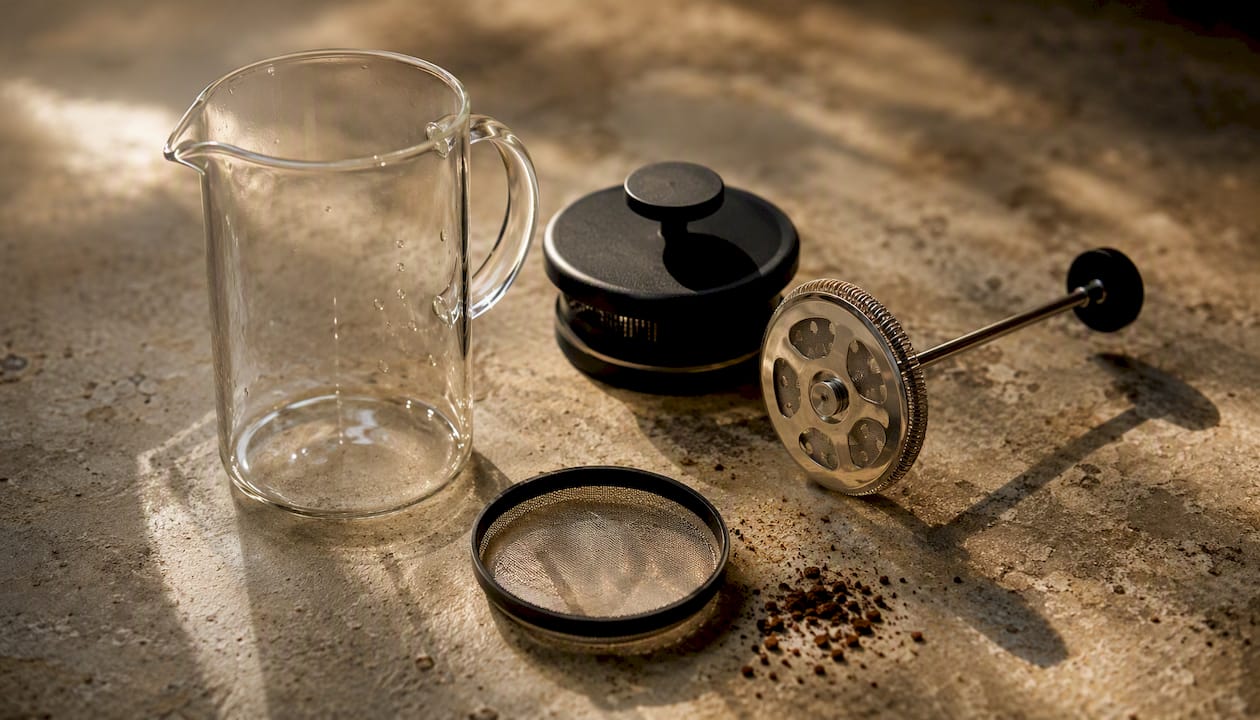
The carafe is where material choice matters most. Borosilicate glass carafes are the classic choice. They’re inexpensive, let you watch the brew happen, and don’t retain any flavor from previous brews, but they’re fragile and lose heat faster than metal. Stainless steel carafes, often double-walled, hold temperature far longer, which matters if you like to let coffee sit for a second cup, but they cost more and hide the brewing process. Mesh filters come in nylon or fine metal screen; metal tends to hold up longer and lets slightly more sediment through, which some drinkers prefer for extra body.
Sizing follows how you actually drink coffee:
- Single-serve presses (around 12 ounces) for one person, one cup
- Standard 3 to 4 cup presses (roughly 34 ounces) for couples or small households
- Larger 8 to 12 cup presses for entertaining or office use
- Insulated travel presses that double as a thermal mug
Pro Tip: If you’re brewing daily, spend the extra money on a stainless steel or double insulated carafe. Glass presses look great on a counter, but they’re the first thing that cracks when a plunger gets shoved down too hard or the carafe gets bumped in a sink full of dishes.
How Immersion Brewing Actually Works
French press coffee is an immersion method, meaning every ground sits fully submerged in water for the entire brew instead of water flowing through them once, as it does in a drip machine or pour-over cone. That full contact time is the whole reason the flavor profile is different.
Immersion brewing produces a fuller body and deeper sweetness than paper-filtered methods precisely because the extraction is slower and more uniform, according to Serious Eats’ brewing analysis. Every particle gets equal exposure to water instead of the uneven contact that happens when water rushes through a cone of grounds in seconds.
The mesh filter is the other half of the equation. Because it’s metal or nylon rather than paper, it doesn’t trap the microscopic oils in coffee beans. Those oils carry a lot of flavor compounds and contribute to what tasters describe as body or mouthfeel, the weight of the coffee on your tongue. Paper filters strip most of that out, which is why drip coffee tastes cleaner and lighter by comparison.
Grind size and contact time work as a pair here. Coarse grounds have less surface area exposed to water and generally require a longer steeping time to extract flavor properly. Grind too fine for that same steep time and you’ll pull too much out of the beans, tipping the flavor toward bitterness and astringency instead of the sweetness and balance you’re after. This interaction is also why understanding coffee extraction helps so much once you start adjusting variables on your own.
French Press Ratios, Grind, and Temperature at a Glance
Four numbers control almost everything about how your French press coffee turns out. Get these right and the rest is mostly personal taste.
| Parameter | Recommendation |
|---|---|
| Grind size | Coarse, similar to sea salt or coarse breadcrumbs |
| Coffee to water ratio | 1:10 to 1:16 by weight, with 1:15 as a solid starting point |
| Water temperature | Around 93°C |
| Steep time | 4 minutes for the classic method |
A practical French press recipe used by roasters keeps the ratio between 1:10 and 1:16, meaning 1 gram of coffee per 10 to 16 grams of water, with water sitting right around 93°C plus or minus a few degrees. If you don’t own a kitchen scale, a rough guide is 2 tablespoons of coffee per 6 ounces of water, though weighing will give you far more consistent results cup to cup.
No thermometer? Bring water to a full boil, then let it sit off the heat for 30 to 45 seconds before pouring. That drop gets you close enough to the target range without any equipment.
A few notes on adjusting these numbers:
- Coarser grind needs more time in contact with water to extract fully, sometimes 5 to 6 minutes instead of 4
- A stronger ratio like 1:12 suits darker roasts and bold drinkers
- A lighter ratio like 1:16 suits delicate single-origin beans where you want clarity, not weight
Our full French press coffee ratio guide walks through how to dial these in for your specific beans if you want to go deeper than the defaults.
How to Brew French Press Coffee: The Classic 4-Minute Method
Here’s the sequence, start to finish, for a standard 4-minute brew using a 1:15 ratio.
- Preheat the press. Rinse the carafe with hot water and dump it out. A cold glass or steel carafe will pull heat from your brew water and throw off your temperature.
- Weigh and grind your coffee. Use a coarse setting, roughly 30 grams of coffee for a 450 gram batch of water (a standard 34 ounce press).
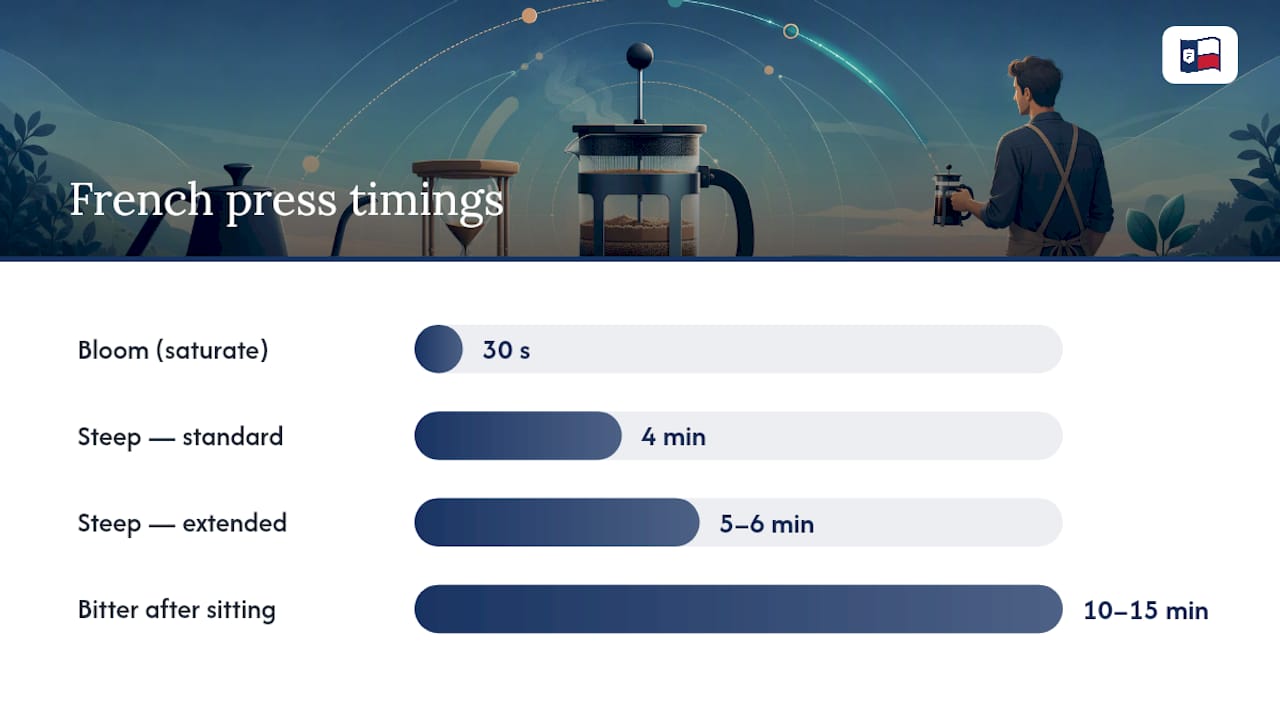
- Add grounds and bloom. Pour just enough hot water to saturate the grounds, about double their weight, and let them sit for 30 seconds. You’ll see bubbles rise as trapped CO2 escapes.
- Stir and add remaining water. At around the 30 to 45 second mark, stir gently to break the crust that forms on top, then pour in the rest of your water and set the lid on with the plunger pulled up.
- Steep for 4 minutes. Set a timer. Don’t stir again, don’t touch it.
- Plunge slowly and pour immediately. Press the plunger down with steady, gentle pressure, not a hard shove, then pour every drop into cups or a separate carafe right away.
That last step matters more than people think. Coffee left sitting on the grounds after plunging keeps extracting, and within 10 to 15 minutes it turns noticeably bitter.
Two quick variations worth trying: for a stronger cup, tighten your ratio to 1:12 without changing the grind or time. For a mellower, more forgiving brew, go coarser and stretch the steep to 5 or 6 minutes, since French press variables aren’t tightly coupled the way pour-over ones are, giving you room to experiment without ruining the batch.
Pro Tip: Set a phone timer the moment you start pouring water, not after you’ve finished. Those extra 20 to 30 seconds of pouring time add up over multiple brews and are usually why “the same recipe” tastes different day to day.
Why Your French Press Coffee Tastes Off (and How to Fix It)
Most French press problems trace back to one of three symptoms, and each has a clear cause.
Bitter, harsh coffee almost always means over-extraction. Either your grind is too fine, letting more surface area contact the water than it should, or your steep ran long. Fine grounds cause over-extraction and bitterness because they release compounds faster than coarse grounds do, and a cheap grinder producing inconsistent particle sizes makes this worse. Coarsen the grind or cut the steep time by 30 seconds and taste again.
Weak, watery coffee is the opposite problem: under-extraction from a grind that’s too coarse or water that cooled too much before you poured. Tighten your ratio, add a bit more coffee, or extend the steep slightly.
Gritty texture usually comes from pressing too fast or too hard, which forces fine particles around the edges of the mesh screen instead of trapping them. Press slowly and steadily. If grit persists even with a gentle plunge, check your mesh filter for damage or gaps.
A few other quick fixes worth knowing:
- Leftover coffee turning bitter fast means you need to decant to a separate vessel the moment you finish plunging
- Persistent grit despite a proper coarse grind often points to a worn or torn mesh screen that needs replacing
- A wobbly or hard-to-press plunger usually means the gasket has worn out and lost its seal against the carafe wall
Beyond the Classic Brew: Cold Press and Serving Ideas
The French press isn’t limited to one method. It doubles as one of the simplest cold brew setups you can own, and it opens up a handful of serving styles worth trying.
For cold brew, use a very coarse grind (coarser than your hot brew setting), cold or room temperature water, and let it steep for 12 to 18 hours at room temperature or in the fridge. Plunge slowly once it’s done, then strain through a fine mesh sieve or cheesecloth if you want extra clarity, since the long steep pulls more fines through than a standard 4-minute brew.
Some brewers also try an inverted method, flipping the press upside down before adding grounds so the plunger seals the bottom, which prevents the grounds from getting wet and dripping through the mesh before you’re ready to press. It’s more common with AeroPress-style brewers, but some French press users adapt it for extended steeps beyond 6 minutes.
On serving: French press coffee is strong enough to dilute for iced coffee without going watery, pours well over ice with a splash of cream, and holds up to sweeteners better than lighter-bodied brews because the flavor doesn’t disappear. If you like flavored syrups, a small pour into your French press coffee turns a straightforward morning cup into something closer to café-style. Pour immediately once you’re done brewing, and if you’re not drinking it all right away, move the remainder to a thermal carafe rather than leaving it in the press.
Cleaning Your French Press So It Keeps Brewing Well
A French press that isn’t cleaned properly doesn’t just look dingy, it actively makes your coffee taste worse, since old oils go rancid and cling to the mesh and glass.
Daily cleaning is quick: discard the grounds right after brewing, rinse the mesh filter and carafe with hot water, and dry everything before storing. Avoid metal scrubbers on glass carafes since they leave micro scratches that trap residue over time.
Deep cleaning should happen weekly if you brew often. Unscrew the plunger assembly, separate every piece of the filter stack, and soak them in warm water with a few drops of mild dish soap or a spoonful of baking soda to lift built-up coffee oils. Rinse thoroughly, since soap residue is its own flavor problem. If the mesh screen looks warped, torn, or won’t seal tightly against the carafe wall anymore, replace it rather than fighting a leaky seal every morning.
A couple of storage habits worth building:
- Never leave wet grounds sitting in the carafe overnight; they mold faster than you’d expect
- Store the press fully dry and slightly disassembled so trapped moisture doesn’t build up inside the plunger mechanism
Pro Tip: A stiff brush made for cleaning press filters gets into the mesh grooves that a sponge can’t reach. Font’s café essentials and supplies collection carries cleaning tools designed for exactly this kind of buildup.
French Press vs. Pour-Over, Drip, and Espresso
Choosing a brew method really comes down to what you want in the cup and how much control you want over the process.
French press wins on body and simplicity. There’s no filter to buy, no pouring technique to master, and the payoff is a heavier, oil-rich cup with more texture than nearly any other home method. Pour-over and drip, by contrast, produce a cleaner, brighter cup because the paper filter strips out oils and fines, trading body for clarity, a preference that comes down to taste rather than one method being objectively better.
Espresso sits in its own category entirely, using pressure rather than immersion or gravity, and it demands a dedicated machine and much finer grind. It’s not really a fair comparison to French press since the goals (a concentrated shot vs. a full cup) are different from the start.
Practical tradeoffs worth weighing:
- French press handles multiple cups at once with zero technique curve, making it a strong pick for social brewing or a household that shares a pot
- Pour-over rewards precision (scale, gooseneck kettle, timer) with more clarity and brightness in the final cup
- Drip machines win on hands-off convenience for large batches but sacrifice both body and control
If bold, full-bodied cups are what you’re after, French press is hard to beat. If you want a lighter, more delicate cup that highlights acidity and single-origin nuance, a pour-over setup might suit your taste better.
Roaster Tips: Getting the Most Out of Your Beans
Not every roast performs the same way in a French press, and picking beans with this method in mind makes a real difference.
Medium and dark roasts tend to shine here because their bolder, more developed flavors hold up well against the fuller body immersion brewing produces. Light roasts can absolutely work too, but World Barista Champion-level technique treats them differently, tightening the ratio to 1:12 or 1:14 and using a scale and timer to tease out clarity that a looser, “old-school” approach might muddy.
Freshness matters more with French press than most methods because the immersion process pulls flavor from every part of the bean, including the more volatile aromatics that fade fastest after roasting. Checking for signs of fresh roasted coffee before you buy, and storing beans properly once you get them home, protects the exact qualities that make French press worth brewing in the first place.
Pro Tip: For a darker house blend, start at a 1:13 ratio with a 4 minute steep. For a lighter single-origin, loosen to 1:15 and shave the steep to 3 minutes 30 seconds so the acidity doesn’t tip into sourness.
Why the French Press Still Earns Its Place on My Counter
I still reach for a French press more than any other brewer when I’m cupping a new batch, and it’s not nostalgia. When you’re trying to actually taste a coffee, judge its body, its sweetness, whether the roast profile is doing what you intended, immersion brewing gives you the most honest read. Nothing is stripped out by a paper filter, so flaws and strengths both show up clearly.
That said, coffee isn’t the only thing worth brewing well. We built out matcha and loose-leaf tea lines because a lot of the same principles, freshness, correct ratios, water temperature, apply just as much to a good bowl of matcha as they do to a French press pot. If your mornings ever call for something other than coffee, it’s worth exploring what else is on the shelf.
Stock Your Counter for Better French Press Coffee
Getting a great French press brew starts before the water ever hits the grounds, it starts with the beans. Font-mag’s retail coffee collection is roasted in small batches, which means fresher beans reach your kitchen instead of sitting in a warehouse for months, and freshness is exactly what immersion brewing shows off or exposes.
If you’re cutting caffeine but not flavor, our decaf coffee still holds up to the full-bodied French press treatment without keeping you up past 9 p.m. Want to dress up your cup for iced coffee or a flavored twist, browse our flavored coffee lineup, or grab the brushes and cleaning tools from our home barista supplies to keep your press performing brew after brew. Pick a roast, order before your current bag runs dry, and free shipping kicks in automatically on orders over $35.
Frequently Asked Questions About French Press Coffee
What is a French press brew, exactly? It’s coffee made by steeping coarse grounds in hot water for several minutes, then pressing a mesh plunger down to separate the grounds from the liquid, resulting in a full-bodied cup with more natural oils than paper-filtered coffee.
How is French press coffee different from drip coffee? French press uses immersion brewing, full contact between water and grounds, while drip uses flow-through brewing with a paper filter that strips out oils and fines, producing a lighter, cleaner cup.
Why does my French press coffee taste bitter? Bitterness usually means over-extraction from too fine a grind or too long a steep. Coarsen the grind, shorten the steep time slightly, or pour the coffee out immediately after plunging instead of letting it sit.
Can I make cold brew in a French press? Yes. Use a very coarse grind with cold water, steep 12 to 18 hours, then plunge slowly and strain if needed for extra clarity.
How often should I clean my French press? Rinse it after every use and do a full deep clean, disassembling the filter stack and soaking in warm soapy water, at least once a week if you brew daily.
Sources
A few references stand out for anyone who wants to go further than this guide covers.
- French press - Wikipedia
- French press guide - Food & Wine
- How to make better French press coffee - Serious Eats
- French Press Coffee - About Coffee
- How to make French press coffee - Simply Recipes