

Why Pre-Ground Coffee Loses Flavor: A Science Guide
Pre-ground coffee loses flavor because grinding shatters the bean’s protective structure, exposing an enormous amount of fresh surface area to oxygen, heat, and ambient air. The volatile aromatic compounds responsible for everything you love about a great cup — the floral top notes, the caramel sweetness, the fruity brightness — begin evaporating within minutes. CO₂, which acts as a natural preservative and aroma carrier inside the bean, escapes in hours rather than weeks. The simplest fix is to grind just before brewing. If pre-ground is your reality, store it in an airtight, opaque container, keep it cool and dry, and finish the bag within a week.
The three fastest causes of flavor loss after grinding:
- Volatile evaporation: Aromatic compounds like aldehydes, esters, and pyrazines escape into the air the moment the bean’s cell walls are broken.
- Lipid oxidation: Coffee oils exposed to oxygen undergo autoxidation, producing stale, cardboard-like off-flavors.
- CO₂ loss: Trapped carbon dioxide, which helps carry and protect aromatics during brewing, degasses rapidly from ground coffee.
Pro Tip: Buy whole beans in their original valve-sealed roaster bag and grind only what you need per session. The one-way valve lets CO₂ out without letting oxygen in, which is something no standard home canister replicates.
Key Takeaways
Pre-ground coffee loses most of its aroma within hours of grinding because volatile aromatics evaporate, CO₂ escapes, and lipid oxidation begins the moment the bean’s surface area multiplies.
| Point | Details |
|---|---|
| Grinding is the critical event | Surface area increases by orders of magnitude, triggering immediate volatile loss, CO₂ escape, and oxidation. |
| Thiol loss is fast and irreversible | Key aroma thiols can fall by roughly 84% within 60 minutes; thiol-melanoidin binding cannot be undone. |
| One week is the practical limit | Opened pre-ground coffee held in an airtight, opaque container generally stays near peak freshness for about one week. |
| Original valve bags beat home canisters | One-way degassing valves let CO₂ out without letting oxygen in, something standard canisters cannot replicate. |
| Font-mag ships roast-to-order | Small-batch beans arrive in the optimal freshness window, so you grind fresh and taste what you paid for. |
Table of Contents
- Why does pre-ground coffee lose flavor so fast?
- The chemistry behind staling: oxidation, lipid breakdown, and thiol loss
- How long does it actually take for ground coffee to go flat?
- What makes pre-ground coffee go stale even faster?
- How to store pre-ground coffee and actually preserve flavor
- When is pre-ground coffee actually fine to use?
- What roasters do to slow staling before the bag reaches you
- The freshness question is really a timing question
- Fresh coffee, delivered the way it should be
- Sources
Why does pre-ground coffee lose flavor so fast?
When a whole bean is ground, its surface area increases by orders of magnitude. A single bean becomes thousands of particles, and every new surface is an open door for oxygen and evaporation. Research confirms that this mechanical change is the core driver of rapid flavor loss: the same chemical reactions that take weeks in a sealed whole-bean bag happen in hours once the bean is ground.
CO₂ plays a bigger role than most people realize. Roasted beans trap carbon dioxide as a byproduct of the Maillard reaction and caramelization during roasting. That CO₂ does two useful things: it pushes oxygen away from the bean’s interior, and during brewing it creates the bloom that slows water flow and promotes even extraction. According to SCA’s Coffee Freshness guidance, whole beans degas significantly over roughly the first three weeks after roasting, but once ground, that same degassing happens in minutes to hours. You can watch this live in a pour-over: freshly ground coffee blooms dramatically, doming up as CO₂ escapes. Pre-ground coffee that’s been sitting open for a day produces almost no bloom at all, which means water channels through unevenly and extraction suffers before staling even enters the picture.
Key physical consequences of grinding:
- Surface area increases by orders of magnitude, accelerating both evaporation and oxygen contact.
- CO₂ escapes in minutes to hours rather than days to weeks.
- Loss of CO₂ reduces bloom during brewing, leading to uneven extraction or channeling.
- Aromatic oils migrate to particle surfaces where they oxidize quickly.
For more on how coffee degassing affects bloom timing and brew quality, Font-mag’s guide covers rest windows and practical brew timing in detail.
The chemistry behind staling: oxidation, lipid breakdown, and thiol loss
The flavor of roasted coffee depends on a fragile ecosystem of several hundred volatile compounds. Staling is what happens when that ecosystem collapses, and it does so through three overlapping chemical pathways.
Lipid autoxidation is the most familiar. Coffee contains oils rich in unsaturated fatty acids. When those oils contact oxygen, they undergo autoxidation, producing compounds like hexanal and other aldehydes that smell and taste like cardboard, old paper, or rancid fat. GC/MS storage trials show that oxygen access and closure method strongly influence how fast these markers accumulate, with opened packaging raising headspace oxygen to near-ambient levels within days.
Thiol loss is less discussed but arguably more damaging to perceived quality. Compounds like 2-furfurylthiol and methanethiol are responsible for the roasty, sulfurous, intensely “coffee” character that makes a fresh cup smell the way it does. These thiols are chemically reactive. They bind irreversibly to melanoidins (the brown polymers formed during roasting), effectively disappearing from the aroma profile. Research on aroma staling kinetics found that certain key thiols can fall by roughly 84% within 60 minutes under measured real-world conditions. That’s not a slow decline. That’s a cliff.
Statistic to know: Aroma staling kinetics research also shows that once oxidation and thiol-binding begin, the process accelerates rather than proceeding at a steady linear rate. The first hour after grinding is the most destructive.
The three chemical mechanisms differ in timescale and reversibility:
- Evaporation is immediate and continuous. Volatile aromatics simply escape into the air. Nothing brings them back.
- Oxidation builds over hours and days, producing new off-flavor compounds rather than just removing good ones.
- Thiol-melanoidin binding is irreversible and happens fastest right after grinding when reactive sites are freshest.
Analytical tools like GC/MS aroma indices confirm that oxygen is the dominant driver of staling, with key aroma compounds declining measurably with each hour of air exposure.
How long does it actually take for ground coffee to go flat?
The honest answer: faster than you’d like, and slower than the worst-case scenario if you store it well. Here’s a practical breakdown.
| Timeframe | What’s happening chemically | Sensory effect |
|---|---|---|
| minutes | Rapid CO₂ loss; volatile evaporation begins immediately | Aroma noticeably weaker than freshly ground |
| hours | Large decline in key thiols and top-note volatiles | Brightness and complexity begin to flatten |
| days | Lipid oxidation compounds accumulate; CO₂ nearly gone | Noticeably duller; some cardboard or papery notes |
| 7 days | Significant oxidation; most delicate aromatics lost | Clearly muted, stale character |
| 2+ weeks (opened) | Rancidity markers present; off-flavors dominate | Unpleasant in many cases |
Variance matters here. A coarser drip grind stored in a sealed container will hold up longer than a fine espresso grind left in an open bag. Darker roasts tend to show lipid oxidation faster because they contain more surface oil. Lighter roasts lose their delicate floral and fruit notes first. Packaging makes a real difference too: SCA’s freshness guidance and roaster recommendations consistently point to airtight, low-oxygen storage as the primary lever.
Pro Tip: If you rely on pre-ground, buy the smallest bag available and commit to finishing it within 7 days of opening. A fresh small bag beats a large “economy” bag every time.
For a deeper look at freshness indicators you can actually see and smell, Font-mag’s guide covers nine sensory signals worth knowing.
What makes pre-ground coffee go stale even faster?
Some conditions accelerate the timeline above dramatically. Understanding them helps you diagnose why a bag you bought Monday tastes flat by Thursday.
- Oxygen exposure is the single biggest factor. Every time you open the bag, you flood the grounds with fresh air. A bag opened five times a day stales far faster than one opened once.
- Heat speeds every chemical reaction. Storing ground coffee near a stove, on top of the refrigerator, or in direct sunlight can cut freshness life roughly in half compared to a cool pantry.
- Light, especially UV, catalyzes oxidation reactions. Clear or translucent containers are a bad idea.
- Humidity causes moisture absorption, which accelerates hydrolysis of aroma compounds and can introduce off-flavors from the environment.
- Fine grind size creates more total surface area than a coarser grind, so espresso-ground coffee stales faster than coarse drip-ground coffee. A fine grind also has more “fines” (ultra-small particles) that extract unevenly and can taste bitter even before staling compounds accumulate.
- Grind uniformity matters independently of freshness. Poorly calibrated grinding produces a mix of fine and coarse particles that extract at different rates, making the cup taste simultaneously over- and under-extracted. This is a separate problem from staling, but it compounds the quality gap between pre-ground and freshly ground coffee.
How to store pre-ground coffee and actually preserve flavor
The goal is simple: minimize oxygen, block light, control temperature, and reduce how often you expose the grounds to ambient air. Execution takes a little discipline.
What works:
- An airtight, opaque container with as little headspace as possible. Vacuum-seal canisters (like those with a pump lid) are genuinely better than standard screw-top jars.
- Keeping the container in a cool, dark pantry or cabinet, away from the stove and any heat source.
- Dividing a larger bag into smaller daily portions immediately after opening, then sealing each portion tightly before storing.
- Leaving grounds in their original roaster bag if it has a one-way valve, squeezing out excess air, and folding the top tightly before clipping it closed.
What doesn’t work:
- The refrigerator, unless grounds are in a vacuum-sealed, airtight container. An open jar in the fridge absorbs odors from everything around it and suffers condensation every time it moves between cold and room temperature. Storage research consistently shows refrigeration harms flavor unless the seal is airtight.
- Freezing an opened bag. Freeze only vacuum-sealed single-use portions, and let them come fully to room temperature before opening to prevent condensation.
- Large containers that sit half-empty. The headspace is just oxygen waiting to work.
Roasters recommend treating an opened bag like an opened bottle of wine: the clock starts the moment air gets in, and peak freshness lasts about one week with proper storage.
Pro Tip: Portion your ground coffee into small airtight bags or containers right after you open a new bag. Seal each portion individually. You’ll open the main supply only once, and each daily portion stays protected until you need it.
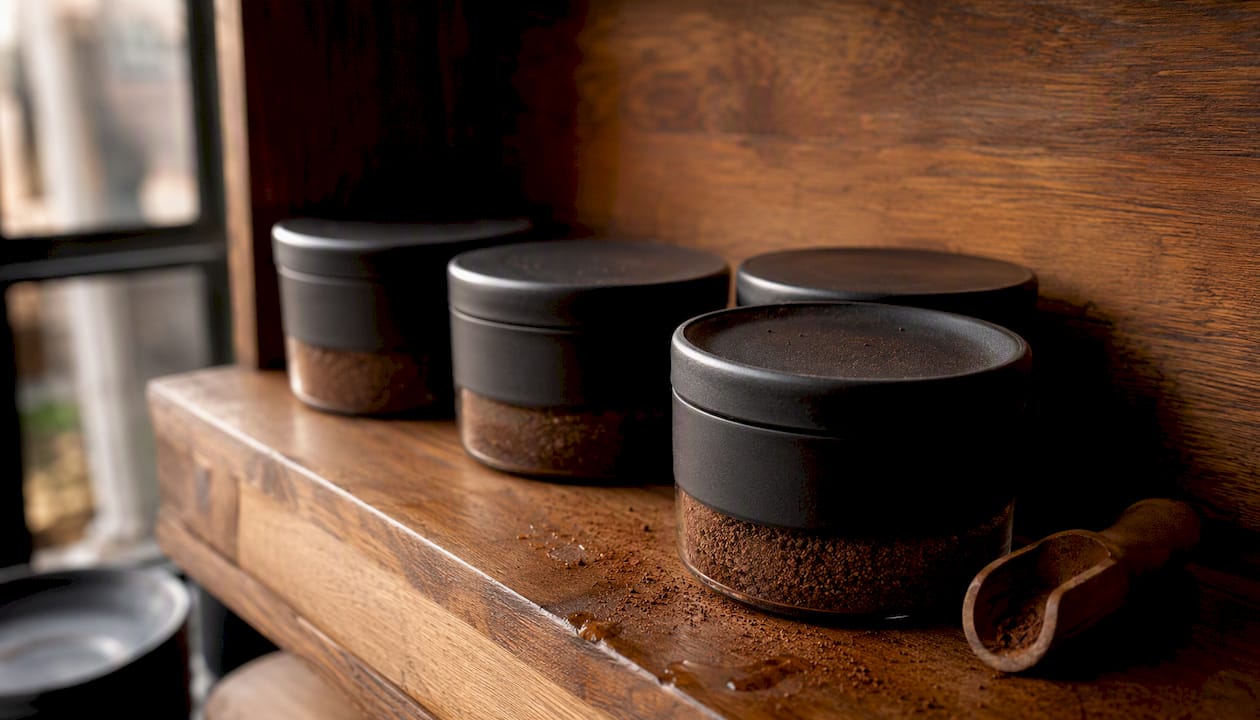
For a full breakdown of optimal storage conditions, Font-mag’s storage guide covers containers, temperature ranges, and what to avoid.
When is pre-ground coffee actually fine to use?
Pre-ground coffee is a reasonable choice in more situations than coffee purists admit. The freshness trade-off is real, but it’s not always the deciding factor.
- Office automatic brewers that use drip machines with no bloom stage extract so indiscriminately that the nuance lost to staling is largely irrelevant. A decent pre-ground medium roast works fine here.
- Travel and camping make grinding impractical. Single-serve portion packs (nitrogen-flushed, sealed) are the best pre-ground option in this context.
- Low-skill or entry-level automatic brewers at home often can’t extract the full complexity of freshly ground specialty coffee anyway. The gap narrows considerably.
- Coarser grinds hold up better than fine grinds in storage, so if you’re buying pre-ground for a drip or French press, you’re starting from a better position than someone buying espresso-ground.
One genuinely useful decision rule: if you don’t own a quality burr grinder, a freshly roasted coarse-ground bag from a reputable roaster often beats a home grind from a blade grinder. Blade grinders produce wildly inconsistent particle sizes, and that extraction chaos can taste worse than mild staling in a properly stored pre-ground bag.
Darker roasts are more forgiving of storage time because their bolder, more robust flavor profile masks early staling better than a delicate light roast. If you’re buying pre-ground and know it’ll sit for a few days, a medium-dark is a safer bet than a bright Ethiopian natural.
What roasters do to slow staling before the bag reaches you
Good roasters treat packaging as part of the product, not an afterthought. The choices they make at the bag level have a measurable impact on what you taste at home.
- One-way degassing valves let CO₂ escape from freshly roasted beans without allowing oxygen back in. This is why keeping beans in their original roaster bag is often smarter than transferring them to a home canister. The valve does something your canister cannot.
- Nitrogen flushing replaces the headspace oxygen in a sealed bag with inert nitrogen before sealing. This dramatically slows oxidation and is standard practice among quality-focused roasters.
- Screw-cap closures outperform clip-sealed bags in controlled trials. GC/MS packaging studies show measurable differences in headspace oxygen levels between closure types over weeks of storage.
- Roast date transparency is the most useful label signal. A bag that shows a roast date (not just a “best by” date) tells you exactly where you are in the freshness window.
What to look for on a bag:
- A printed roast date (not just a best-by date)
- A one-way degassing valve
- Opaque, foil-lined packaging
- A resealable closure (zipper or screw cap, not just a fold-top)
- Recommended use-by guidance relative to roast date, not just a shelf date
The freshness question is really a timing question
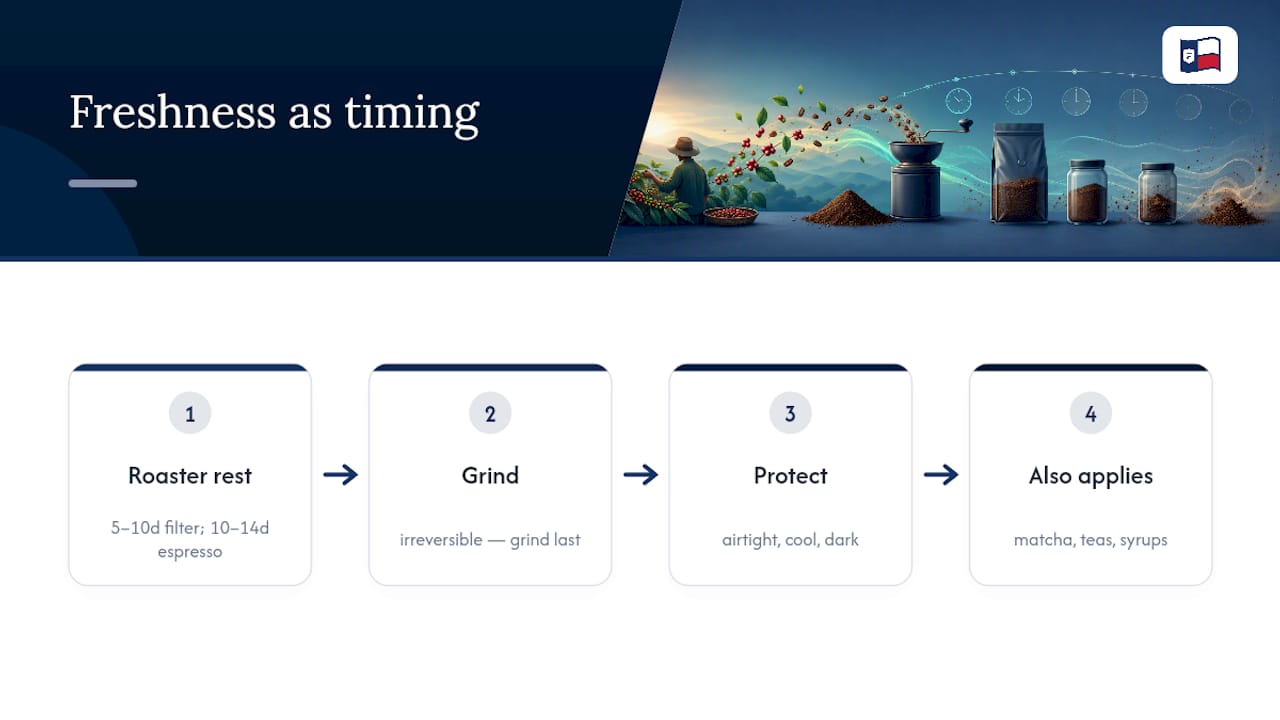
Here’s what I’ve come to believe after thinking seriously about this: most coffee drinkers frame freshness as a storage problem when it’s actually a timing problem. The science is clear that grinding is the irreversible event. Everything after that is damage control.
The roaster’s job is to get you beans that are rested enough to brew well (typically 5–10 days post-roast for filter, 10–14 days for espresso) but not so old that the volatile window has closed. Your job is to grind at the last possible moment and protect what’s left in the meantime. No canister, no freezer trick, no nitrogen flush at home fully substitutes for that timing.
Pre-ground coffee isn’t a moral failing. It’s a convenience trade-off, and a reasonable one in plenty of situations. But if you’re buying specialty-grade coffee and grinding it a week before you brew it, you’re paying for complexity you’ll never taste.
One thing worth mentioning: the same freshness logic applies to other specialty beverages. A premium Japanese matcha, for example, degrades rapidly once opened and exposed to air and light. The same airtight, cool, dark storage principles that protect your ground coffee apply directly to matcha, loose-leaf teas, and even the flavor integrity of quality syrups over time. Freshness isn’t a coffee-only concern.
Fresh coffee, delivered the way it should be
Font-mag’s small-batch retail coffee ships fast from Texas, roasted to order so the beans arrive in their optimal rest window, not weeks past it. That’s the concrete difference between buying from a roaster who cares about timing and pulling a bag off a grocery shelf with no roast date in sight.
Beyond coffee, Font-mag carries vibrant Japanese matcha, premium loose-leaf teas from MAG Tea, and the full Sweetbird collection of café-quality syrups for anyone building a complete specialty beverage setup at home or in a café. Free shipping on orders over $35, with subscription options so you never run out at the wrong moment. Browse the specialty offerings and find your next favorite.
Sources
- Coffee Decoded: 9 Fresh Coffee - SCA
- Aroma Staling Kinetics: How Coffee Loses 84% of Its Character Impact in 60 Minutes | Deep Brew | JayArr Coffee
Recommended
- Why Freshness Matters in Coffee: Flavor Science Explained – Font Coffee Roasters
- Why Coffee Origins Taste Different: A Flavor Science Guide – Font Coffee Roasters
- Why Coffee Goes Stale and How to Stop It – Font Coffee Roasters
- How Roast Level Shapes Coffee Flavor: A Guide for Enthusiasts – Font Coffee Roasters